
Position: It is Time to Virtualize Foundation Models with a Self-evolving Operating System Layer
Abstract
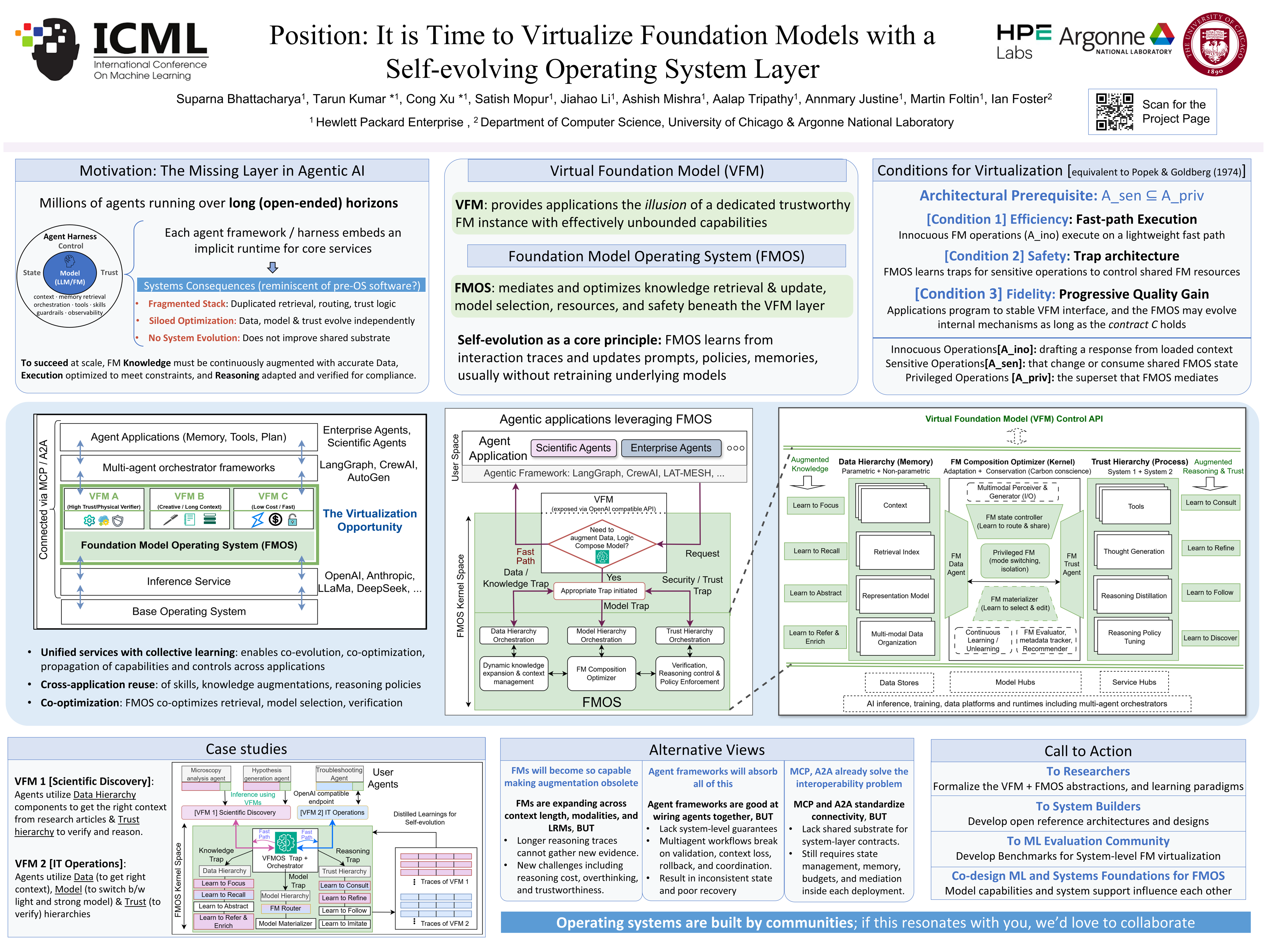
AI applications have shifted from single, mono-lithic foundation models (FM) to compound agentic systems. Yet today’s stacks remain fragmented: even as protocols (e.g., MCP, A2A) ease tool/agent connectivity, each framework embeds an implicit runtime for state, memory, budgets, and guardrails, making behavior non-portable and governance brittle. It mirrors computing before operating systems, when every program re-implemented basic services. This position paper argues that the field now needs a Foundation Model Operating System (FMOS): a system layer that virtualizes FM interactions analogous to how virtual machines abstract physical hardware, giving applications the illusion of dedicated, trustworthy FM instances with effectively unbounded capabilities. Internally, the FMOS orchestrates knowledge across memory tiers, model selection and resource allocation, and verification and policy enforcement. Like the human brain switching between fast intuition and slow deliberation, the FMOS learns when to intervene and when to let inference proceed directly and continuously adapting its policies based on operational experience.