
Rethinking Human Intent-to-CAD: Parametric CAD Model Generation via Cooperative Multi-Task Alignment and Spatial-Aware Reinforcement Learning
Abstract
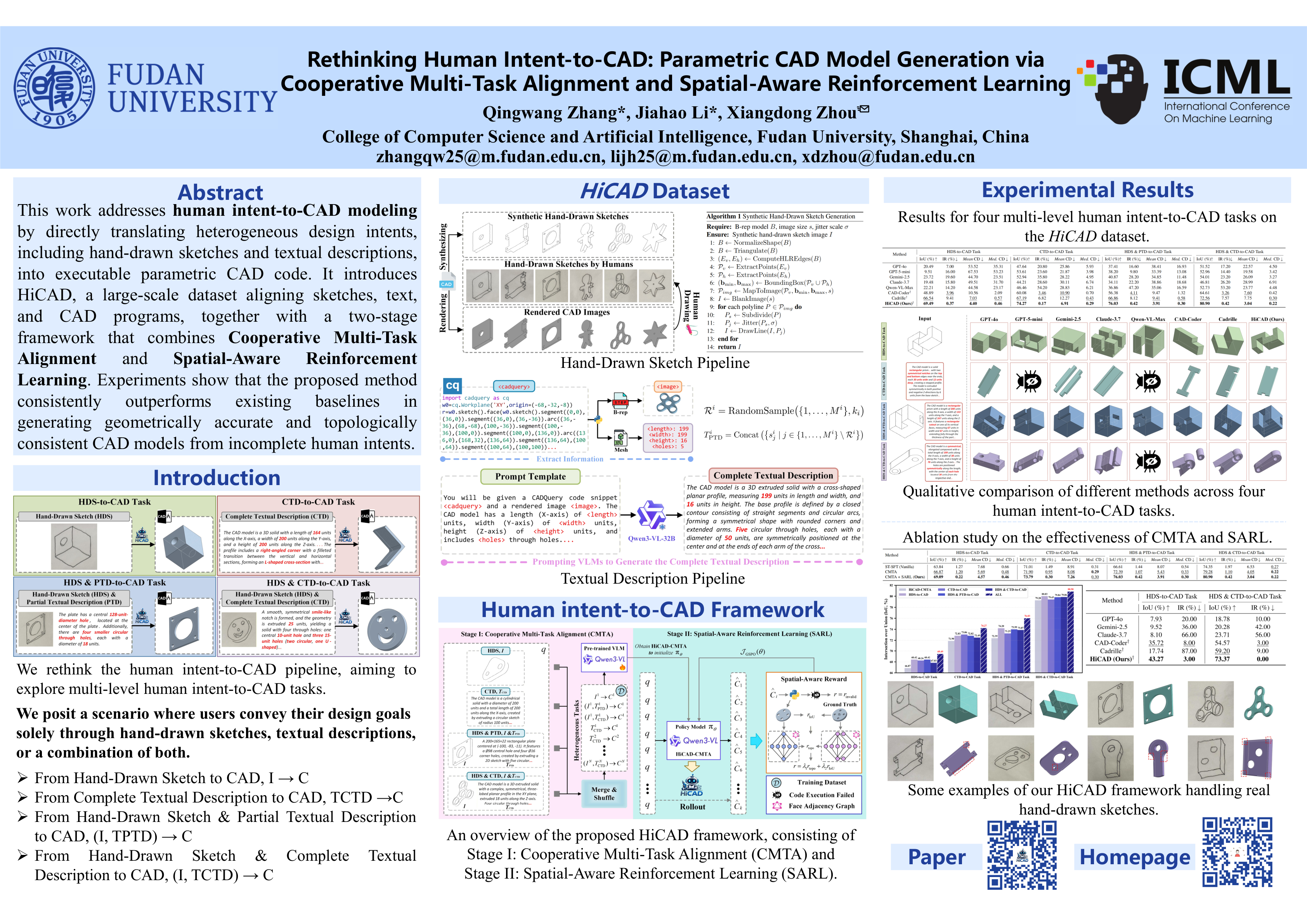
Parametric Computer-Aided-Design (CAD) modeling from human intent remains challenging, particularly during the conceptual design stage, where design goals are expressed through incomplete and unstructured modalities (e.g., hand-drawn sketches and textual descriptions). In this work, we rethink the human intent-to-CAD pipeline and propose a unified method that directly maps multi-level human intents to executable codes, without assuming the prior existence of target CAD models. To support our study, we construct HiCAD, the first large-scale dataset aligning hand-drawn sketches, textual descriptions, and parametric CAD codes. Based on this, we introduce HiCAD, a two-stage framework comprising Cooperative Multi-Task Alignment to bridge the representational gap between heterogeneous inputs, and Spatial-Aware Reinforcement Learning to enforce geometric and topological consistency. Extensive experiments demonstrate that our method significantly outperforms existing baselines across multiple tasks, validating its effectiveness and robustness in transforming heterogeneous human intents into high-fidelity parametric CAD models. Our project page: https://zqwlearning.github.io/HiCAD.
Lay Summary
Designers often begin with rough ideas rather than finished 3D models. These ideas may appear as hand-drawn sketches, short text descriptions, or a mix of both, but current computer-aided design tools still struggle to turn such early, incomplete input into precise and editable designs. In this work, we study how to help computers understand early-stage design intent and convert it into CAD models. We build a large dataset that connects rough sketches, written descriptions, and the computer instructions needed to create editable 3D shapes. Using this dataset, we develop HiCAD, a system that learns from both sketches and text and then generates code that a CAD program can run. HiCAD is also trained to check whether the generated designs make sense as shapes, so that the final models better match the user’s intent. Our experiments show that HiCAD performs better than existing methods on several design tasks. This work could make CAD tools easier to use during the creative stage, helping people move from rough ideas to editable 3D designs more quickly.