
Escaping the Diversity Trap in Robotic Manipulation via Anchor-Centric Adaptation
Abstract
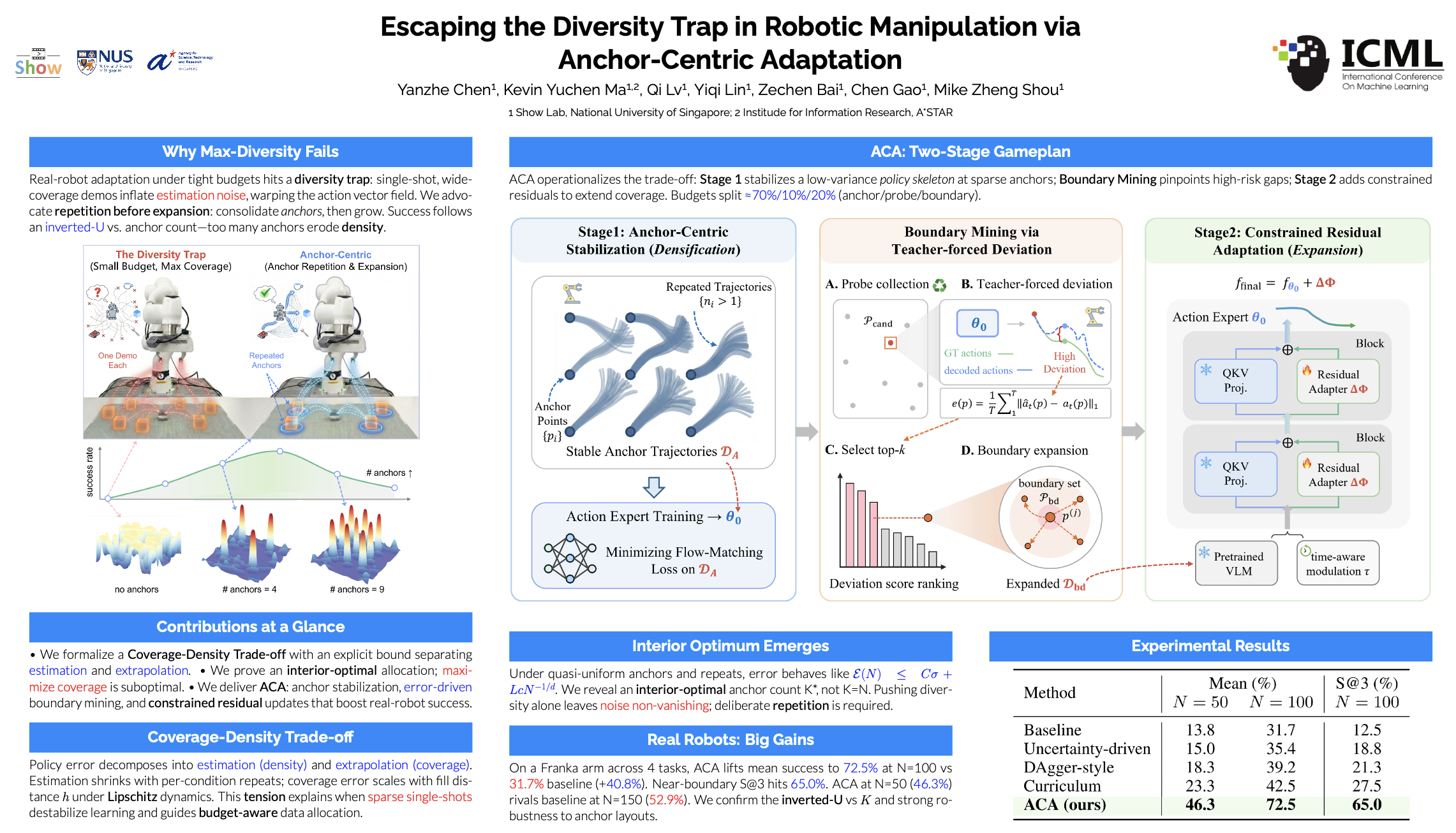
While Vision-Language-Action (VLA) models offer broad general capabilities, deploying them on specific hardware requires real-world adaptation to bridge the embodiment gap. Since robot demonstrations are costly, this adaptation must often occur under a strict data budget. In this work, we identify a critical diversity trap: the standard heuristic of ``maximizing coverage" by collecting diverse, single-shot demonstrations can be self-defeating due to non-vanishing estimation noise. We formalize this phenomenon as a Coverage--Density Trade-off. By decomposing the policy error into estimation (density) and extrapolation (coverage) terms, we characterize an interior optimal allocation of unique conditions for a fixed budget. Guided by this analysis, we propose Anchor-Centric Adaptation (ACA), a two-stage framework that first stabilizes a policy skeleton through repeated demonstrations at core anchors, then selectively expands coverage to high-risk boundaries via teacher-forced error mining and constrained residual updates. Real-robot experiments validate our trade-off framework and demonstrate that ACA significantly improves task reliability and success rates over standard diverse sampling strategies under the same budget.
Lay Summary
Teaching a robot to work on a specific machine requires real‑world practice, but each human demonstration is costly. A common approach is to show the robot as many different situations as possible. We found that with a limited budget, this "see everything once" strategy actually hurts performance. Instead, we first let the robot practice a few core situations repeatedly until it becomes stable. Then we identify challenging cases where it tends to fail and collect a small number of targeted extra demonstrations only for those spots. A lightweight fine‑tuning step adapts the robot without forgetting its core skills. In real‑world experiments, our method significantly improved success rates while using far fewer total demonstrations. This makes robot training more efficient and practical for everyday applications.