
Towards Diverse Scientific Hypothesis Search with Large Language Models
Abstract
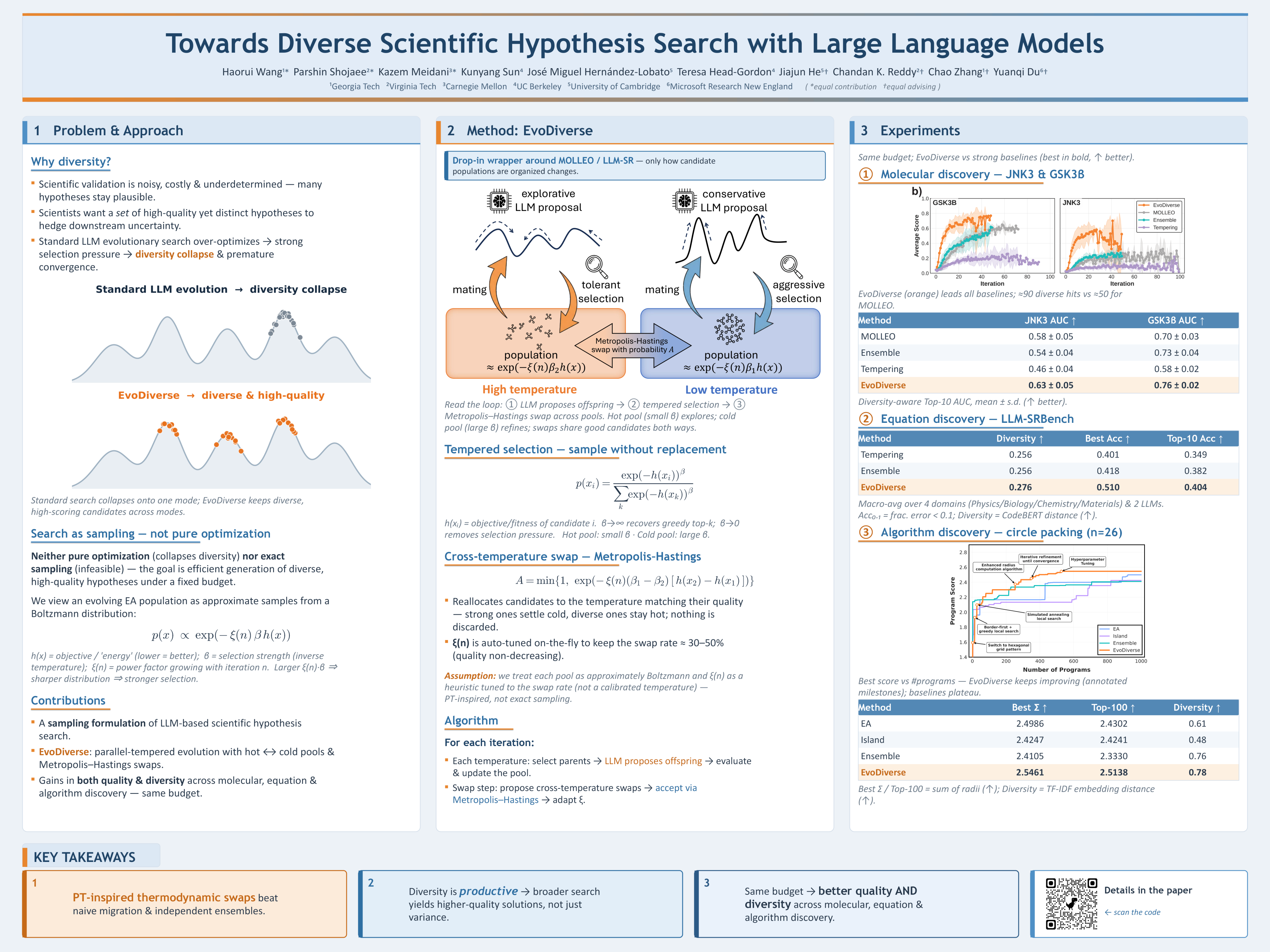
Large language models (LLMs) are on the rise for accelerating scientific discovery, most recently in advanced tasks such as generating valid scientific hypotheses. Yet in many discovery settings, the goal is not to identify a single best hypothesis since validation can be noisy and expensive, and scientists benefit from a set of high-quality alternative hypotheses that hedge against downstream uncertainty for the best solutions. Nevertheless, commonly used evolutionary search recipes tend to prioritize optimization over exploration in hypothesis generation, and the resulting selection pressure during the search process leads to diversity collapse. Motivated by these limitations, we formulate hypothesis search as a sampling problem, where the objective is to efficiently produce diverse, high-quality hypotheses under a fixed validation budget. Building on this perspective, we propose EvoDiverse, an evolutionary framework inspired by the classical parallel tempering algorithm that searches hypotheses at multiple temperature levels and enables principled information exchange across temperatures to improve exploration without disrupting convergence. Across domains including molecular discovery, equation discovery, and algorithm discovery, our approach consistently improves both hypothesis quality and diversity under the same validation budget, and produces candidates that remain robust under more expensive downstream computational validations.
Lay Summary
Artificial intelligence can now help scientists generate possible discoveries, such as new drug-like molecules, mathematical equations, or computer algorithms. But many current systems behave like a scientist who follows the first promising clue too aggressively: they quickly improve one idea, while losing many other useful possibilities. This is a problem because scientific tests are expensive and uncertain, and a single top-ranked candidate may fail in later validation. We introduce EvoDiverse, a search method that makes a language model explore several paths in parallel. Some search paths are adventurous and try unusual ideas, while others are conservative and refine the best candidates found so far. EvoDiverse periodically lets these paths exchange useful candidates, so exploration and refinement can support each other instead of competing. In experiments on molecule design, equation discovery, and algorithm discovery, EvoDiverse produced candidate sets that were both stronger and more varied than standard language-model-guided evolutionary search using the same number of evaluations. This gives scientists a richer shortlist of promising hypotheses to test next, which is often more useful than receiving only one “best” answer.