
RADIO1D: Elastic Representations for Condensed Vision Modeling
Abstract
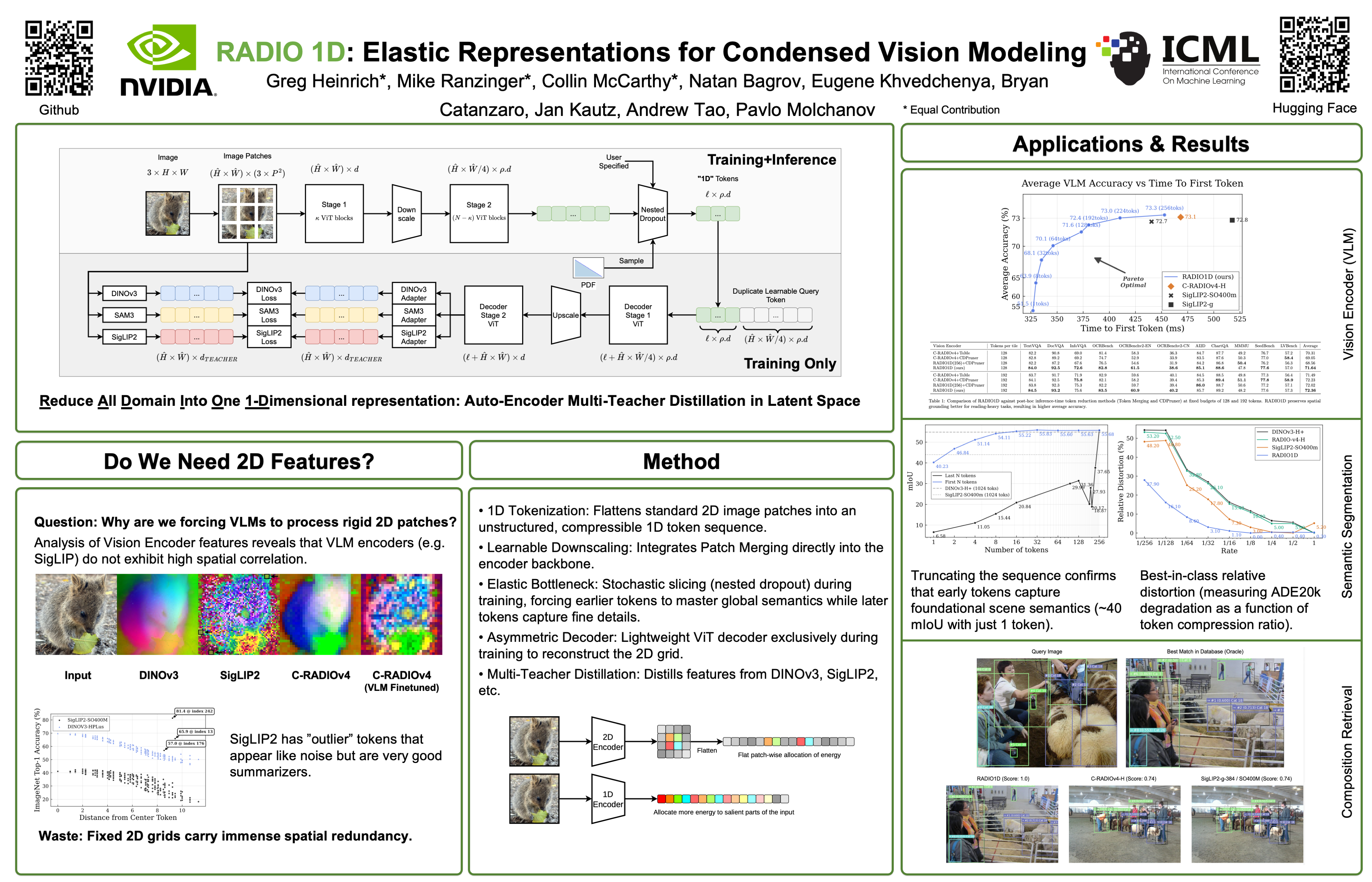
This paper challenges the assumption that vision-language models (VLMs) require fixed patch-based 2D vision features. Analyzing fine-tuned vision encoders, we find that representations become increasingly abstract and less spatially coherent during VLM training. Notably, models trained with image-text alignment (such as SigLIP2) develop a small number of specialized tokens that effectively summarize global image content. Building on this, we introduce RADIO1D, which compresses images into a compact, variable-length 1D token sequence using multi-teacher knowledge distillation and an autoencoder design. The resulting representations exhibit strong hierarchical summarization, enabling accurate scene understanding–even with a single token–and support improved composition-aware image retrieval. In VLMs, RADIO1D provides flexible accuracy-efficiency tradeoffs through adjustable token counts, delivering competitive performance on diverse multimodal benchmarks with lower computational overhead and better accuracy. We release our models under a permissive license.
Lay Summary
Standard vision-language models typically process images by slicing them into a rigid, two-dimensional grid of patches. However, our analysis reveals that during training, these models move away from this strict spatial layout, instead developing a few specialized tokens that summarize the entire image's content. Building on this insight, we introduce RADIO1D, which compresses images into a flexible, variable-length 1D token sequence. By distilling knowledge from multiple teacher models, RADIO1D structures this sequence hierarchically. It concentrates global, scene-level information into the very first few tokens, while subsequent tokens capture finer details. This allows models to achieve accurate scene understanding using highly condensed representations, sometimes relying on just a single token. Ultimately, RADIO1D provides vision-language models with an adjustable tradeoff between computational efficiency and accuracy, delivering strong performance with less overhead.