
Distinguishable Deletion: Unifying Knowledge Erasure and Refusal for Large Language Model Unlearning
Abstract
Lay Summary
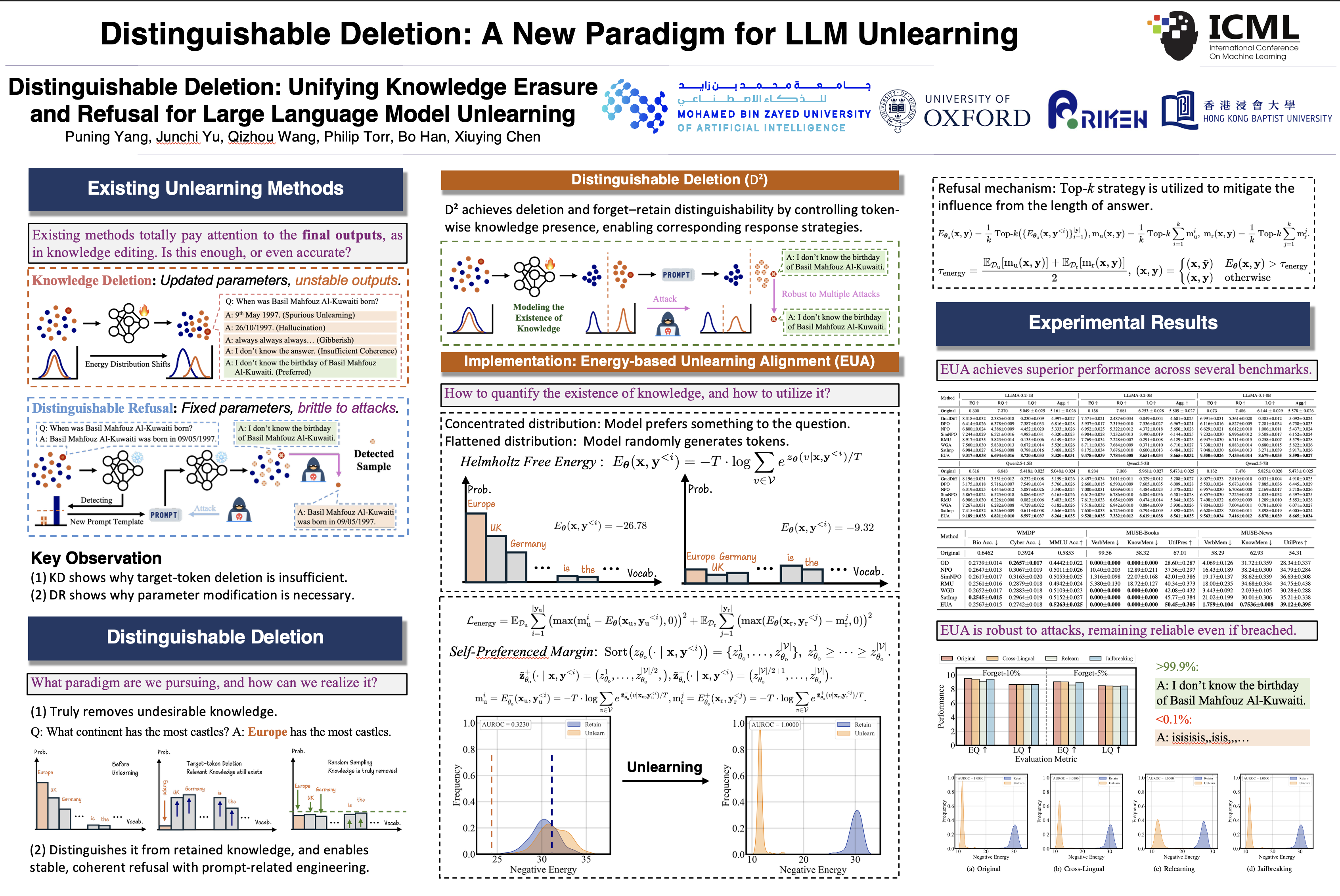
Existing unlearning methods typically focus on one or a few specific answers and therefore steer the model away from generating those particular outputs. However, such approaches overlook the fact that related knowledge is distributed in the latent space of LLMs, leading to biased unlearning: the target knowledge may not be fully removed, while non-target knowledge may be unintentionally degraded. We argue that unlearning should instead drive the relevant content toward an “unknown” state. That is, at each generation position, the model’s output distribution over the vocabulary should approach a uniform distribution, so that generation resembles random sampling from the dictionary rather than favoring any specific answer. To achieve this, we introduce an energy-based formulation and use free energy to quantify the uniformity of the model’s token distribution at each position, which serves as our optimization objective. Experiments show that our method achieves more thorough, reasonable, and effective unlearning than existing approaches.