
Bridging Time and Frequency: A Joint Modeling Framework for Irregular Multivariate Time Series Forecasting
Abstract
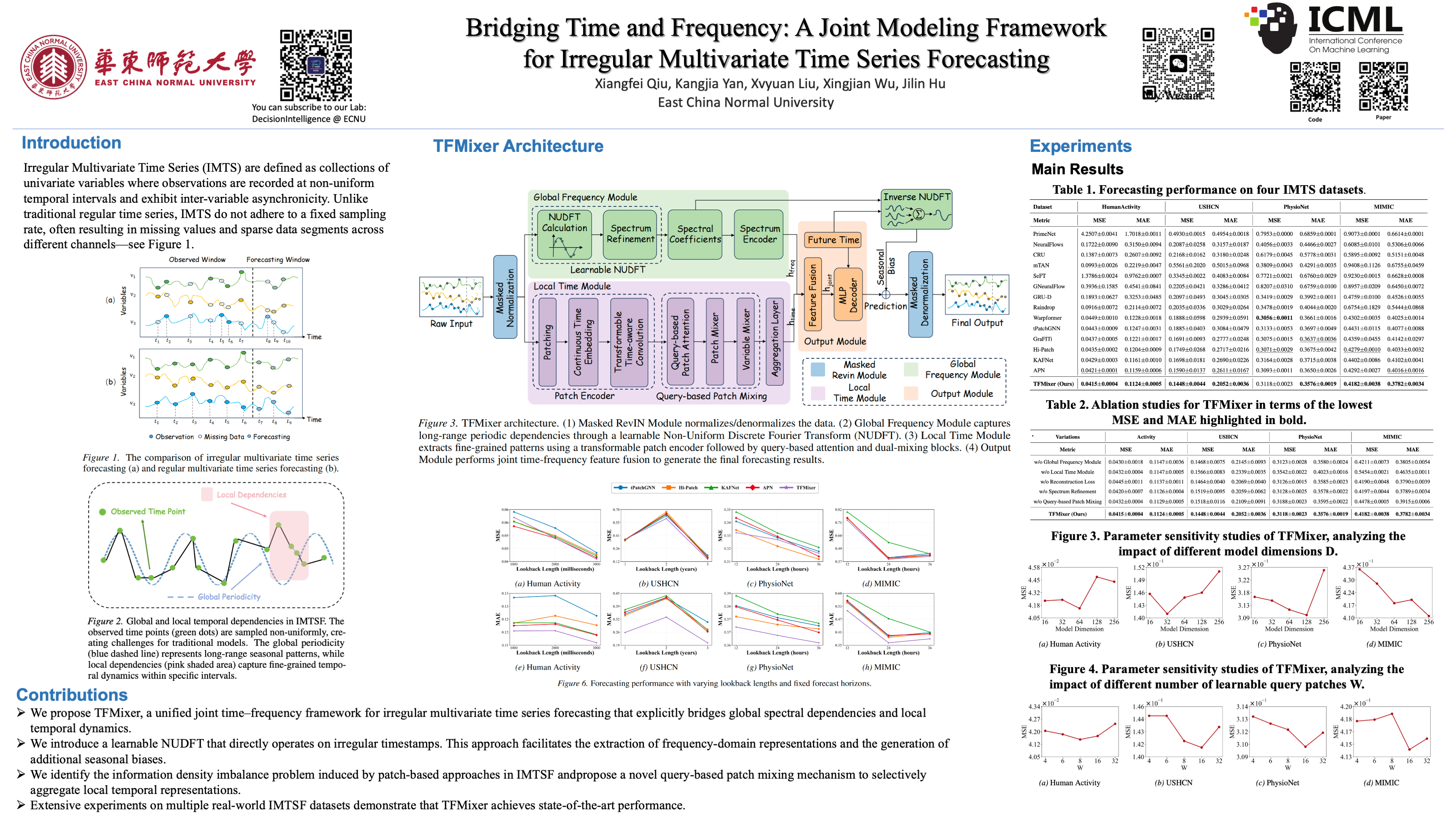
Irregular multivariate time series (IMTS) forecasting is challenging due to non-uniform sampling and variable asynchronicity. These irregularities violate the equidistant assumptions of standard models, hindering local temporal modeling and rendering classical frequency-domain methods ineffective for capturing global periodic structures. To address this challenge, we propose TFMixer, a joint time–frequency modeling framework for IMTS forecasting. Specifically, TFMixer incorporates a Global Frequency Module that employs a learnable Non-Uniform Discrete Fourier Transform (NUDFT) to directly extract spectral representations from irregular timestamps. In parallel, the Local Time Module introduces a query-based patch attention mechanism to adaptively aggregate informative temporal segments and alleviate information density imbalance. Finally, TFMixer fuses the time-domain and frequency-domain representations to generate forecasts and further leverages inverse NUDFT for explicit seasonal extrapolation. Extensive experiments on real-world IMTS benchmarks demonstrate the effectiveness and robustness of TFMixer under irregular sampling and missing data.
Lay Summary
Time series forecasting plays an important role in many real-world applications, including healthcare monitoring, climate science, finance, and industrial systems. In practice, data is often collected irregularly: measurements may arrive at uneven time intervals, some observations may be missing, and different variables may be recorded asynchronously. These challenges make forecasting much more difficult for existing models, which are usually designed for regularly sampled data. To address this problem, we propose TFMixer, a forecasting framework designed specifically for irregular time series. TFMixer learns from data in two complementary ways. First, it captures long-term repeating patterns, such as seasonal or periodic behaviors, directly from irregular observations without requiring interpolation or resampling. Second, it focuses on important local temporal patterns while reducing the influence of sparse or less informative observations. By combining these two perspectives, TFMixer can better understand both global trends and fine-grained dynamics in irregular data.