
Does Math Reasoning Improve General LLM Capabilities? Understanding Transferability of LLM Reasoning
Abstract
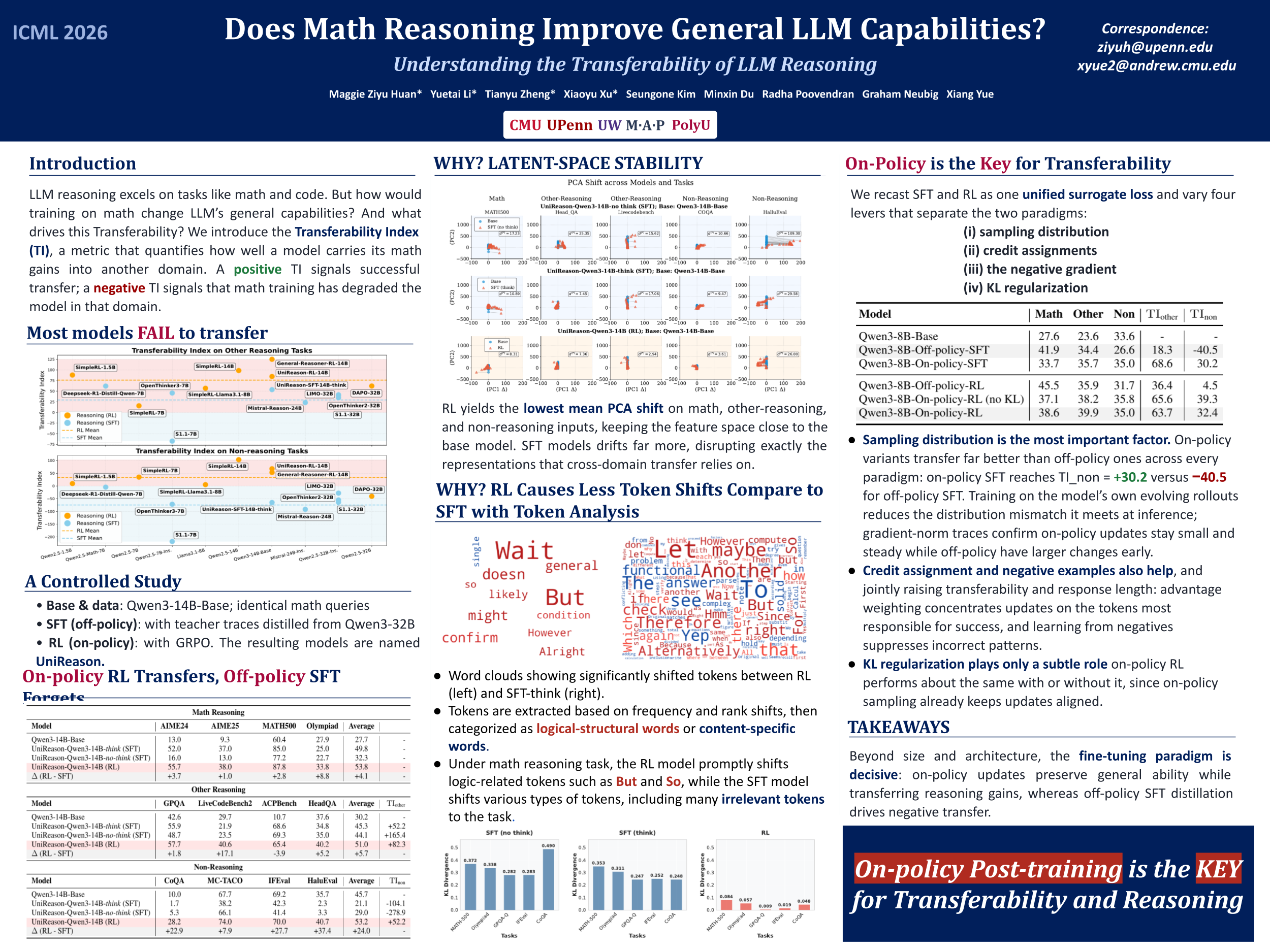
Math reasoning has become the poster child of progress in large language models (LLMs), with new models rapidly surpassing human-level performance on benchmarks like MATH and AIME. But as math leaderboards improve week by week, it is worth asking: do these gains reflect broader problem-solving ability or just narrow overfitting? To answer this question, we evaluate over 20 open-weight reasoning-tuned models across a broad suite of tasks, including math, scientific QA, agent planning, coding, and standard instruction-following. We surprisingly find that most models that succeed in math fail to transfer their gains to other domains. To rigorously study this phenomenon, we conduct controlled experiments using math-only data with two widely-used methods: Reinforcement Learning (RL) and Supervised Finetuning (SFT) with detailed ablations. On top of the observation that RL-tuned models transfer better than SFT-tuned models, we identify on-policy fine-tuning as the key mechanism underlying cross-domain transfer, regardless of whether the training signal comes from RL or supervised learning. Latent-space representation and token-space distribution shift analyses reveal that off-policy SFT induces substantial representation and output drift, while on-policy RL preserves general-domain structure. Our results suggest a need to rethink the post-training recipes, particularly the reliance on off-policy SFT-distilled data to advance reasoning models.
Lay Summary
Recent AI language models have become remarkably good at solving math problems, sometimes even outperforming top humans on challenging exams. But does mathematical strength mean that a model has become a stronger thinker overall, or has it simply learned to excel at one type of test? To find out, we evaluated more than 20 language models across a wide range of tasks, including mathematics, science question answering, coding, planning, and everyday instruction following. Surprisingly, most models that excelled at math showed little improvement on other tasks. To understand why, we conducted controlled experiments in which models were trained only on math data using two common post-training methods. We found that off-policy training often degraded general capabilities, whereas on-policy training enabled better transfer across tasks. Our findings suggest that how we train AI models matters as much as what we train them on. In particular, on-policy post-training may be more effective for promoting transferable reasoning beyond mathematics.