
Spatially-Regularized Entropy for Discriminative Token Merging in Fine-Grained Re-Identification
Abstract
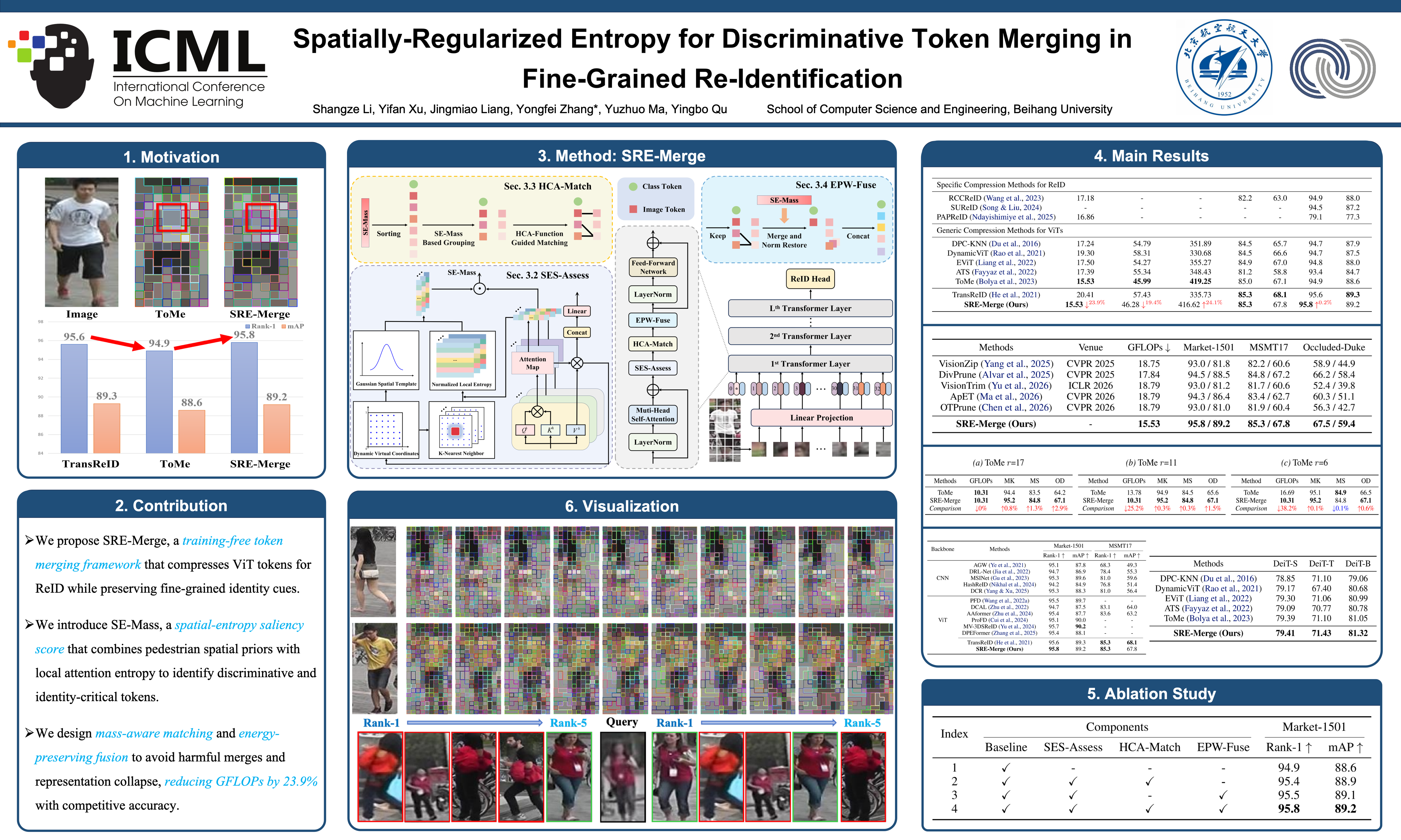
While Vision Transformers (ViTs) offer strong global modeling, their quadratic computational cost limits utility in latency-sensitive applications like person re-identification (ReID). Existing compression strategies, such as token pruning or generic merging, typically rely on coarse-grained criteria tailored for image classification. In fine-grained retrieval, these approaches often discard or smooth out subtle but discriminative local details. To resolve this, we propose SRE-Merge, a training-free framework designed for discriminative token compression. SRE-Merge injects spatial priors into the merging process through three mechanisms: (i) Spatial-Entropy Saliency Assessment (SES-Assess), which quantifies token importance as Spatial-Entropic Mass (SE-Mass) by coupling spatial structure with local attention entropy; (ii) Hybrid Context-Affinity Matching (HCA-Match), which guides precise pair selection by combining feature similarity with mass-derived context; and (iii) Energy-Preserving Weighted Fusion (EPW-Fuse), which incorporates SE-Mass weighting to counteract feature variance reduction. Extensive experiments on standard benchmarks show that SRE-Merge reduces GFLOPs of the base ViT model by about 24\% while retaining competitive retrieval accuracy, establishing a superior accuracy-efficiency trade-off.
Lay Summary
Modern computer vision systems can match the same person across different cameras, which is useful for applications such as video search and public safety when deployed responsibly. However, accurate systems based on powerful image models are often slow and expensive to run, because they process many small image parts even when some parts come from background or contain repeated information. This paper introduces SRE-Merge, a method that makes such systems more efficient without requiring the model to be retrained. Instead of simply removing image parts, our method carefully combines less important parts while preserving small visual clues that help distinguish one person from another, such as clothing patterns, bags, or local appearance details. It does this by estimating which image regions are likely to matter most and avoiding harmful combinations that could blur important identity information. Experiments on standard person re-identification benchmarks show that SRE-Merge reduces computation substantially while keeping strong matching accuracy. This makes accurate person re-identification models more practical for real-world use.