
LLawCo: Learning Laws of Cooperation for Modeling Embodied Multi-Agent Behavior
Abstract
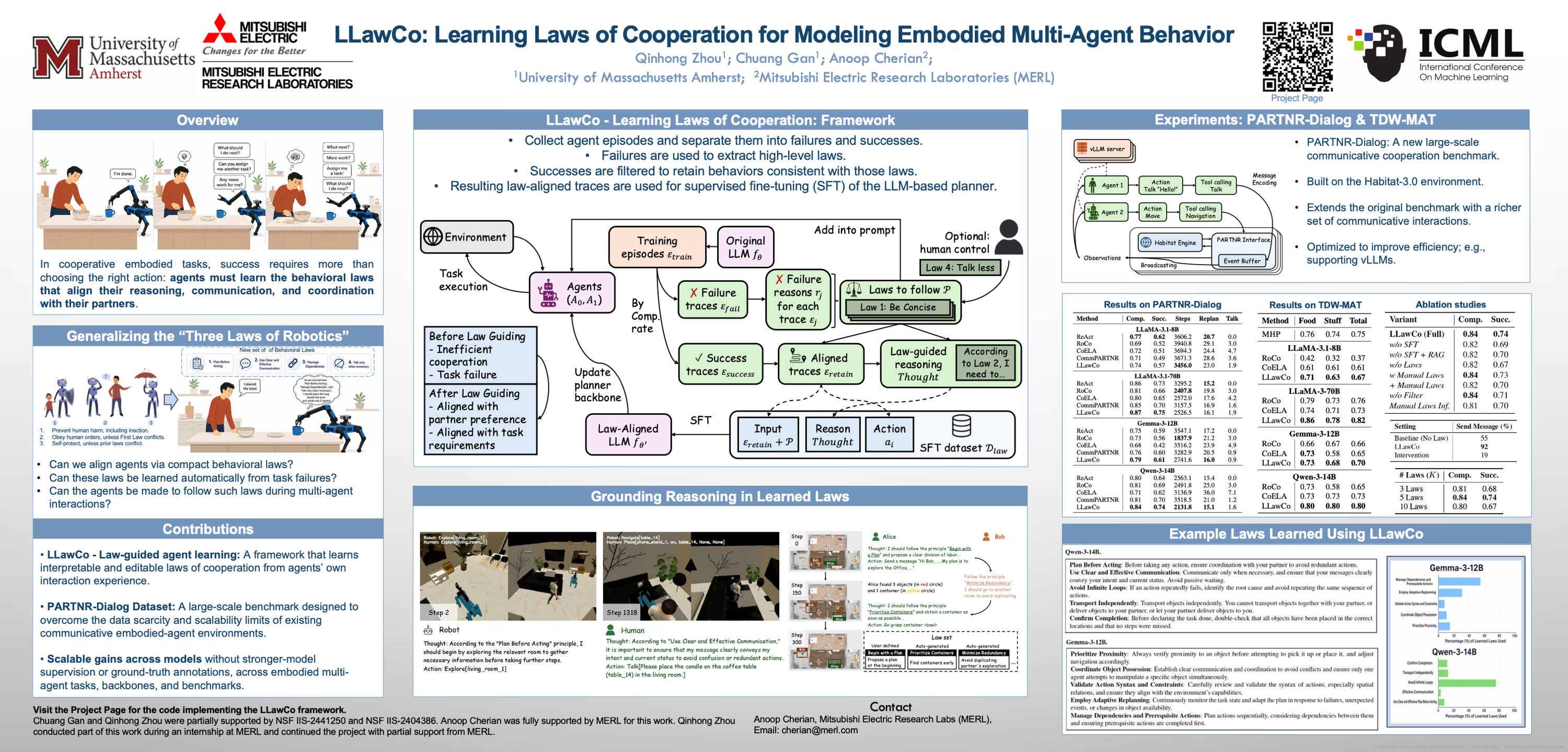
Embodied agents operating in decentralized and partially observable environments have attracted growing attention in recent years. However, existing large language model (LLM)-based agents often exhibit behaviors that are misaligned with their partners or inconsistent with the environment state, leading to inefficient cooperation and poor task success. To address this challenge, we propose a novel framework, Learning Laws of Cooperation (LLawCo), that enables embodied agents to autonomously align with both their partners and task objectives. Our framework allows agents to reflect on past failures to extract misaligned behavioral patterns, which are used to derive high-level behavioral laws, such as “Talk when necessary” and “Wait for partner.” These laws are explicitly incorporated into the agents’ chains of thought via supervised fine-tuning, aligning their reasoning with task requirements and the behavior of other agents. To evaluate our approach, we introduce PARTNR-Dialog, a large-scale multi-agent communicative and cooperative planning benchmark built on the PARTNR environment. Experiments on existing tasks and our new benchmark demonstrate significant improvements in cooperative efficiency and task success rates. Across four backbone LLMs, our method achieves average success rate improvements of 4.5% on the PARTNR-Dialog benchmark and 6.8% on the TDW-MAT benchmark over state-of-the-art open-source communicative agent frameworks.
Lay Summary
AI agents are increasingly expected to work with people or other agents in shared environments, such as helping organize a room or complete household tasks. However, these agents often fail to cooperate well: they may repeat failed actions, misunderstand what their partner is doing, or communicate at the wrong time. We propose LLawCo, a method that helps agents learn simple cooperation principles from their own past mistakes. Instead of relying only on hand-written rules, the agent reviews failed attempts, summarizes recurring problems into high-level “laws” such as planning before acting or communicating clearly, and then learns to use these laws when deciding what to do next. We also introduce PARTNR-Dialog, a benchmark for testing embodied agents that need to both act and communicate while working together. Across several language models and task environments, agents trained with LLawCo cooperate more effectively and complete more tasks. More broadly, this work suggests that making an agent’s cooperation principles explicit can improve both performance and interpretability, while also giving humans a clearer way to inspect or adjust agent behavior.