
Latent Reasoning VLA: Latent Thinking and Prediction for Vision-Language-Action Models
Abstract
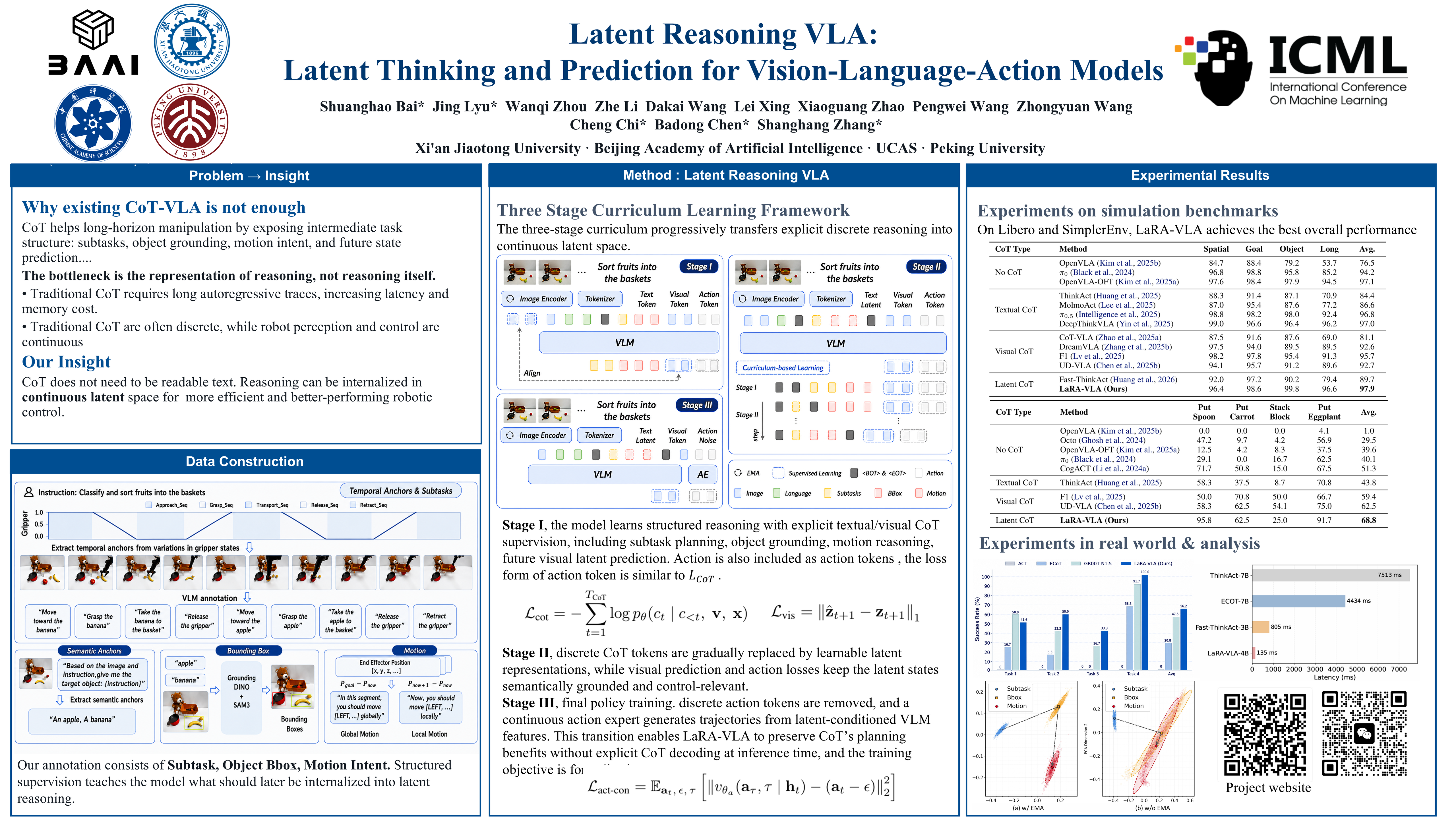
Vision-Language-Action (VLA) models benefit from Chain-of-Thought (CoT) reasoning, but existing approaches incur high inference overhead and rely on discrete reasoning representations that mismatch continuous perception and control. We propose Latent Reasoning VLA (LaRA-VLA), a unified VLA framework that internalizes multi-modal CoT reasoning into continuous latent representations for embodied action. LaRA-VLA performs unified reasoning and prediction in latent space, eliminating explicit CoT generation at inference time and enabling efficient, action-oriented control. To realize latent embodied reasoning, we introduce a curriculum-based training paradigm that progressively transitions from explicit textual and visual CoT supervision to latent reasoning, and finally adapts latent reasoning dynamics to condition action generation. We construct two structured CoT datasets, LIBERO-LaRA and Bridge-LaRA, and evaluate LaRA-VLA across simulation benchmarks and long-horizon real-robot manipulation tasks. Experimental results show that LaRA-VLA outperforms existing state-of-the-art VLA methods while achieving up to a 90\% reduction in inference latency compared to explicit CoT-based VLA approaches, highlighting latent reasoning as an effective and efficient paradigm for real-time embodied control.
Lay Summary
Vision-language-action (VLA) models enable robots to translate visual observations and language instructions into physical actions. Recent studies show that chain-of-thought (CoT) reasoning can improve robotic decision-making, particularly for long-horizon and complex tasks. However, existing CoT-based approaches often require generating extensive textual reasoning during inference, resulting in substantial computational overhead that limits their use in real-time robotic control. To address this challenge, we propose Latent Reasoning VLA (LaRA-VLA), a framework that internalizes reasoning into compact continuous latent representations rather than explicit textual outputs. By performing reasoning directly in latent space, LaRA-VLA preserves the benefits of structured intermediate reasoning while significantly improving inference efficiency. We introduce a curriculum-based training strategy that progressively transitions the model from explicit reasoning supervision to latent reasoning and action generation. In addition, we construct new datasets with structured reasoning annotations for robotic manipulation in both simulated and real-world environments. Extensive experiments on simulation benchmarks and real-robot tasks demonstrate that LaRA-VLA consistently outperforms existing methods while reducing inference latency by up to 90%. Our results suggest that latent reasoning is a promising direction for building efficient and capable robotic systems for real-world deployment.