
Twins: Learn to Predict Unified Representations with Focal Loss
Abstract
Lay Summary
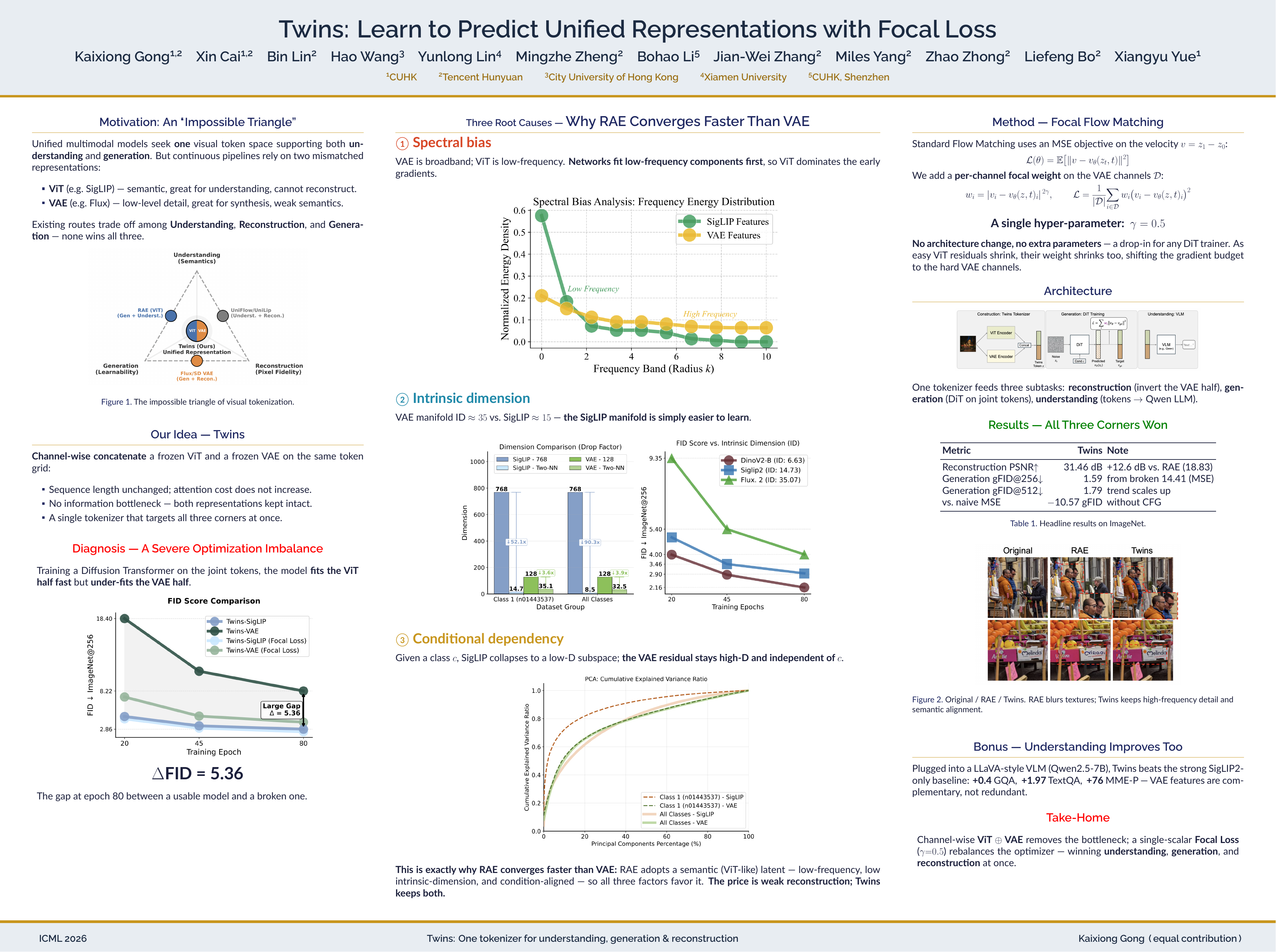
Modern AI systems are increasingly expected to do two very different things with images: understand what is in a picture (for example, answering questions about it) and create new pictures from scratch. Today, these two abilities usually rely on two different ways of "looking at" images inside the model — one focused on meaning, the other focused on visual details — which makes it hard to combine them into a single system. We introduce Twins, a method that lets the model use both views of an image at the same time without making it slower or larger. However, we discovered that when training such a model, it tends to learn the "meaning" view quickly but neglects the "visual detail" view, leading to lower-quality generated images. We identify why this imbalance happens and design a new training objective that pays extra attention to the harder-to-learn details. As a result, Twins generates noticeably sharper images while still understanding pictures well, bringing us one step closer to AI systems that can both see and imagine through a single unified lens.