
NeurVLA: Unleashing Failure-Handling Capability of Vision-Language-Action Models via Neural-Symbolic Reasoning
Abstract
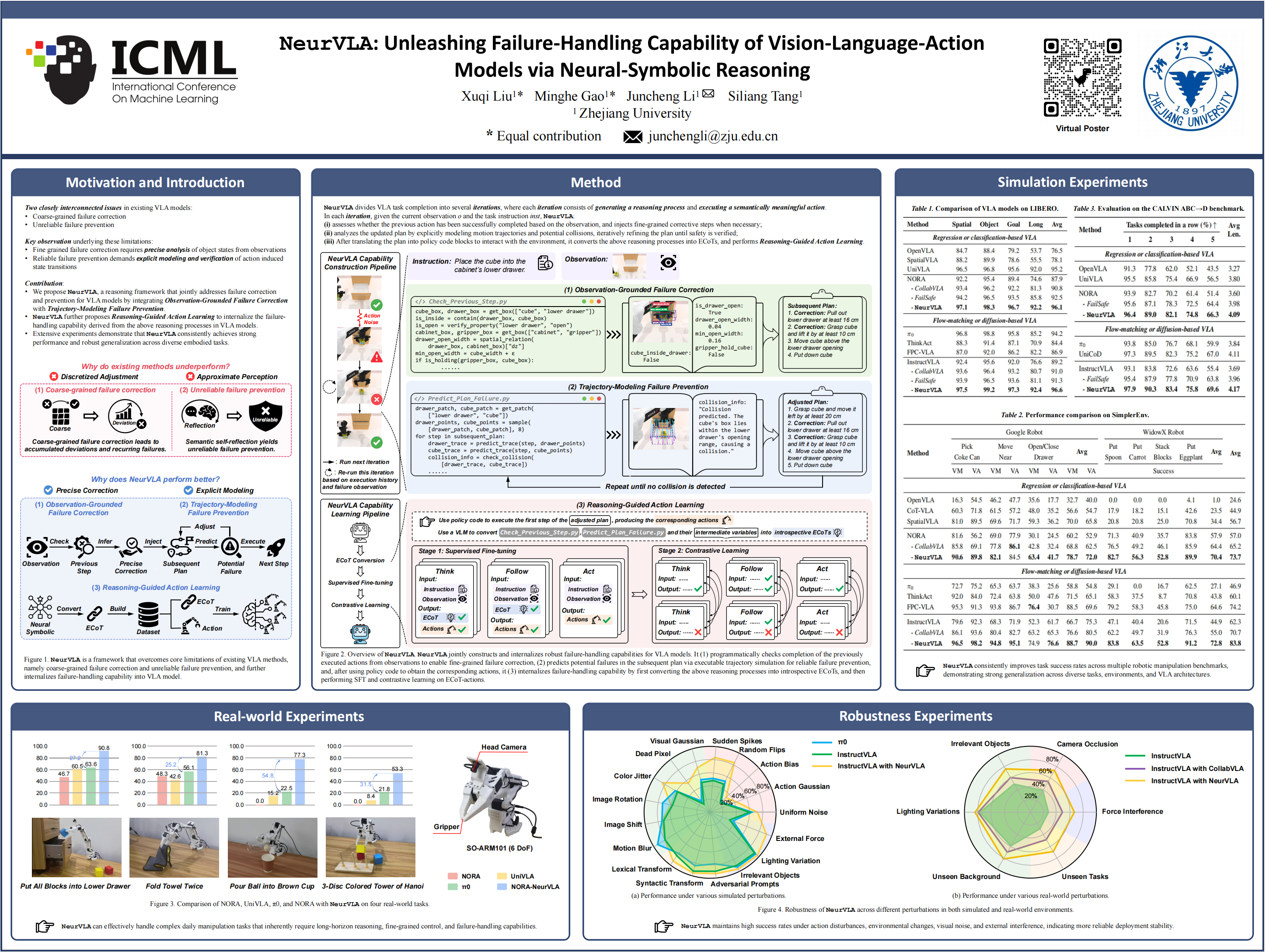
Vision-Language-Action models have recently shown promising progress in embodied robotic manipulation, yet their generalization to diverse open-ended embodied tasks is often hindered by execution failures. While prior work has explored failure handling, existing approaches still suffer from two fundamental limitations: coarse-grained failure correction and unreliable failure prevention. These limitations lead to brittle decision-making when VLA models are deployed in novel tasks and environments. To address them, we propose NeurVLA, a neural-symbolic framework that jointly addresses failure correction and prevention via neural-symbolic reasoning and further internalizes these failure-handling capabilities into VLA models. Experiments demonstrate that NeurVLA achieves strong performance and robust generalization across diverse tasks.
Lay Summary
Robots are increasingly expected to understand instructions, observe their surroundings, and complete everyday tasks. However, when they work in new or changing environments, they often make mistakes, such as moving an object to the wrong place, missing an important obstacle, or repeating a failed action. This paper introduces NeurVLA, a method that helps robots handle such failures more reliably. Instead of only reacting after something goes wrong, NeurVLA teaches robots to check whether their previous action succeeded, make precise corrections when needed, and think ahead about whether the next action may cause a problem. It also turns these failure-handling processes into training examples, so that robots can learn to handle similar situations by themselves in the future. Experiments in simulated environments and on real robots show that this approach improves task success and makes robots more robust under challenging conditions.