
Differentially Private Synthetic Data via APIs 4: Tabular Data
Abstract
Lay Summary
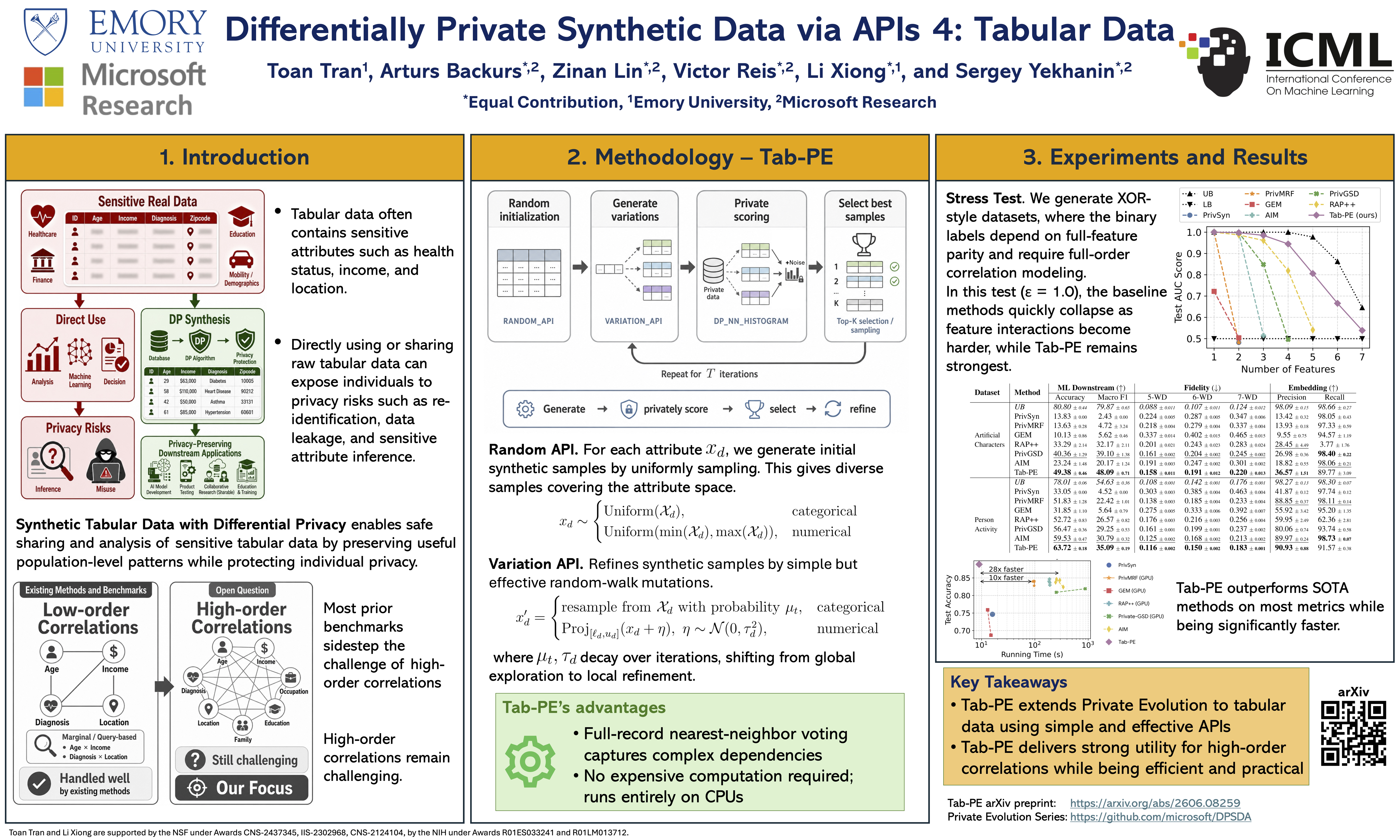
Tabular datasets, such as medical records, financial transactions, and survey data, are widely used in research and machine learning but often contain sensitive personal information. Synthetic data offers a way to share and analyze such data while reducing privacy risks by creating artificial records that resemble the original dataset. This paper studies how to generate synthetic tabular data with formal privacy guarantees. Existing methods often work well when data patterns involve only a few columns, but they can struggle when important patterns depend on complex interactions across many columns. To address this challenge, we propose Tab-PE, a new method inspired by evolutionary search. Tab-PE starts with random synthetic records, creates small variations of them, privately evaluates which records best match the real data, and repeatedly improves the synthetic dataset. Compared with the previous leading methods, which often require many costly calculations over the data on GPUs, Tab-PE runs entirely on CPUs and can generate synthetic data in seconds in our experiments. This makes it efficient and practical for tabular data. Experiments show that Tab-PE better preserves complex data patterns than existing methods, especially under strong privacy constraints, while also running much faster than competitive baselines.