
DLO-Lab: Benchmarking Deformable Linear Object Manipulations with Differentiable Physics
Abstract
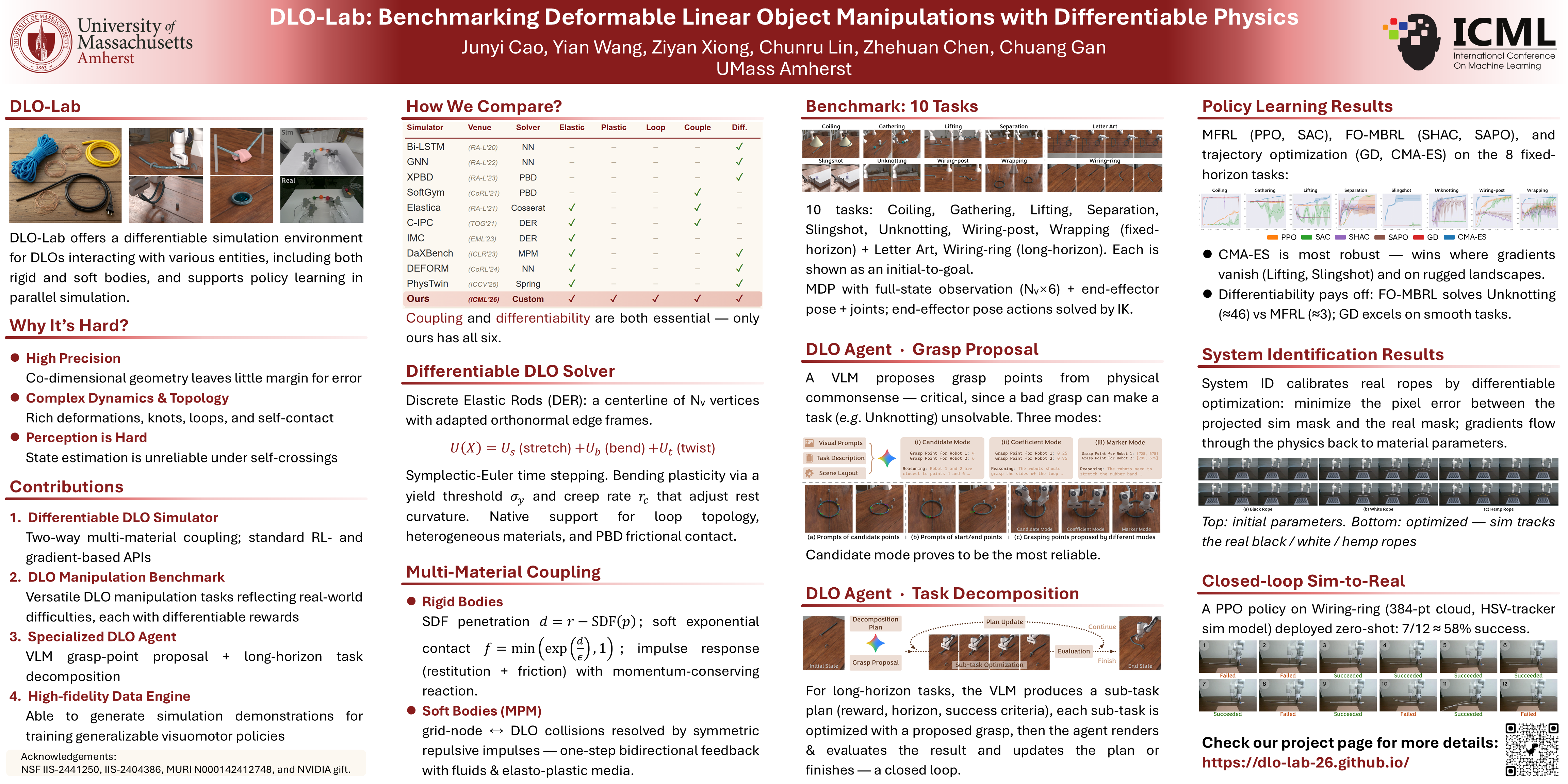
We address the challenge of enabling robots to manipulate deformable linear objects (DLOs), such as ropes, cables, and rubber bands. Prior work has primarily focused on narrow, task-specific problems, often relying on real-world demonstrations or handcrafted heuristics. Such approaches, however, struggle to scale to the wide variety of materials and tasks encountered in practice, and collecting sufficiently diverse real-world data is often impractical. Additionally, existing simulation environments offer limited support for the broad spectrum of material behaviors necessary for generalizable DLO manipulation. To overcome these limitations, we introduce a differentiable simulator explicitly designed for versatile DLO manipulation. Our simulator models a wide range of material properties—including (in)extensibility, elasticity, bending plasticity, and complex interactions with other objects—providing a robust foundation for learning and evaluating manipulation skills. Building on this simulator, we propose a benchmark suite of representative tasks that highlight the unique challenges of DLO manipulation. The successful execution of these tasks is often hindered by the topological complexity and grasp sensitivity inherent to DLOs. Therefore, we introduce a specialized DLO agent that explicitly manages these challenges by proposing strategic grasping points and decomposing long-horizon tasks to maximize control authority. Finally, we evaluate various policy-learning algorithms using our framework, alongside sim-to-real transfer experiments, demonstrating our platform's potential to advance DLO manipulation. Project page: https://dlo-lab-26.github.io/.
Lay Summary
Robots today can pick up rigid objects with ease, but manipulating flexible, string-like materials—ropes, cables, and wires—remains a major challenge. These objects bend, tangle, and deform in complex ways that are difficult to predict and control. Existing robot training environments either lack the physical realism needed to capture this behavior or cannot efficiently teach robots new skills. We developed DLO-Lab, a virtual physics laboratory where robots can practice manipulating ropes and cables with high fidelity. Our simulator accurately models how these objects stretch, bend, twist, and interact with their surroundings, while also providing mathematical shortcuts (gradients) that help robots learn faster—similar to how a student improves more quickly with detailed feedback than with just a pass/fail grade. We designed ten benchmark tasks, from untying knots to threading a rope through a ring, and built an AI assistant that helps robots decide where to grab a rope and how to break complex tasks into manageable steps. We demonstrated that skills learned entirely in our virtual environment transfer successfully to physical robots, confirming that DLO-Lab can serve as a practical training ground for applications such as cable routing in factories and untangling wires in household settings.