
Discrete Diffusion VLA: Bringing Discrete Diffusion to Action Decoding in Vision-Language-Action Policies
Abstract
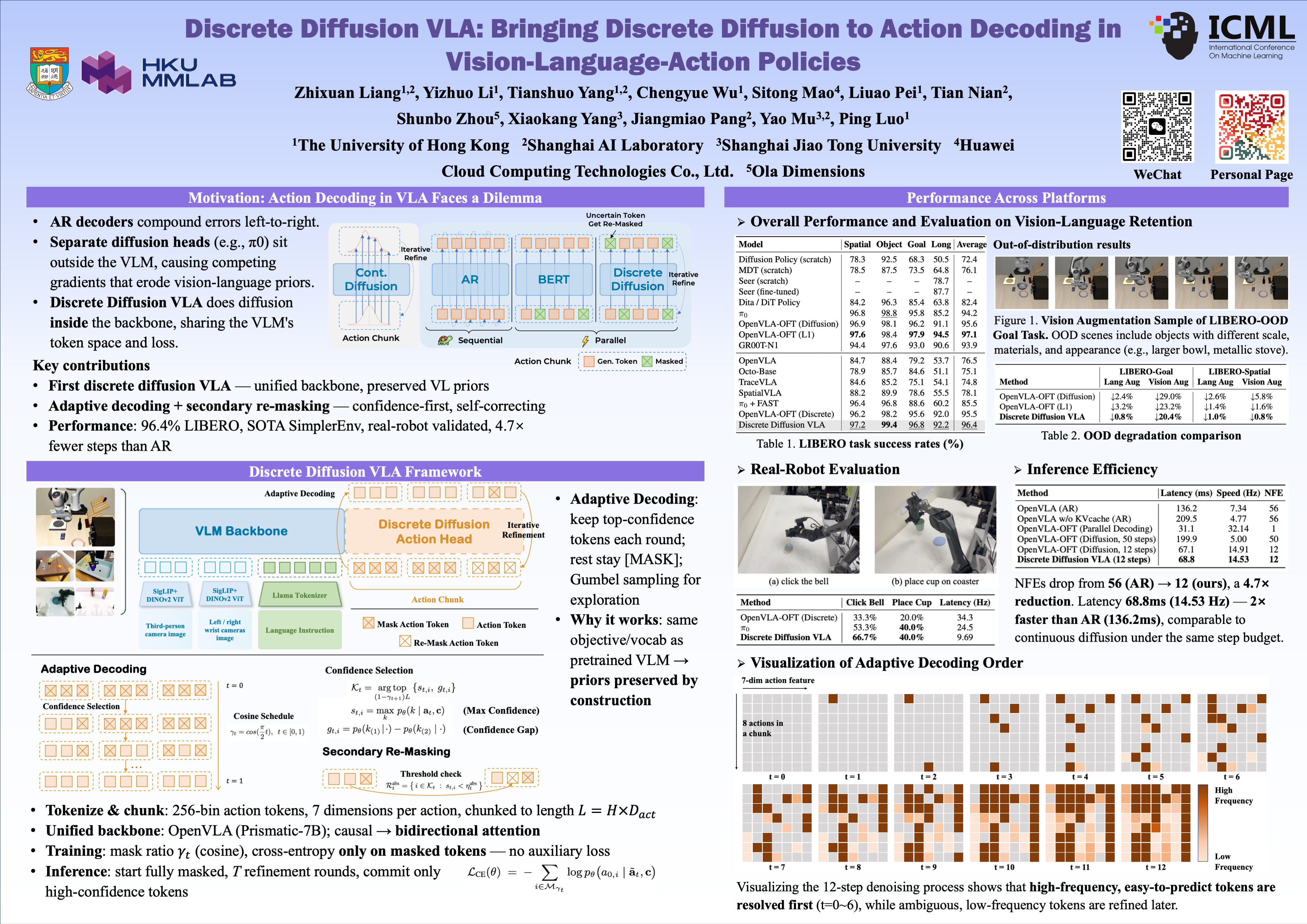
Vision–Language–Action (VLA) models adapt large vision–language backbones to map images and instructions into robot actions. However, prevailing VLAs either generate actions autoregressively in a fixed left-to-right order with poor performance or attach separate diffusion heads outside the backbone that fragments information pathways and hinders unified, scalable architectures. Instead, we present Discrete Diffusion VLA that discretizes action chunks and models them with discrete diffusion pattern retaining progressive refinement inside the unified transformer backbone. Our method achieves an adaptive decoding order that resolves high-confidence action elements before harder ones and employs secondary re-masking to revisit uncertain predictions, enabling robust error correction. This design preserves pretrained vision-language priors, supports parallel decoding, and improves the efficiency. Discrete Diffusion VLA achieves 96.4% avg. success on LIBERO, 71.2% visual matching on SimplerEnv-Fractal, and 54.2% overall on SimplerEnv-Bridge. On out-of-distribution tests of LIBERO-Goal, our method exhibits only 0.8% language degradation versus 8.0% of parallel decoding, and 20.4% vision degradation versus 29.0% for continuous diffusion, demonstrating well retention of pretrained vision-language capabilities. We also conduct two real-robot evaluations on AgileX Cobot Magic platform to show the method's effectiveness.
Lay Summary
Teaching robots to follow instructions is harder than it looks. A robot must simultaneously understand what it sees, interpret a language command like "place the cup on the coaster," and translate that understanding into a precise sequence of physical movements. Most current approaches either generate movements one step at a time in a rigid order, like reading a sentence left to right without being able to go back, or bolt on a separate motion-planning module that disconnects the robot's "thinking" from its "acting," causing it to forget what it learned about language and vision. We designed Discrete Diffusion VLA, a system that handles all of this inside a single unified model. Instead of committing to movements one by one, our robot starts with a rough, fully uncertain plan and progressively fills in the details, tackling the easiest and most confident decisions first and refining the harder ones later, much like how a sculptor removes large chunks of marble before carving fine details. The result is a robot that is more robust when objects look different from training, handles varied instructions more reliably, and runs faster than comparable approaches. We validated the system across three simulation benchmarks and a real dual-arm robot platform, confirming that this unified approach leads to better generalization in the real world.