
DetailMaster: Can Your Text-to-Image Model Handle Long Prompts?
Abstract
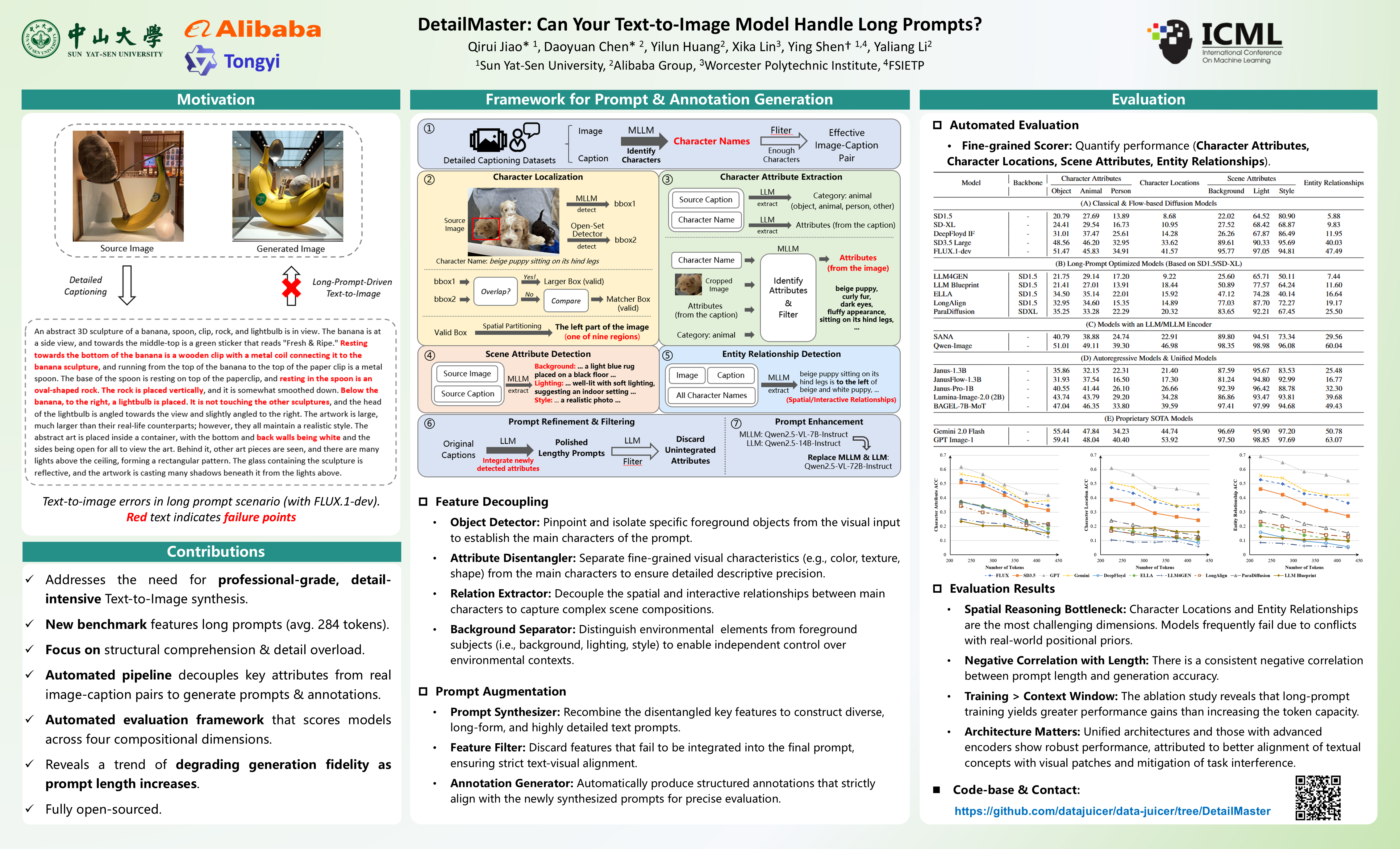
While recent Text-to-Image (T2I) models show impressive capabilities in synthesizing images from brief descriptions, they struggle with the long, detailed prompts required for professional applications. We present DetailMaster, a comprehensive benchmark for evaluating T2I capabilities on long prompts with complex compositional requirements, accompanied by an automated data construction pipeline and an evaluation workflow. Comprising expert-validated prompts averaging 284.89 tokens, our benchmark introduces four critical evaluation dimensions: Character Attributes, Structured Character Locations, Multi-Dimensional Scene Attributes, and Spatial/Interactive Relationships. Evaluations on various general-purpose and long-prompt-optimized models reveal critical performance limitations, showing that weak encoders struggle to preserve syntactic dependencies within prompts and diffusion models suffer from attribute leakage under detail-intensive conditions. Through a controlled ablation study under varying constraints, we further show that high-fidelity generation requires a synergistic combination of expanded prompt limits and long-prompt training. We open-source our dataset and code to foster progress in long-prompt-driven T2I generation.
Lay Summary
AI image generators easily draw simple concepts, but they stumble when given long, complex instructions. If you ask for multiple characters with specific clothing, exact locations, and precise interactions, the generators often gets confused—forgetting items or mixing up features. Because existing benchmarks use short, simple prompts, they cannot properly measure or help fix these advanced mistakes. To tackle this, we built DetailMaster, a rigorous testing framework featuring over 4,100 highly detailed prompts. We also developed an automated grading system that checks if the generated images correctly captured specific character traits, exact object placements, background details, and character interactions. When we tested 19 leading AI image generators, we found that even the most advanced systems consistently fail as instructions get longer. We discovered that simply giving an AI a larger "memory" to read more words isn't enough; it must be explicitly trained on complex descriptions to understand how concepts link together. By highlighting these exact weaknesses and making our testing tools publicly available, we provide a clear roadmap for researchers to build smarter, more reliable AI image generators for professional use.