
FUSE: FK-Steered Multi-Modal Flow Matching for Efficient Simulation-Based Posterior Estimation
Abstract
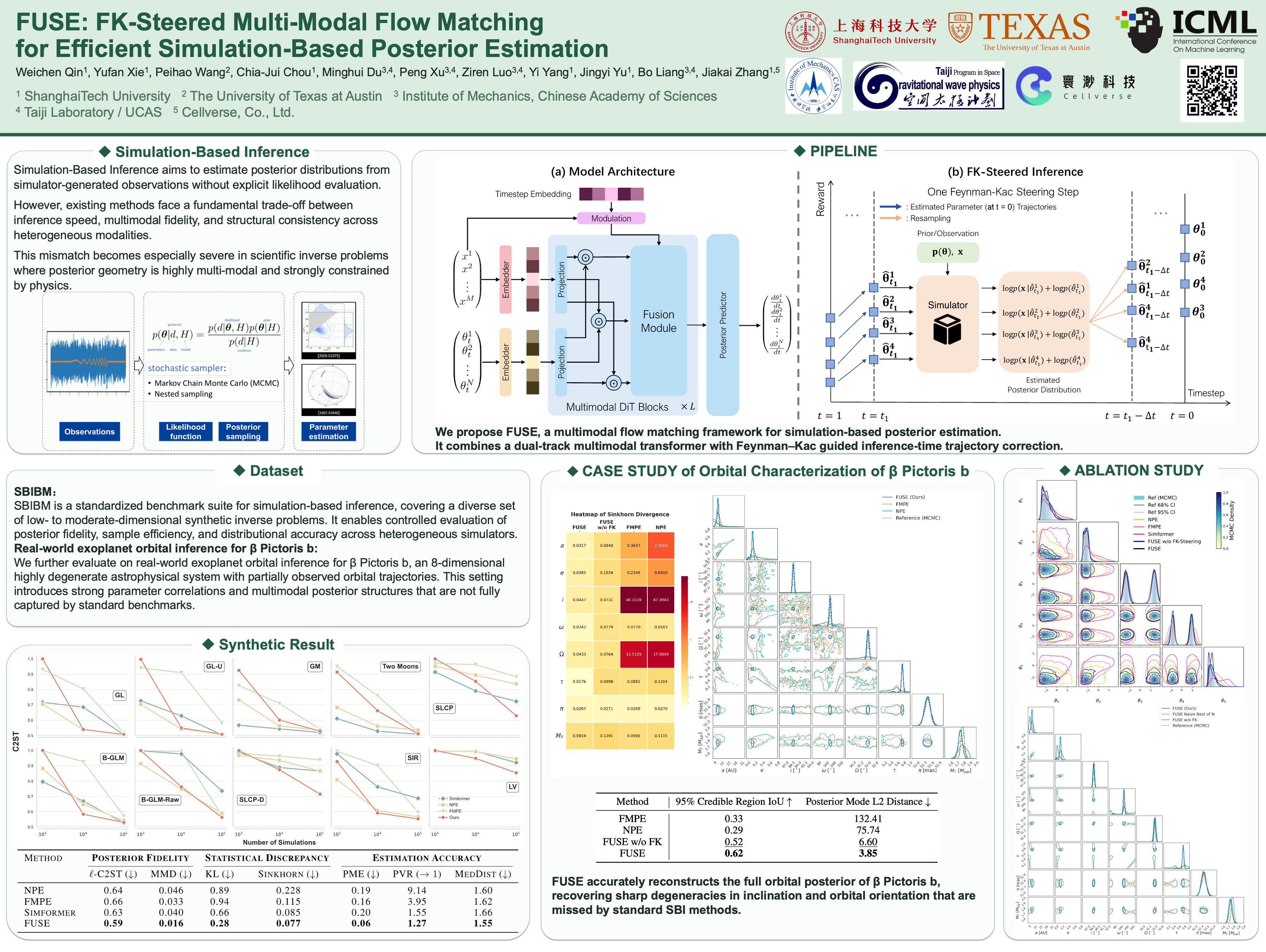
Simulation-Based Inference (SBI) is critical for scientific discovery, with generative models offering a promising path toward efficient inference. However, existing methods struggle with effective multimodal modeling. They often rely on brute-force fusion strategies that ignore the structural disparities between parameters and observations, thus limiting estimation fidelity. In this work, we introduce FUSE (Feynman-Kac steered mUlti-modal flow matching for efficient Simulation-based posterior Estimation). Unlike prior work, FUSE employs a dual-track architecture that preserves the distinct features of multimodal inputs while facilitating dynamic interaction. Additionally, we propose an FK-steered sampling strategy that leverages intermediate observation likelihoods to guide the generative trajectories, effectively improving the sample quality during inference. Our approach outperforms state-of-the-art baselines on standard SBI benchmarks, producing posteriors that closely match ground-truth MCMC. Furthermore, in a real-world exoplanet orbital estimation task, FUSE successfully resolves complex parameter degeneracies that challenge existing methods, highlighting its potential to accelerate complex scientific discoveries in astrophysics and beyond.
Lay Summary
Scientists often need to infer hidden physical quantities from indirect observations, such as estimating the orbit of an exoplanet from telescope measurements. Traditional methods can be accurate but may require many hours or days of computation, while faster neural methods can miss important uncertainty patterns. This paper introduces FUSE, a learning-based method that better connects observations with unknown physical parameters and then refines generated samples using information from the simulator. Across standard benchmark tasks and an exoplanet orbit-estimation problem, FUSE produces posterior estimates that more closely match strong reference methods while remaining much faster at inference time. This makes it a promising tool for accelerating scientific data analysis in astrophysics and related fields.