
SpaCeFormer: Fast Proposal-Free Open-Vocabulary 3D Instance Segmentation
Abstract
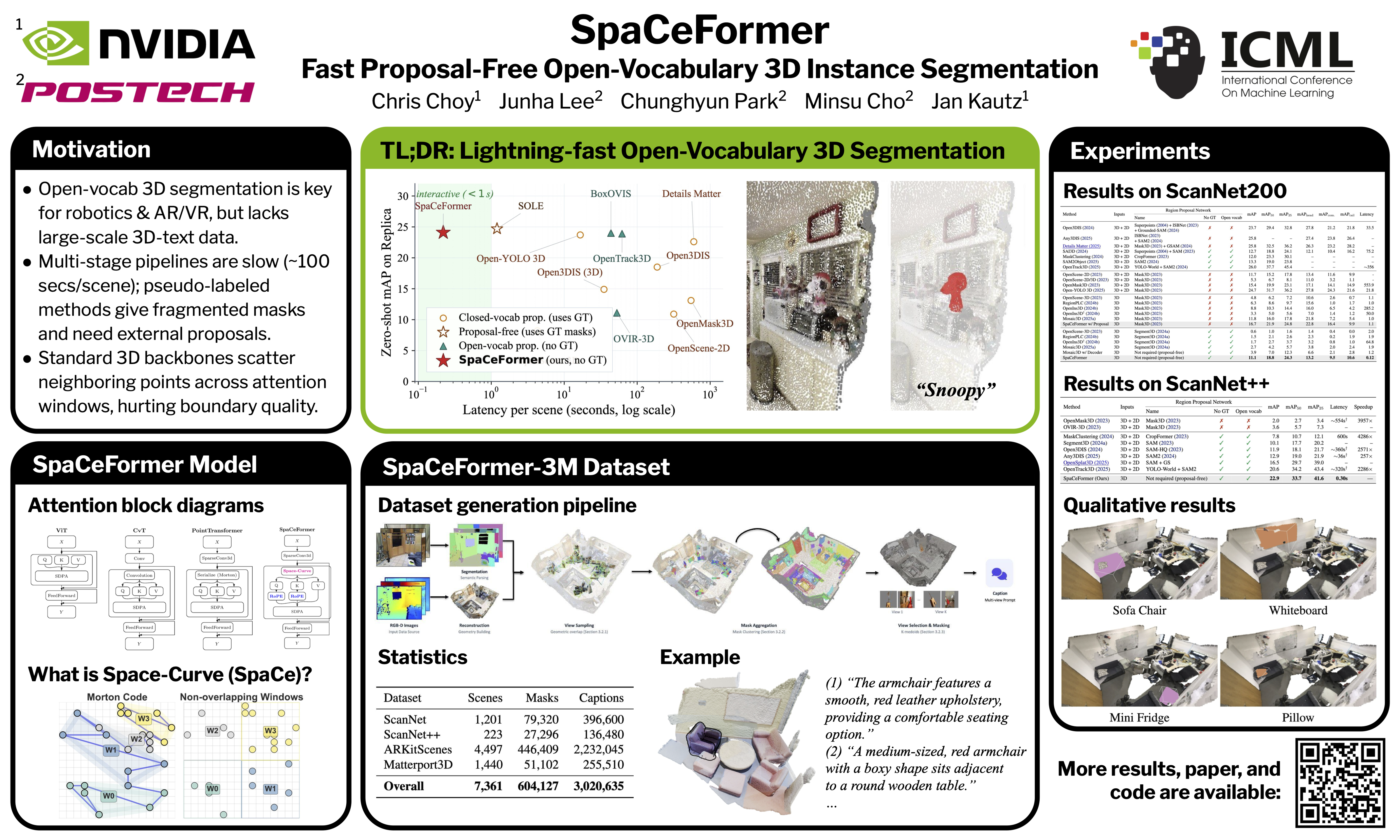
Open-vocabulary 3D instance segmentation is a core capability for robotics and AR/VR, but prior methods trade one bottleneck for another: multi-stage 2D+3D pipelines aggregate foundation-model outputs at hundreds of seconds per scene, while pseudo-labeled end-to-end approaches rely on fragmented masks and external region proposals. We present SpaCeFormer, a proposal-free space-curve transformer that runs in 0.12–0.30 seconds per scene across standard benchmarks, 2–3 orders of magnitude faster than multi-stage 2D+3D pipelines. We pair it with SpaCeFormer-3M, the largest open-vocabulary 3D instance segmentation dataset (3.0M multi-view-consistent captions over 604K instances from 7.4K scenes) built through multi-view mask clustering and multi-view VLM captioning; it reaches 21× higher mask recall than prior single-view pipelines (54.3% vs 2.5% at IoU>0.5). SpaCeFormer combines spatial window attention with Morton-curve serialization for spatially coherent features, and uses a RoPE-enhanced decoder to predict instance masks directly from learned queries without external proposals. On ScanNet200 we achieve 11.1 zero-shot mAP, a 2.8× improvement over the prior best proposal-free method; on ScanNet++ and Replica, we reach 22.9 and 24.1 mAP, surpassing all prior methods including those using multi-view 2D inputs.
Lay Summary
This work helps computers recognize and separate individual objects in 3D scenes—like chairs, tables, or cups—even when the objects are described in everyday language. Existing methods can take several minutes to analyze a single room and often confuse parts of the same object; ours runs in under a second per room and produces cleaner object boundaries by training on a much larger, more accurate dataset of indoor scenes. Faster, more reliable 3D scene understanding can help robots, AR/VR systems, and accessibility tools interact with the world around them.