
RoboTwin 2.0: A Scalable Data Generator and Benchmark with Strong Domain Randomization for Robust Bimanual Robotic Manipulation
Abstract
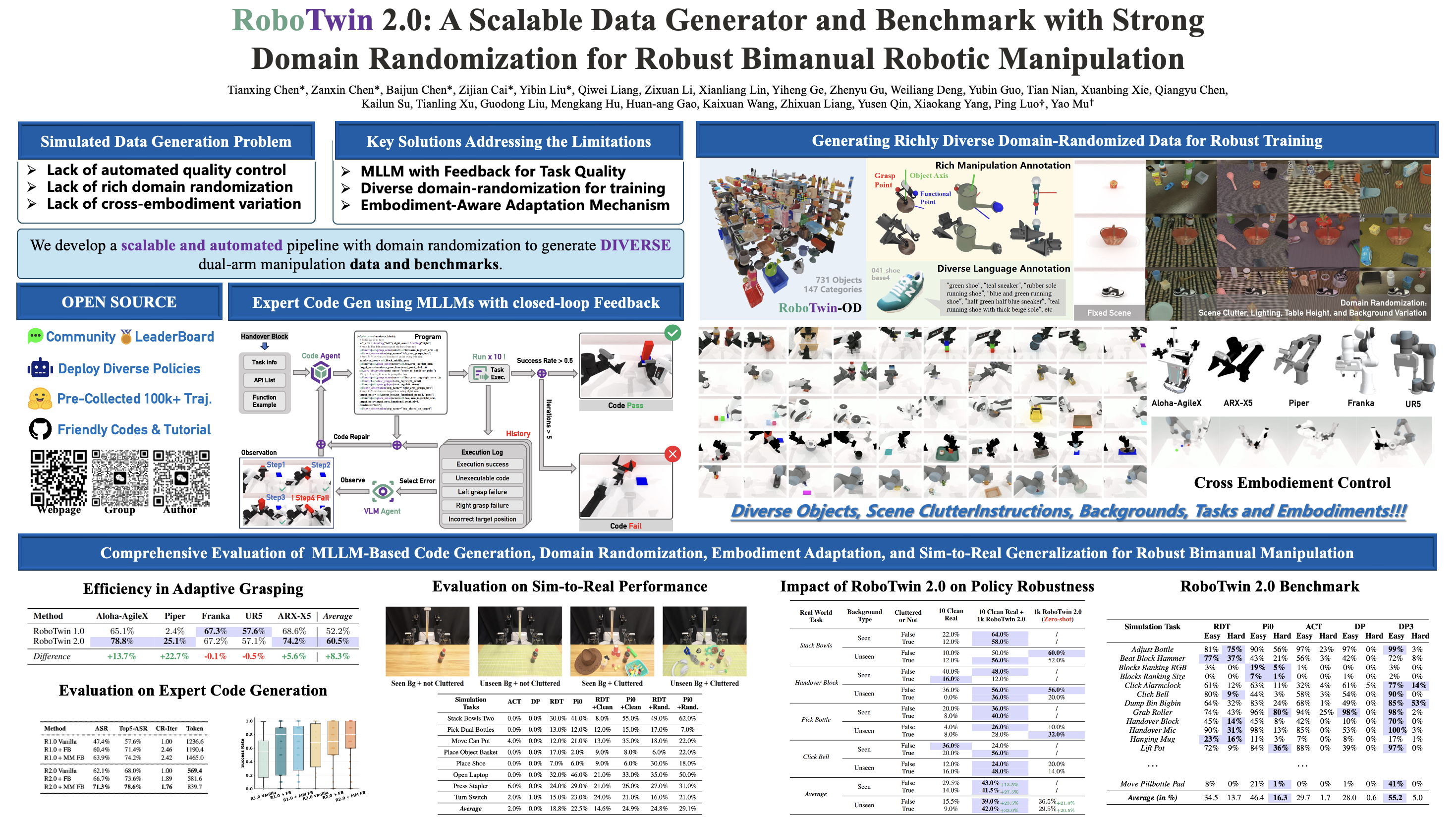
Simulation-based data synthesis has emerged as a powerful paradigm for enhancing real-world robotic manipulation. However, existing synthetic datasets remain insufficient for robust bimanual manipulation due to two key challenges: (1) the lack of an autonomous self-correcting mechanism to resolve execution failures in complex coordination tasks, and (2) the scarcity of diverse visual and spatial variations required to bridge the sim-to-real gap. To this end, we present RoboTwin 2.0, a scalable simulation framework that enables closed-loop, automated, large-scale generation of diverse and realistic data, along with unified evaluation protocols for dual-arm manipulation. Built upon RoboTwin-OD, a foundational library of 731 instances across 147 categories with rich semantic annotations, our framework integrates Multimodal Large Language Models (MLLMs) with simulation-in-the-loop verification. This integration forms an automated feedback mechanism that significantly boosts the success rate of expert task program generation. To enhance robust sim-to-real transfer, RoboTwin 2.0 incorporates structured domain randomization along five axes: clutter, lighting, background, tabletop height and language instructions, thereby maximizing data diversity. We instantiate this framework across 50 dual-arm tasks spanning five robot embodiments. Empirical evaluations demonstrate that Vision-Language-Action (VLA) models pre-trained on our synthetic data achieve a 3.6x improvement in few-shot real-world transfer (over a 10-demo baseline) and a 2.2x gain in zero-shot generalization. We release the data generator, benchmark, pre-collected dataset, and code to support scalable research in robust bimanual manipulation.
Lay Summary
Robots that can use two arms together, like humans do, could be very useful for tasks such as organizing objects, assembling items, or helping in homes and factories. However, teaching robots these skills in the real world is slow, expensive, and often unreliable, because collecting large amounts of real robot data is difficult. In this work, we introduce RoboTwin 2.0, a system that helps generate large amounts of training and testing data for two-arm robots inside a realistic simulator. Instead of manually designing every robot action, our system can automatically create task programs, test them in simulation, detect failures, and improve them through feedback. This makes it much easier to produce successful robot demonstrations at scale. To help robots trained in simulation work better in the real world, RoboTwin 2.0 also creates many variations of each task, such as different object arrangements, lighting conditions, backgrounds, table heights, and language instructions. These variations help robots become more robust to changes they may encounter outside the simulator. We build 50 two-arm manipulation tasks across five different robot platforms and show that training robot models with our synthetic data substantially improves their ability to transfer to real-world tasks, even with very little or no real-world training data. We release our data generator, benchmark, dataset, and code to support future research on more capable and reliable two-arm robots.