
DAG: A Dual Correlation Network for Time Series Forecasting with Exogenous Variables
Abstract
Lay Summary
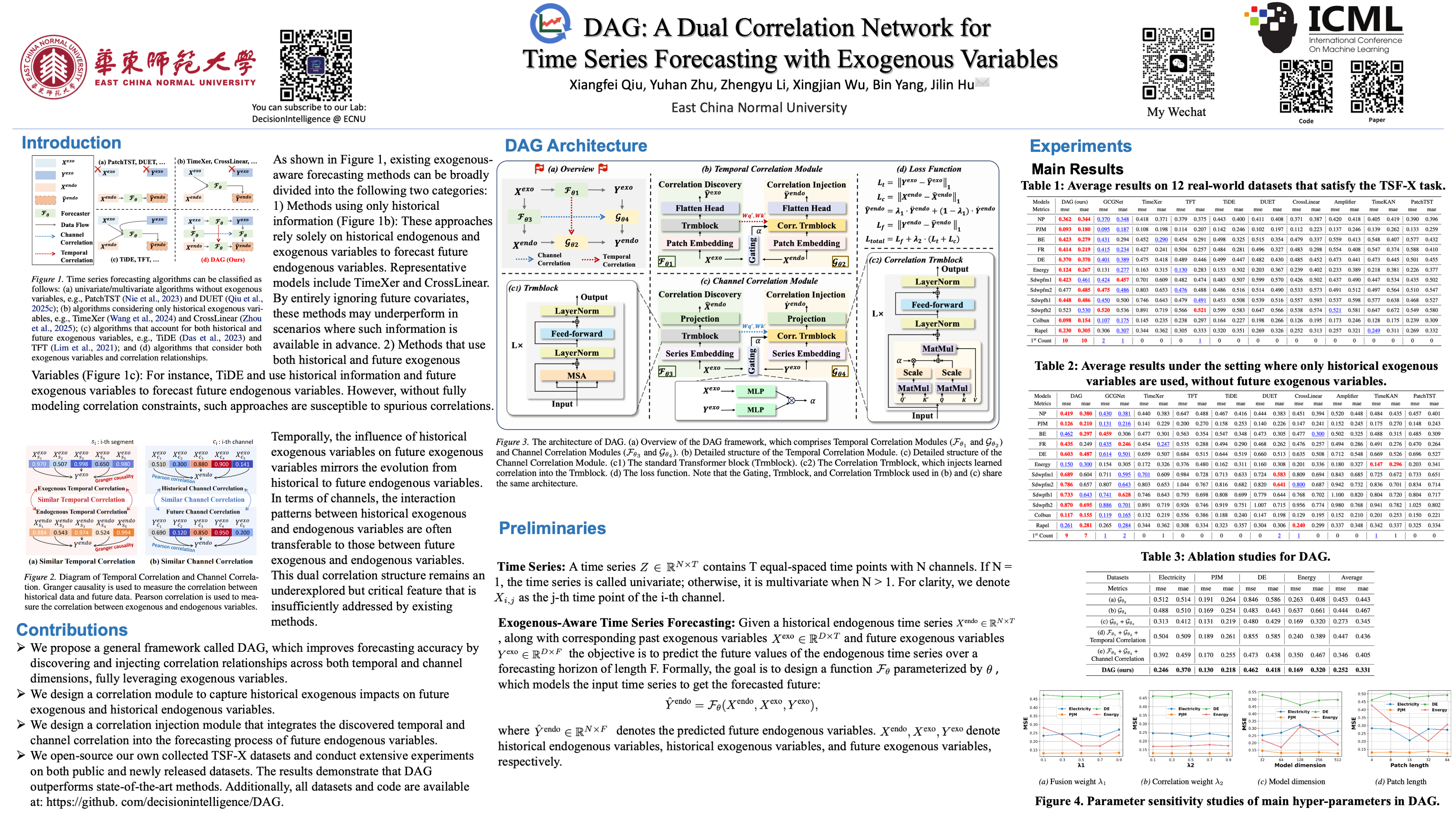
Time series forecasting helps people make better decisions in many areas such as energy systems, traffic management, finance, and healthcare by predicting future events from historical data. In many real-world applications, forecasts can be improved by using additional information beyond the target data itself, such as weather conditions, holidays, or electricity demand. These are called exogenous variables. However, existing forecasting methods often fail to fully utilize such information, especially information that is already known about the future. They also struggle to properly model how different types of data influence one another. To address these issues, we propose a new forecasting framework called DAG. DAG is designed to better capture relationships between historical observations and external information across both time and different data sources. In simple terms, the model learns how external factors influence future outcomes and then uses these learned relationships to improve forecasting accuracy. Experiments on multiple real-world datasets show that DAG consistently produces more accurate predictions than existing methods. Our work demonstrates the importance of effectively leveraging external information for reliable forecasting in practical applications.