
“very likely” Means “uncertain”? How LLMs Diverge from Humans in Linguistic Uncertainty Quantification
Abstract
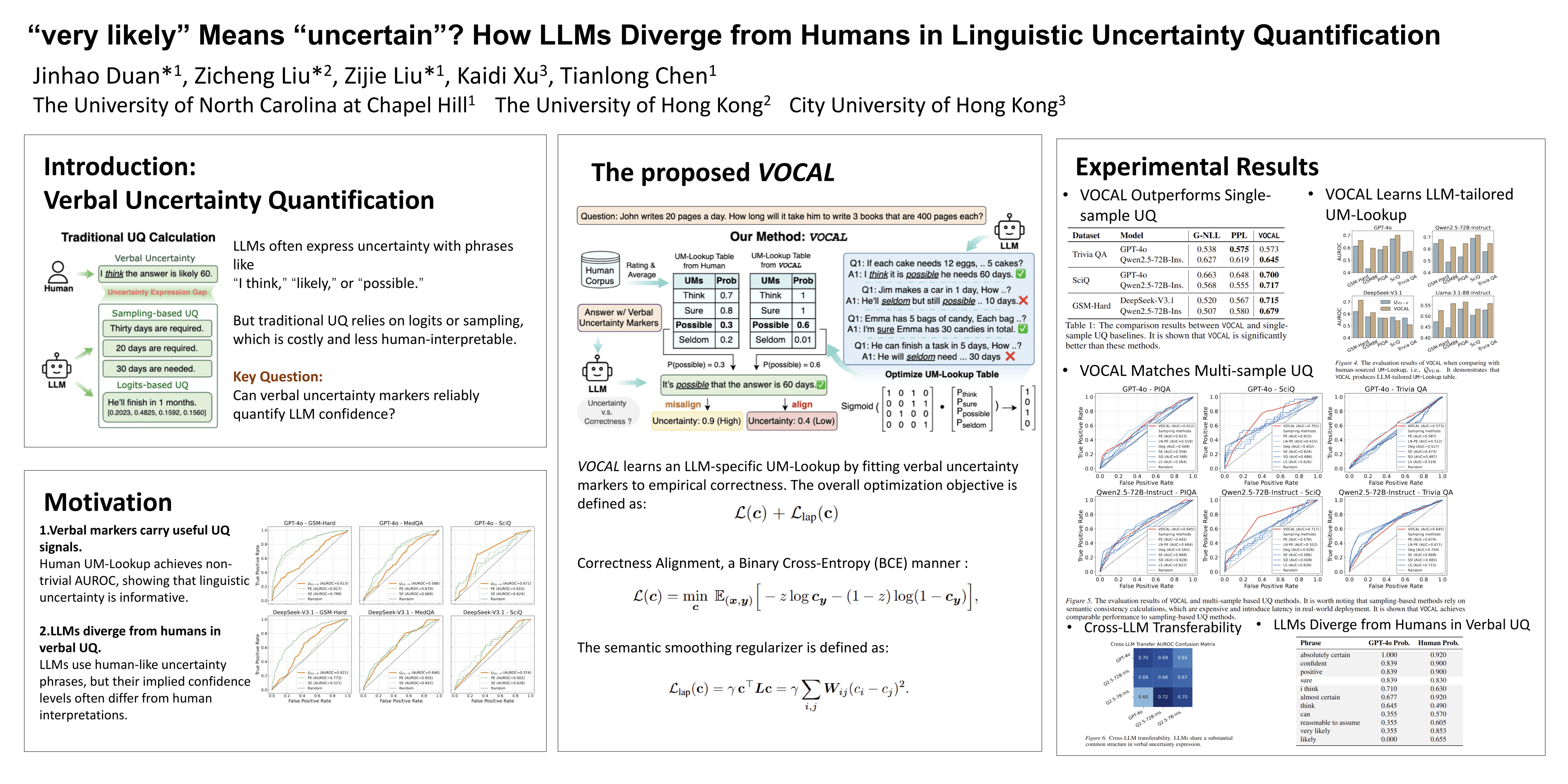
Humans express uncertainty verbally via markers (e.g., "possible", "likely"), yet most LLM uncertainty quantification (UQ) relies on costing likelihood- or consistency-based signals. From a cognitive perspective, accurate verbal uncertainty reflects metacognitive monitoring, representing knowledge boundaries ("knowing that you don't know") to support regulation and information seeking. In this paper, we investigate: How LLMs diverge from humans in verbal uncertainty quantification? Can verbal markers reliably quantify LLM uncertainty? We curate a corpus of human uncertainty markers from psychology and decision-science literature and benchmark LLMs against it. We observe that LLMs encode verbal uncertainty with numerical levels that differ substantially from those of humans. We then introduce VOCAL, a novel optimization-based algorithm that learns an optimal uncertainty profile over uncertainty markers directly from LLM outputs. By fitting a marker–uncertainty mapping to best explain empirical correctness, VOCALdiscovers how much probability mass each verbal marker should convey, rather than estimating uncertainty via repeated sampling. VOCAL enables a direct, marker-level comparison of confidence semantics between humans and LLMs, disentangling mismatch and revealing systematic confidence disparities in verbal expressions.
Lay Summary
LLMs often say things like “likely” or “very likely,” but these words do not always mean the same thing to LLMs as they do to humans. This paper studies this mismatch and proposes VOCAL, a method that learns how each LLM uses verbal uncertainty. VOCAL helps turn natural uncertainty words into more reliable confidence signals, making LLM answers easier to interpret and trust.