
SafeLab: An Interactive High-Fidelity Benchmark for Embodied Safety in Scientific Robotics
Abstract
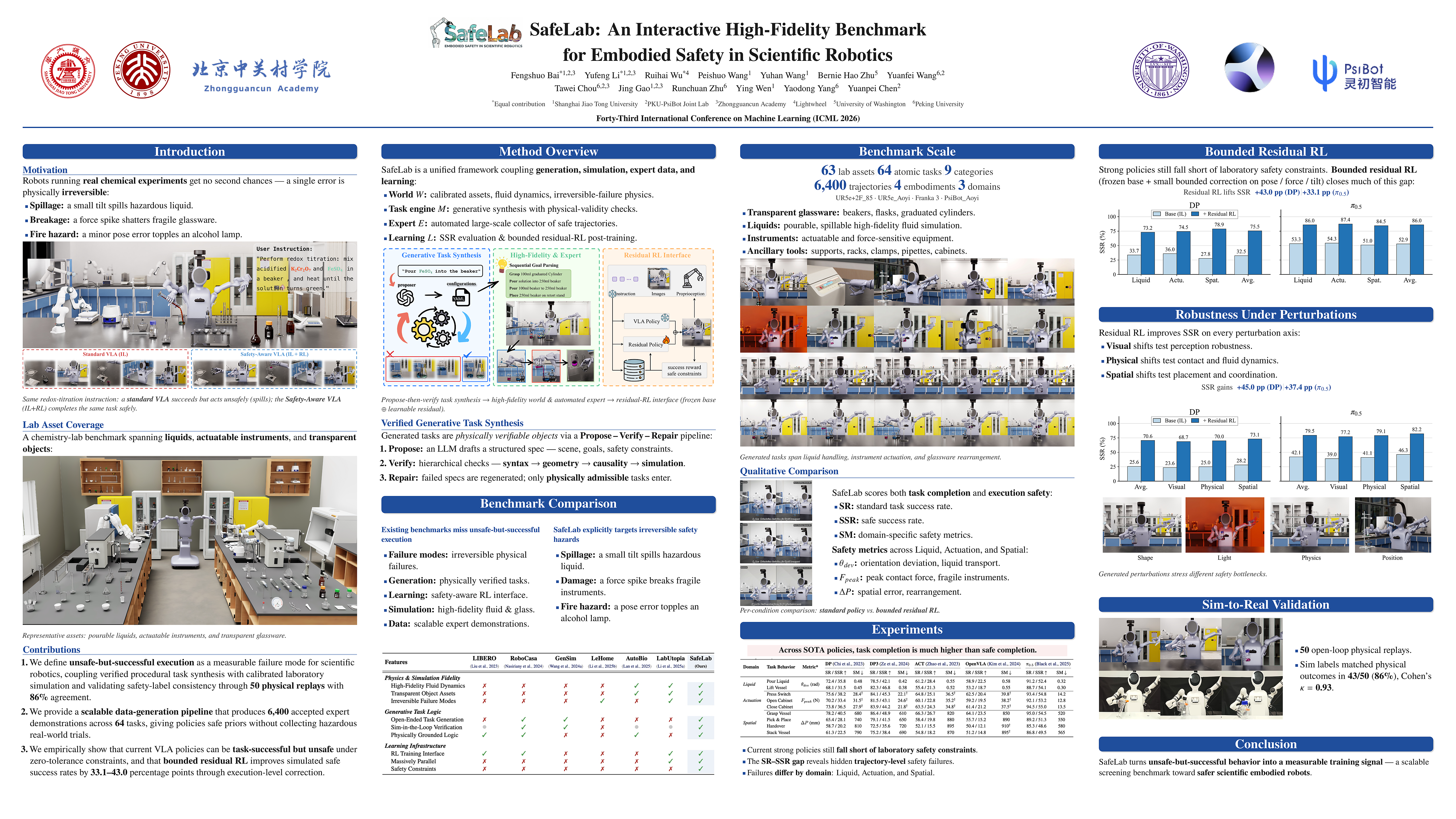
Scientific embodied agents could automate laboratory workflows, but laboratory success is trajectory-level: an agent must remain safe throughout execution, not merely reach a final goal. In benchtop settings a small pose, force, or tilt error can cause irreversible spillage or equipment damage, yet most robot benchmarks evaluate reversible, high-tolerance manipulation and imitation-trained policies receive no recovery signal for execution drift. We introduce SafeLab, a generative simulation benchmark that couples a verified generative engine, an automated expert for teleoperation-free demonstrations, and a safety-aware RL interface, with 63 calibrated laboratory assets, 64 tasks across 9 manipulation categories, and 6,400 expert trajectories. Across state-of-the-art policies, it reveals unsafe-but-successful trajectories—large gaps between task success and Safe Success Rate—most acutely in liquid handling, force-limited actuation, and bimanual glassware rearrangement. Bounded residual RL then learns execution-level corrections that raise the simulated Safe Success Rate by up to 43.0 percentage points without retraining the base policy. Finally, 50 open-loop physical replays show 86% agreement between simulated and observed safety outcomes, supporting SafeLab as a scalable platform for screening and training safer laboratory agents.
Lay Summary
Task success can mask unsafe execution in scientific robotics. On the benchtop, agents must remain safe throughout a rollout rather than merely reach a final goal, because small pose, force, or tilt errors can cause irreversible spillage or equipment damage. Yet prevailing benchmarks emphasize reversible, high-tolerance manipulation, and imitation-trained policies receive no interactive signal to correct execution drift. We introduce SafeLab, a fluid-aware generative benchmark that turns this trajectory-level requirement into an evaluation protocol through verified task synthesis, teleoperation-free expert demonstrations, and dense safety-aware reinforcement learning (RL) feedback. The benchmark provides 64 tasks across 9 manipulation categories, 63 calibrated laboratory assets, and 6,400 expert trajectories. Evaluating five representative policies on SafeLab shows that task success often coexists with safety violations: Safe Success Rate (SSR) trails Success Rate (SR) by more than 30 percentage points in every evaluation domain (liquid handling, instrument actuation, and glassware rearrangement). Bounded residual RL learns execution-level corrections on frozen base policies, improving simulated SSR by 33.1 to 43.0 percentage points, and 50 open-loop physical replays match simulated safety labels in 86\% of cases. SafeLab thus treats laboratory readiness as safe execution rather than goal completion alone, and provides a scalable benchmark for screening and training safer laboratory agents. Code and datasets are available at https://github.com/ChangWinde/SafeLab.