
From Seeing to Thinking: Decoupling Perception and Reasoning Improves Post-Training of Vision-Language Models
Abstract
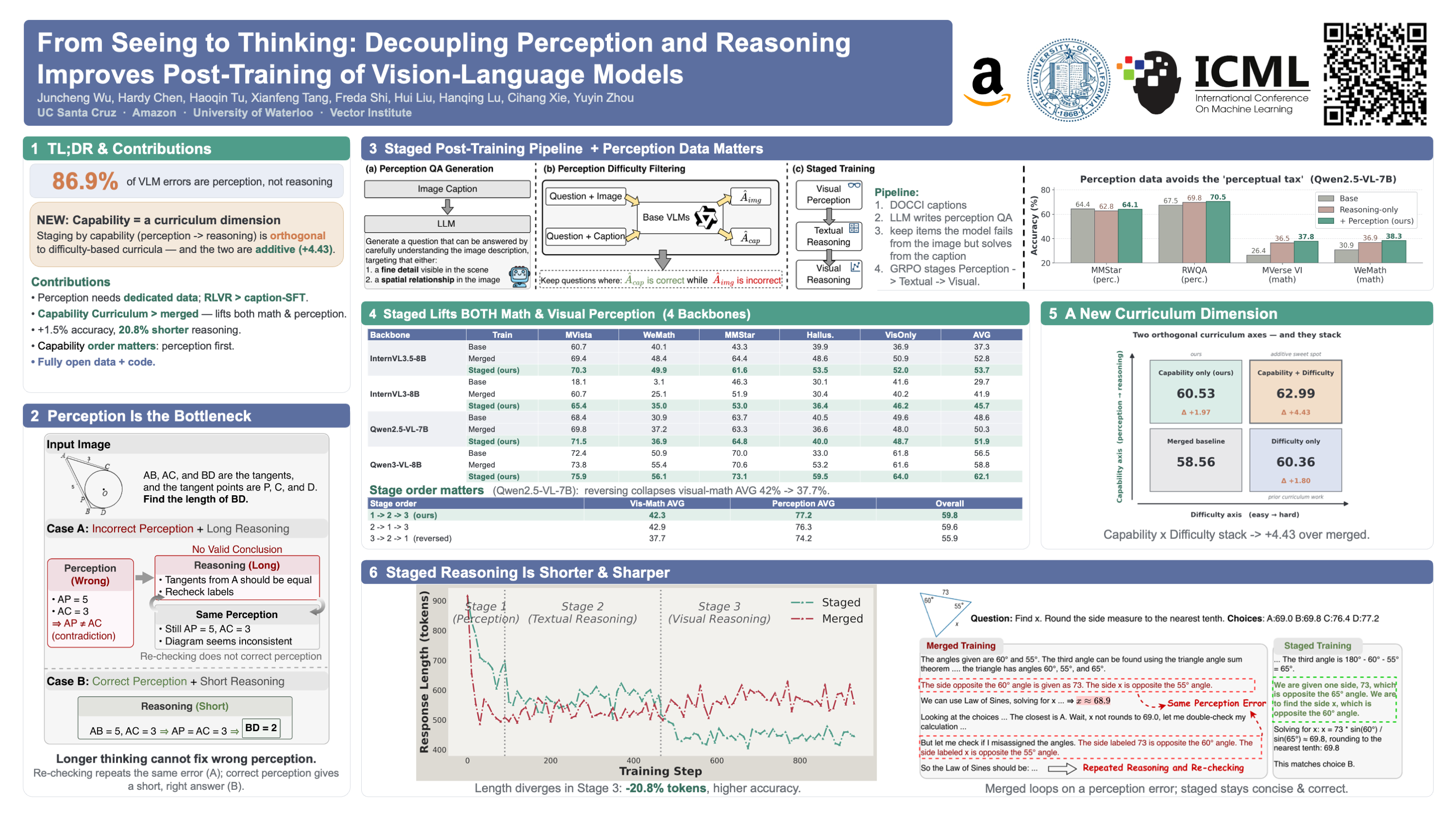
Recent advances in vision-language models (VLMs) emphasize long chain-of-thought reasoning; yet, we find that their performance on visual tasks is primarily limited by a lack of visual perception as opposed to reasoning itself. In this work, we systematically study the interplay between perception and reasoning in VLM post-training by decomposing their capabilities into three separate training stages: visual perception, visual reasoning, and textual reasoning, incorporating specialized training data. We demonstrate that visual perception (a) requires targeted optimization with specialized data; (b) serves as a fundamental scaffold that should be solidified through staged training before refining visual reasoning; and (c) is more effectively learned via RL than caption-based SFT. Our experiments across multiple VLMs demonstrate that staged training consistently improves both visual perception and reasoning performance over merged training. Notably, models trained with our approach achieve 1.5% higher reasoning accuracy with 20.8% shorter reasoning traces, suggesting that superior perception reduces the need for excessive reasoning. Furthermore, we show that this capability-based staging represents a new curriculum dimension orthogonal to traditional difficulty-based curricula, and combining both yields further additive gains. Our staged-training models achieve superior performance among open-weight VLMs, establishing advanced results on several visual math and perception (e.g., +5.2% on WeMath and +3.7% on RealWorldQA) tasks compared with the base counterpart.
Lay Summary
Modern AI systems can look at a picture and answer questions about it — for example, solving a geometry problem shown in a diagram. To make them better, researchers have mostly taught these systems to "think" longer, working through problems step by step. But when we examined where they go wrong, we found the real bottleneck was not faulty thinking but faulty seeing: in nearly 87% of mistakes, the model had simply misread the image. Worse, thinking harder did not help — once the model misread a picture, every extra step of reasoning was built on that same wrong observation. We argue that seeing should be treated as its own skill and trained separately, before reasoning. We built a training recipe that strengthens a model's visual perception first, then layers reasoning on top, using dedicated data for each stage. We also created a way to turn captioned-image datasets into perception training data. Models trained this way are both more accurate and more efficient: they reason about 21% more concisely because they no longer need to second-guess what they saw. The lesson is simple — an AI that sees clearly does not need to overthink.