
Diffusion-based learning framework for Constrained Nonconvex Optimization with Weighted Bootstrapped Refinement
Abstract
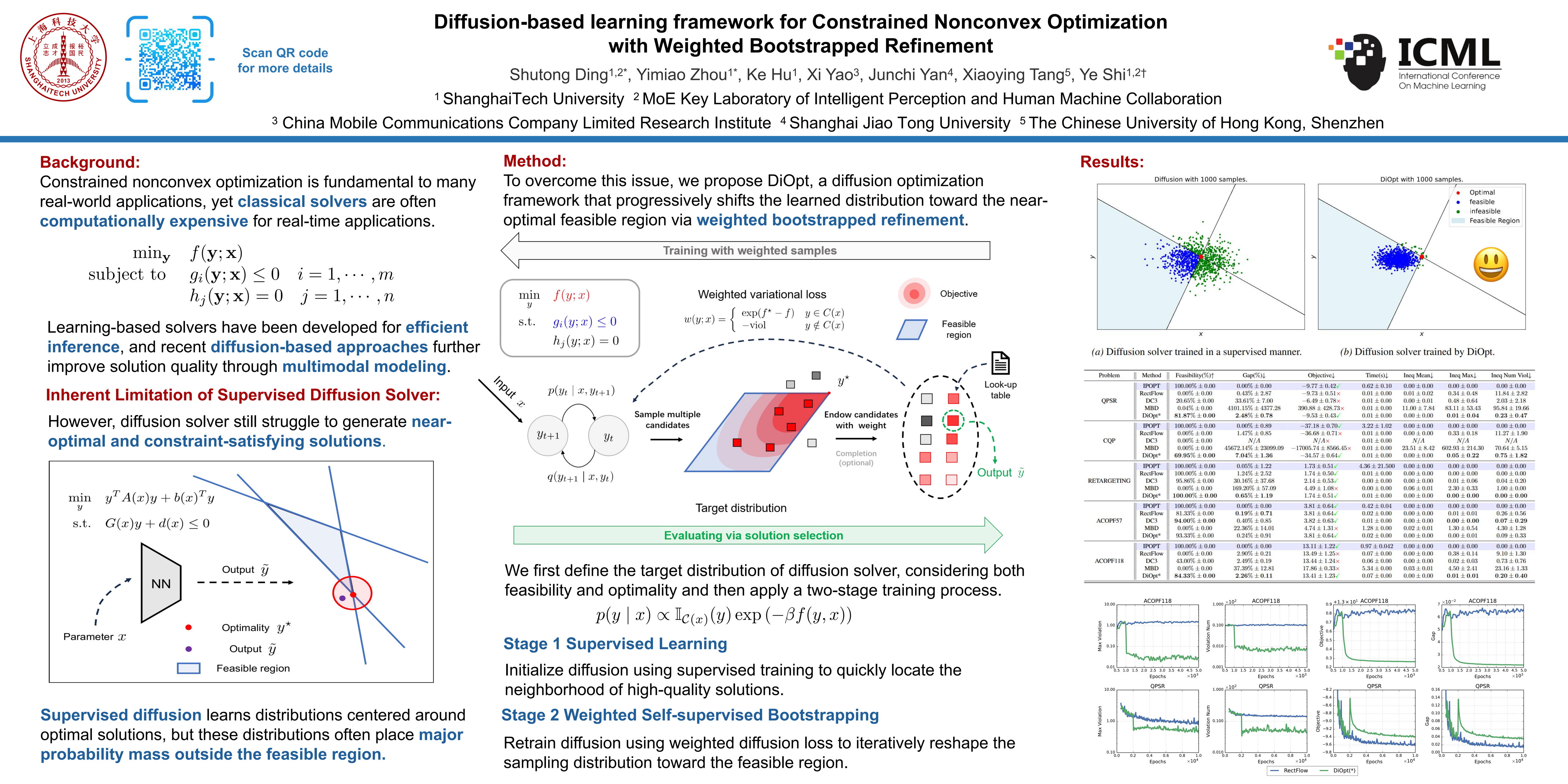
Recent advances in diffusion models show promising potential to accelerate nonconvex problem solving by leveraging their multimodality. However, most existing diffusion-based optimization approaches rely on supervised learning and lack a mechanism to enforce constraint satisfaction, which is required in real-world applications. In that case, we investigate and theoretically analyze the inherent problem of supervised diffusion solvers and identify the distributional misalignment problem, i.e., the generated solution distribution often exhibits low probability mass on the feasible region. To resolve this issue, we propose DiOpt, a new diffusion-based learning framework for constrained nonconvex optimization, which effectively learns the mapping from noise to the constraint region. Specifically, this framework operates in two distinct phases: an initial warm-start phase, implemented via supervised learning, followed by a bootstrapping training phase. This dual-phase architecture is designed to iteratively refine solutions, thereby improving the objective function with high constraint satisfaction. Finally, we also employ a solution selection technique in inference for better optimality. Notably, DiOpt is the first successful integration of the diffusion solver in constrained nonconvex optimization. Evaluations on diverse nonconvex tasks demonstrate the superiority of DiOpt in both optimality and constraint satisfaction. Our official page is released at \url{https://dingsht.tech/diopt-webpage}.
Lay Summary
Constrained optimization problems arise in many real-world systems, such as power grids, wireless networks, and robotic motion planning, where solutions must both perform well and satisfy strict constraints. While traditional methods can be computationally expensive, and learning-based approaches are fast, they often fail to produce feasible solutions. In this paper, we propose DiOpt, a diffusion-based framework for constrained nonconvex optimization. Although diffusion models can generate diverse candidate solutions, they often suffer from a mismatch between generated samples and the feasible region, leading to low feasibility. DiOpt addresses this issue with a two-stage training strategy: it first learns a rough approximation from available data, and then refines it through a self-supervised weighted bootstrapping process to better align with the feasible set and improve solution quality. Experiments show that DiOpt produces solutions that are both high-quality and significantly more likely to satisfy constraints, making diffusion-based methods more reliable for real-world optimization tasks.