
TransLight: Image-Guided Customized Lighting Control with Generative Decoupling
Abstract
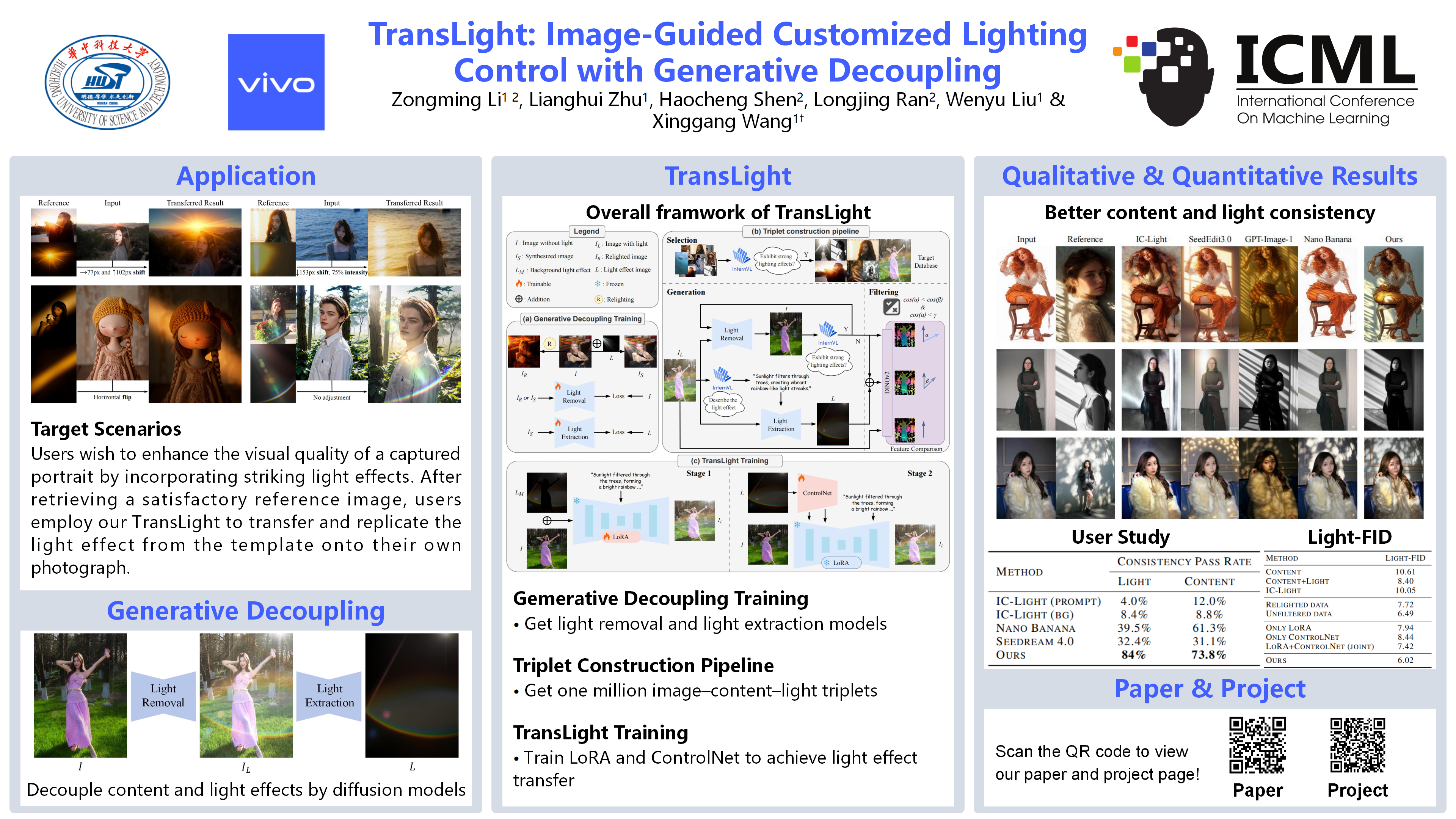
Most existing illumination-editing methods struggle to jointly offer customized lighting control and preserve content integrity, limiting their effectiveness especially in transferring complex light effects from a reference to a target image in portrait photography. To address this problem, we propose TransLight, a novel framework that enables high-fidelity and high-freedom transfer of geometric-structured light effects such as Tyndall beams and specular highlights. Extracting light effects from the reference image is the most critical and challenging step, as real-world lighting contains complex geometric structures tightly coupled with image content. To achieve this, we propose Generative Decoupling, using two fine-tuned diffusion models to accurately separate image content and lighting, and create a new million-scale dataset of image–content–light triplets. We then adopt IC-Light as the generative model, training it on these triplets with the reference lighting image as an additional conditioning signal. The resulting model enables customized and natural transfer of diverse light effects. Notably, by fully disentangling light effects from reference images, our generative decoupling strategy gives TransLight highly flexible illumination control. Experiments show that TransLight successfully transfers geometric-structured lighting effects across diverse images in portrait photography, offering more customized control than existing methods and charting new directions in illumination harmonization and editing. Our project page is hustvl.github.io/TransLight.
Lay Summary
Existing illumination-editing methods struggle to transfer complex light effects in portrait photography while preserving content integrity. We propose TransLight to enable high-fidelity transfer of geometric-structured light effects like Tyndall beams. Our solution, Generative Decoupling, uses diffusion models to accurately separate image content and lighting. We trained this model on a new million-scale dataset of image–content–light triplets. By using reference lighting as a conditioning signal, TransLight achieves natural and customized illumination transfer. This strategy provides highly flexible control without distorting the original image. Experiments show TransLight successfully transfers diverse geometric-structured lighting across portraits. It offers more customized control than existing methods for illumination harmonization and editing.