
Scalable First-Order Bayesian Optimization via Structured Automatic Differentiation
Sebastian Ament ⋅ Carla Gomes
Keywords:
PM: Gaussian Processes
T: Optimization
T: Probabilistic Methods
OPT: First-order
OPT: Global Optimization
OPT: Optimization and Learning under Uncertainty
T: Active Learning and Interactive Learning
Probabilistic Methods
2022 Poster
Abstract
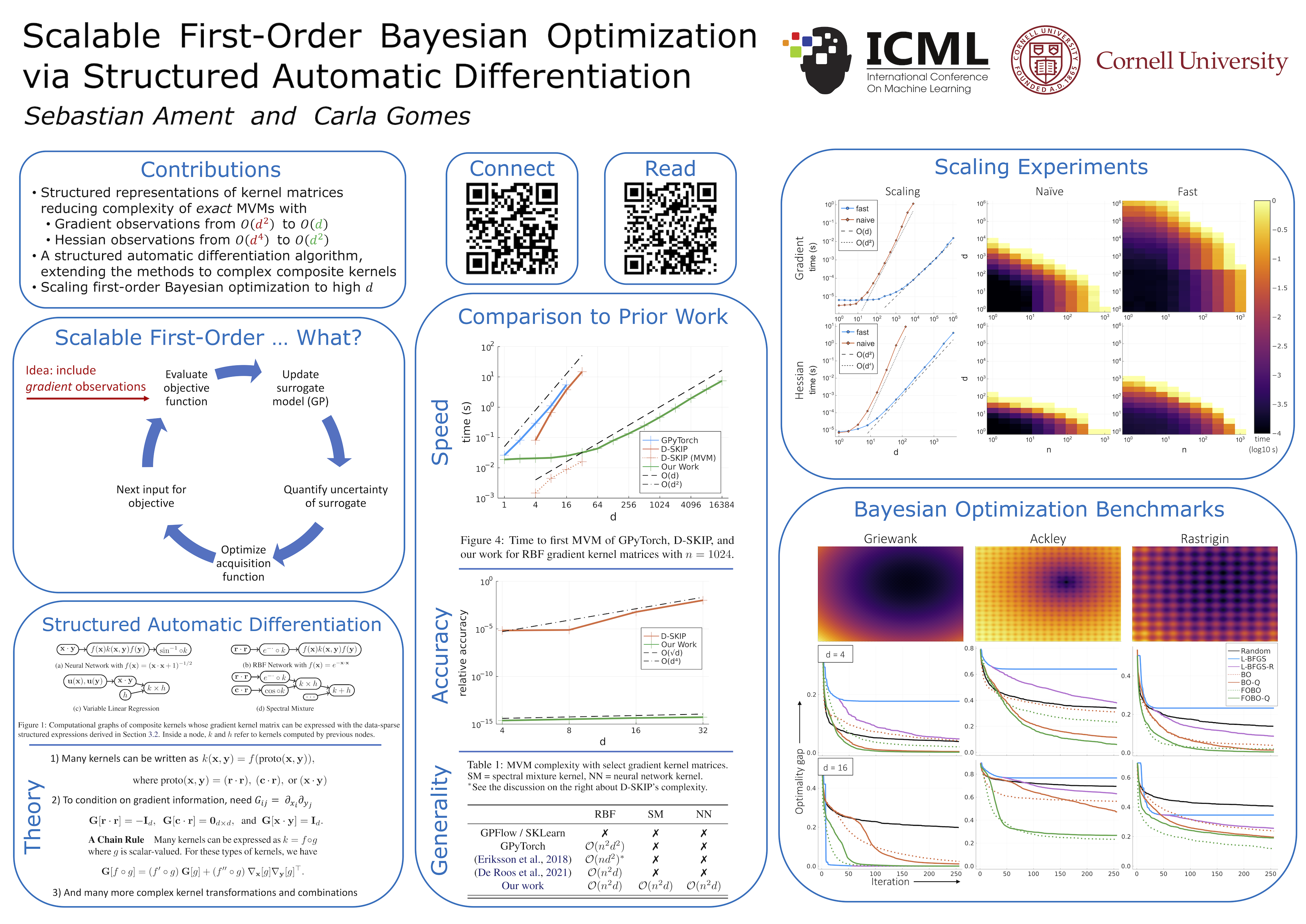
Bayesian Optimization (BO) has shown great promise for the global optimization of functions that are expensive to evaluate, but despite many successes, standard approaches can struggle in high dimensions. To improve the performance of BO, prior work suggested incorporating gradient information into a Gaussian process surrogate of the objective, giving rise to kernel matrices of size $nd$ × $nd$ for $n$ observations in $d$ dimensions. Naïvely multiplying with (resp. inverting) these matrices requires $O(n^2d^2)$ (resp. $O(n^3d^3)$) operations, which becomes infeasible for moderate dimensions and sample sizes. Here, we observe that a wide range of kernels gives rise to structured matrices, enabling an exact $O(n^2d)$ matrix-vector multiply for gradient observations and $O(n^2d^2)$ for Hessian observations. Beyond canonical kernel classes, we derive a programmatic approach to leveraging this type of structure for transformations and combinations of the discussed kernel classes, which constitutes a structure-aware automatic differentiation algorithm. Our methods apply to virtually all canonical kernels and automatically extend to complex kernels, like the neural network, radial basis function network, and spectral mixture kernels without any additional derivations, enabling flexible, problem-dependent modeling while scaling first-order BO to high $d$.
Chat is not available.
Successful Page Load