
DNA: Domain Generalization with Diversified Neural Averaging
Xu Chu ⋅ Yujie Jin ⋅ Wenwu Zhu ⋅ Yasha Wang ⋅ Xin Wang ⋅ Shanghang Zhang ⋅ Hong Mei
2022 Poster
Abstract
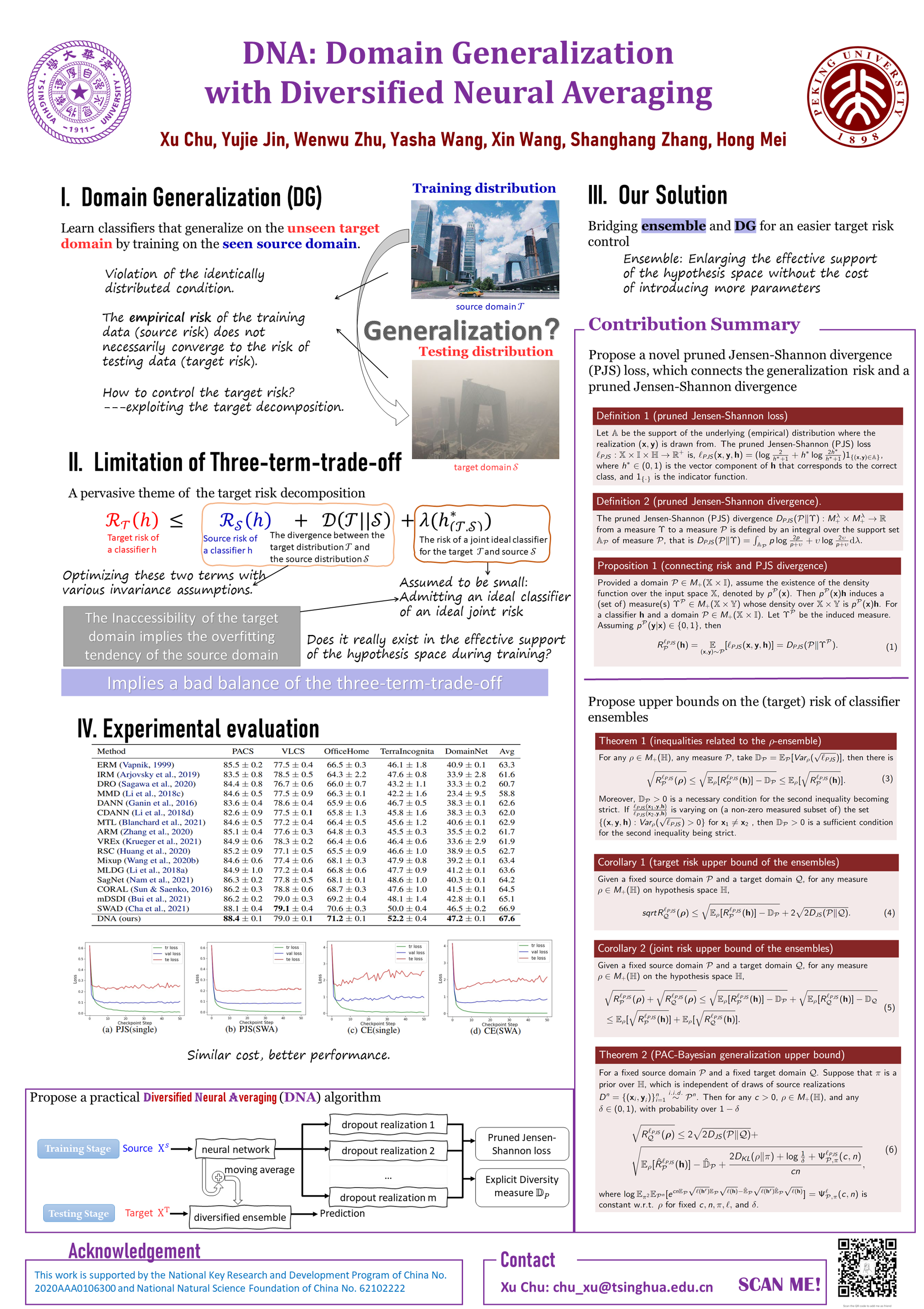
The inaccessibility of the target domain data causes domain generalization (DG) methods prone to forget target discriminative features, and challenges the pervasive theme in existing literature in pursuing a single classifier with an ideal joint risk. In contrast, this paper investigates model misspecification and attempts to bridge DG with classifier ensemble theoretically and methodologically. By introducing a pruned Jensen-Shannon (PJS) loss, we show that the target square-root risk w.r.t. the PJS loss of the $\rho$-ensemble (the averaged classifier weighted by a quasi-posterior $\rho$) is bounded by the averaged source square-root risk of the Gibbs classifiers. We derive a tighter bound by enforcing a positive principled diversity measure of the classifiers. We give a PAC-Bayes upper bound on the target square-root risk of the $\rho$-ensemble. Methodologically, we propose a diversified neural averaging (DNA) method for DG, which optimizes the proposed PAC-Bayes bound approximately. The DNA method samples Gibbs classifiers transversely and longitudinally by simultaneously considering the dropout variational family and optimization trajectory. The $\rho$-ensemble is approximated by averaging the longitudinal weights in a single run with dropout shut down, ensuring a fast ensemble with low computational overhead. Empirically, the proposed DNA method achieves the state-of-the-art classification performance on standard DG benchmark datasets.
Chat is not available.
Successful Page Load