
Rethinking Visual Autoregressive Sampling with Information-Grounding Guidance
Abstract
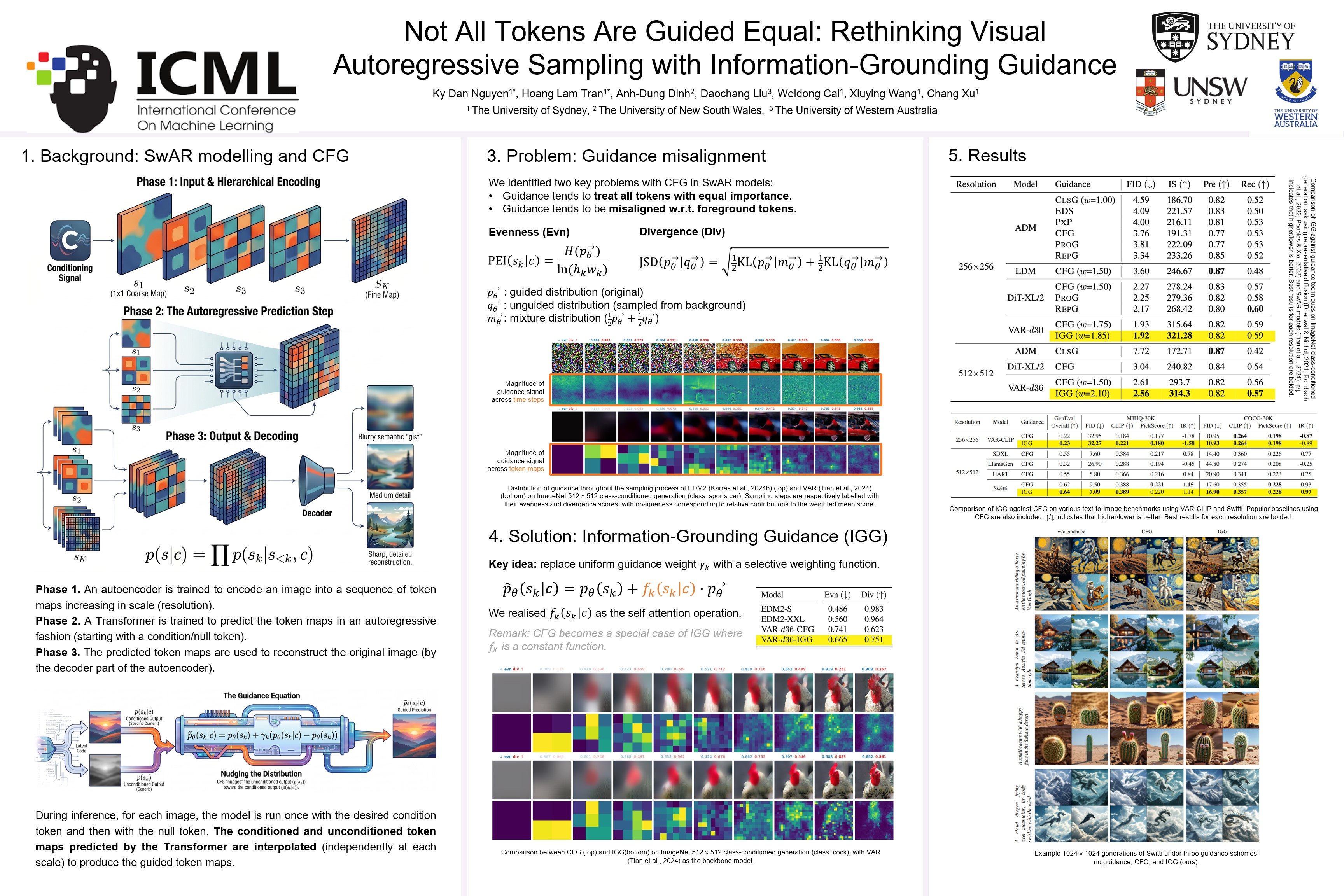
Autoregressive (AR) models based on next-scale prediction are rapidly emerging as a powerful tool for image generation, but they face a critical weakness: information inconsistencies between patches across timesteps introduced by progressive resolution scaling. These inconsistencies scatter guidance signals, causing them to drift away from conditioning information and leaving behind ambiguous, unfaithful features. We tackle this challenge with Information-Grounding Guidance (IGG), a novel mechanism that anchors guidance to semantically important regions through attention. By adaptively reinforcing informative patches during sampling, IGG ensures that guidance and content remain tightly aligned. Across both class-conditioned and text-to-image generation tasks, IGG delivers sharper, more coherent, and semantically grounded images, setting a new benchmark for AR-based methods.
Lay Summary
Scale-wise AI models generate images by starting with a blurry, low-resolution sketch and progressively sharpening it (increasing the resolution). However, this scaling process introduces discrepancies in the guidance received by the AI across generation steps. This confuses the AI, drifting its attention away from the main subject and leading to distorted details in the resulting image. To solve this, we propose a new method that automatically anchors the AI's focus to the most important parts of the image by dynamically adjusting the magnitude of its guidance. This ensures that its attention remains tightly aligned with the content of the image, regardless of resolution changes. Across various generation tasks, applying our method consistently helps the AI deliver sharper and more coherent results.