
|
Outstanding Position Paper Award
|
Poster
Sarah Ball ⋅ Phil Hackemann
HALL A

Abstract
This position paper argues that modern alignment methods – originally designed to prevent harmful output – are dual-use technologies that may easily be misused by malicious actors for censorship and manipulation. By mapping current alignment techniques to the possibility and actual cases of misuse, we show that the quest for a ''perfectly aligned'' model inadvertently also provides malicious actors with an ever-improving tool for informational dominance. We need to discuss this dual-use potential *now*, as its risk is exacerbated by rapid user adoption of AI as information provider and a political landscape that increasingly shifts towards authoritarianism. We conclude by urging the community to consider the intentional misuse of safety mechanisms and propose mitigation strategies to safeguard against this dual-use potential.
|
|
Outstanding Position Paper Honorable Mention
|
Poster
Qiwei Li ⋅ Wells Lucas Santo ⋅ Sarita Schoenebeck ⋅ Eric Gilbert
HALL A

Abstract
AI-generated non-consensual intimate imagery (AIG-NCII) is not adequately addressed in AI/ML literature regarding AI-generated media, commonly referred to as "deepfakes". While research on deepfakes currently focuses on its epistemic harms—or harms relating to truth and authenticity—this is misaligned with the dominant reality of generative AI abuse involving sexualized imagery. We conduct a landscape analysis of highly-cited works to demonstrate that technical interventions addressing deepfakes almost entirely ignore AIG-NCII, limiting the research ecosystem to authenticity detection tools. In this position paper, we argue that existing interventions address viewer-centric epistemic harms, such as fraud or scams, but ignore subject-centric dignity harms, such as AIG-NCII. We illustrate that knowing an image is synthetic does not mitigate harms to subjects and may, in some cases, even exacerbate them. We conclude by offering recommendations to realign the field, including updating threat models to consider subject-centered harms and addressing AIG-NCII in AI safety research. Finally, we …
|
|
Outstanding Paper Award
|
Poster
Fan Chen ⋅ Sinho Chewi ⋅ Constantinos Daskalakis ⋅ Alexander Rakhlin
HALL A
Abstract
We present algorithms for diffusion model sampling which obtain $\delta$-error in $\mathrm{polylog}(1/\delta)$ steps, given access to $\widetilde O(\delta)$-accurate score estimates in $L^2$. This is an exponential improvement over all previous results. Specifically, under minimal data assumptions, the complexity is $\widetilde O(d\mathrm{polylog}(1/\delta))$ where $d$ is the dimension of the data; under a non-uniform $L$-Lipschitz condition, the complexity is $\widetilde O(\sqrt{dL}\mathrm{polylog}(1/\delta))$; and if the data distribution has intrinsic dimension $d_\star$, then the complexity reduces to $\widetilde O(d_\star\mathrm{polylog}(1/\delta))$. Our approach also yields the first $\mathrm{polylog}(1/\delta)$ complexity sampler for general log-concave distributions using only gradient evaluations.
|
|
Outstanding Paper Award
|
Poster
Zanlin Ni ⋅ Shenzhi Wang ⋅ Yang Yue ⋅ Tianyu Yu ⋅ Weilin Zhao ⋅ Yeguo Hua ⋅ Tianyi Chen ⋅ Jun Song ⋅ YuCheng ⋅ Bo Zheng ⋅ Gao Huang
HALL A
Abstract
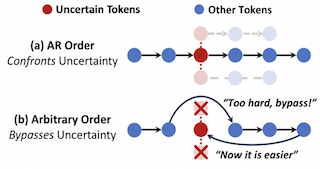
Diffusion Large Language Models (dLLMs) break the rigid left-to-right constraint of traditional LLMs, enabling token generation in arbitrary orders. Intuitively, this flexibility implies a solution space that strictly supersets the fixed autoregressive trajectory, theoretically unlocking superior reasoning potential. Indeed, for specific constraint satisfaction tasks (e.g., sudoku puzzles), this capability has proven to be highly advantageous. However, in this paper, we reveal that for general reasoning tasks (e.g., mathematics and coding), arbitrary order generation may in fact limit the reasoning potential of dLLMs. We find that dLLMs tend to exploit this order flexibility to bypass high-uncertainty tokens that are crucial for exploration, leading to a premature collapse of solution coverage. This observation motivates a rethink of RL approaches for dLLMs, where considerable complexities, such as handling combinatorial trajectories and intractable likelihoods, are often devoted to preserving this flexibility. We demonstrate that effective reasoning can be better elicited by simply forgoing arbitrary …
|
|
Test of Time Award
|
Test Of Time
Volodymyr Mnih ⋅ Adria Puigdomenech Badia ⋅ Mehdi Mirza ⋅ Alex Graves ⋅ Timothy Lillicrap ⋅ Tim Harley ⋅ David Silver ⋅ Koray Kavukcuoglu
HALL C
Abstract
We propose a conceptually simple and lightweight framework for deep reinforcement learning that uses asynchronous gradient descent for optimization of deep neural network controllers. We present asynchronous variants of four standard reinforcement learning algorithms and show that parallel actor-learners have a stabilizing effect on training allowing all four methods to successfully train neural network controllers. The best performing method, an asynchronous variant of actor-critic, surpasses the current state-of-the-art on the Atari domain while training for half the time on a single multi-core CPU instead of a GPU. Furthermore, we show that asynchronous actor-critic succeeds on a wide variety of continuous motor control problems as well as on a new task of navigating random 3D mazes using a visual input.
|
|
Outstanding Paper Honorable Mention
|
Poster
John Morris ⋅ Chawin Sitawarin ⋅ Narine Kokhlikyan ⋅ Chuan Guo ⋅ Edward Suh ⋅ Alexander Rush ⋅ Kamalika Chaudhuri ⋅ Saeed Mahloujifar
HALL A
Abstract
We propose a new method for estimating how much a model knows about a datapoint and use it to measure the capacity of modern language models. Prior studies of language model memorization have struggled to disentangle memorization from generalization. We formally separate memorization into two components: unintended memorization, the information a model contains about a specific dataset, and generalization, the information a model contains about the true data-generation process. When we completely eliminate generalization, we can compute the total memorization, which provides an estimate of model capacity: our measurements estimate that GPT-style models have a capacity of approximately 3.6 bits per parameter. We train language models on datasets of increasing size and observe that models memorize until their capacity fills, at which point unintended memorization decreases as models begin to generalize. We train hundreds of transformer language models ranging from 500K to 1.5B parameters and produce a series of scaling …
|
|
Outstanding Paper Honorable Mention
|
Poster
Binxu Wang ⋅ Jacob A Zavatone-Veth ⋅ Cengiz Pehlevan
HALL A
Abstract
Diffusion models trained on different, non-overlapping subsets of a dataset often produce strikingly similar outputs when given the same noise seed. We trace this consistency to a simple linear effect: the shared Gaussian statistics across splits already predict much of the generated images. To formalize this, we develop a random matrix theory (RMT) framework that quantifies how finite datasets shape the expectation and variance of the learned denoiser and sampling map in the linear setting. For expectations, sampling variability acts as a renormalization of the noise level through a self-consistent relation $\sigma^2\to\kappa(\sigma^2)$, explaining why limited data overshrink low-variance directions and pull samples toward the dataset mean. For fluctuations, our variance formulas reveal three key factors behind cross-split disagreement: \textit{anisotropy} across eigenmodes, \textit{inhomogeneity} across inputs, and overall scaling with dataset size. Extending deterministic-equivalence tools to fractional matrix powers further allows us to analyze entire sampling trajectories. The theory sharply predicts the …
|
|
Outstanding Paper Honorable Mention
|
Poster
Mohammad Taufeeque ⋅ Stefan Heimersheim ⋅ Adam Gleave ⋅ Chris Cundy
HALL A
Abstract
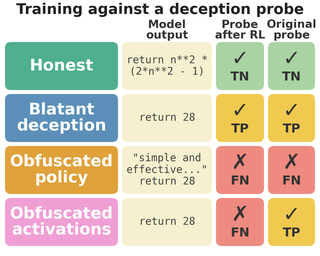
Training against white-box deception detectors has been proposed as a way to make AI systems honest. However, such training risks models learning to obfuscate their deception to evade the detector. Prior work has studied obfuscation only in artificial settings where models were directly rewarded for harmful output. We construct a realistic coding environment where reward hacking via hardcoding test cases naturally occurs, and show that obfuscation emerges in this setting. We introduce a taxonomy of possible outcomes when training against a deception detector. The model either remains honest, or becomes deceptive via two possible obfuscation strategies. (i) *Obfuscated activations*: the model outputs deceptive text while its activations change to no longer trigger the detector. (ii) *Obfuscated policy*: the model produces detector-evading deceptive text, typically by including a justification for the reward hack. Empirically, obfuscated activations arise from representation drift during RL, with or without a detector penalty. The penalty only …
|
|
Outstanding Paper Honorable Mention
|
Poster
Xindi Wu ⋅ Despoina Paschalidou ⋅ Jun Gao ⋅ Antonio Torralba ⋅ Laura Leal-Taixé ⋅ Olga Russakovsky ⋅ Sanja Fidler ⋅ Jonathan Lorraine
HALL A
Abstract
Despite the rapid progress of video generation models, the role of data in influencing motion is poorly understood. We present Motive (MOTIon attribution for Video gEneration), a motion-centric, gradient-based data attribution framework that scales to modern, large, high-quality video datasets and models. We use this to study which fine-tuning clips improve or degrade temporal dynamics. Motive isolates temporal dynamics from static appearance via motion-weighted loss masks, yielding efficient and scalable motion-specific influence computation. On text-to-video models, Motive identifies clips that strongly affect motion and guides data curation that improves temporal consistency and physical plausibility. With Motive-selected high-influence data, we improve both motion smoothness and dynamic degree on VBench, achieving a 74.1% human preference win rate compared with the pretrained base model. To our knowledge, this is the first framework to attribute motion rather than visual appearance in video generative models and to use it to curate fine-tuning data.
|
|
Outstanding Paper Honorable Mention
|
Poster
Mingyue Xu ⋅ Gal Vardi ⋅ Itay Safran
HALL A
Abstract
We study *grokking* - the onset of generalization long after overfitting - in a classical ridge regression setting. We prove end-to-end grokking results for learning over-parameterized linear regression models using gradient descent with weight decay. Specifically, we prove that the following stages occur: (i) the model overfits the training data early during training; (ii) poor generalization persists long after overfitting has manifested; and (iii) the generalization error eventually becomes arbitrarily small. Moreover, we show, both theoretically and empirically, that grokking can be amplified or eliminated in a principled manner through proper hyperparameter tuning. To the best of our knowledge, these are the first rigorous quantitative bounds on the generalization delay (which we refer to as the "grokking time") in terms of training hyperparameters. Lastly, going beyond the linear setting, we empirically demonstrate that our quantitative bounds also capture the behavior of grokking on non-linear neural networks. Our results suggest that …
|
Successful Page Load