
Training-Free Coverless Multi-Image Steganography with Access Control
Abstract
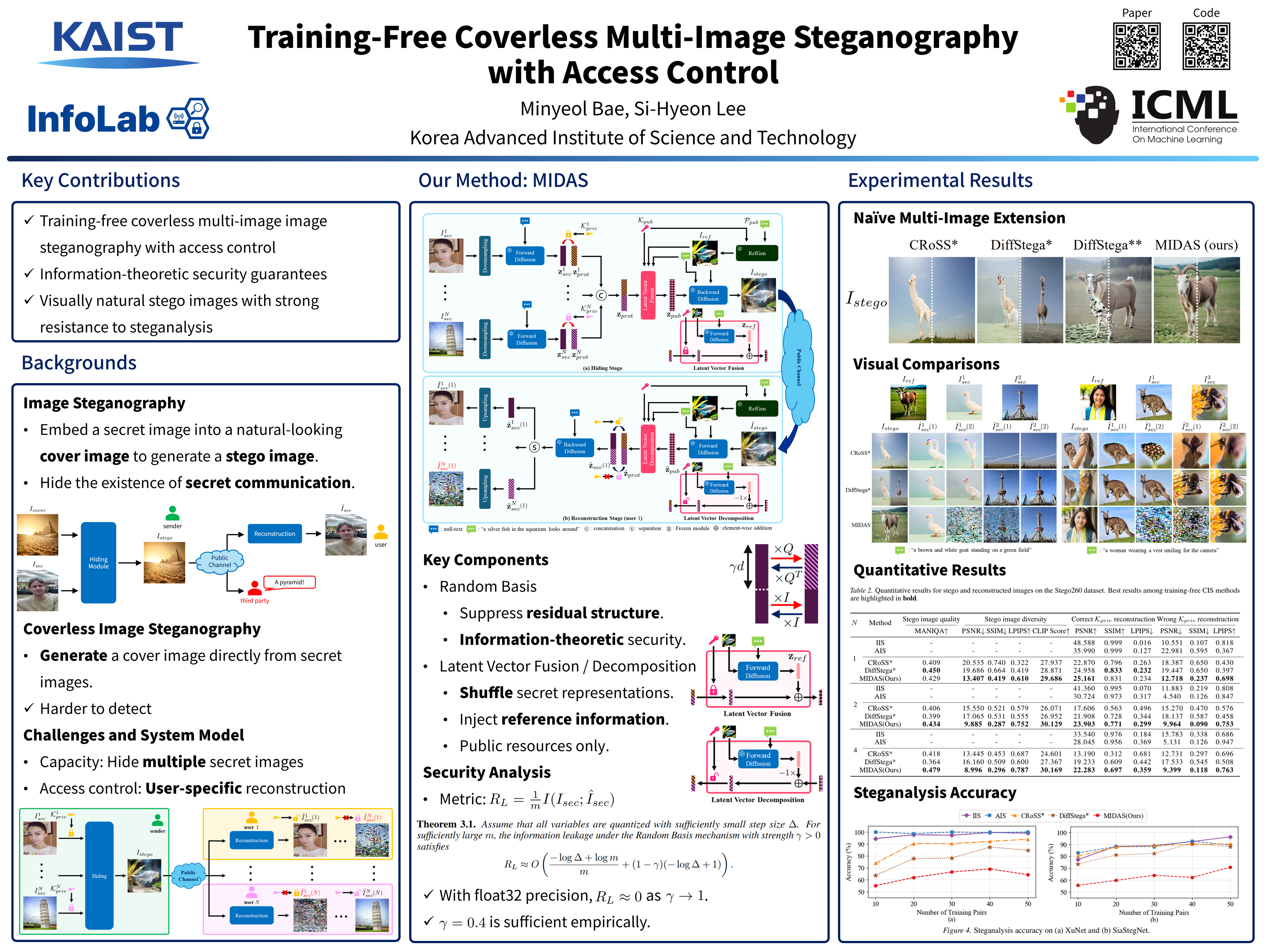
Coverless Image Steganography (CIS) hides information without explicitly modifying a cover image, providing strong imperceptibility and inherent robustness to steganalysis. However, existing CIS methods largely lack robust access control, making it difficult to selectively reveal different hidden contents to different authorized users. Such access control is critical for scalable and privacy-sensitive information hiding in multi-user settings. We propose MIDAS (Multi-Image Diffusion-based Access-controlled Steganography), a training-free diffusion-based CIS framework that enables multi-image hiding with user-specific access control via latent-level fusion. MIDAS introduces a Random Basis mechanism to suppress residual structural information, together with a theoretical analysis of information leakage, and a Latent Vector Fusion module that reshapes aggregated latents to better align with the diffusion process. Experimental results demonstrate that MIDAS consistently outperforms existing training-free CIS baselines in access control functionality, stego image quality and diversity, robustness to noise, and resistance to steganalysis, establishing a practical and scalable approach to access-controlled coverless steganography.
Lay Summary
How can we securely transmit secret information? Recently, the machine learning community has shown growing interest in techniques that generate natural-looking images containing hidden information and later reconstruct the hidden content from the generated images. However, generating realistic images while hiding large amounts of information, such as multiple secret images, remains highly challenging. A straightforward approach is to directly concatenate multiple secret images together. However, we found that this often produces unnatural and low-quality generated images with noticeable artifacts along the concatenation boundaries. To address this issue, we introduce two key components: Random Basis and Latent Vector Fusion. These modules are fully invertible while effectively mixing and reshaping the residual structural information contained in the secret images, enabling the generation of more natural and coherent images. Building on these techniques, we propose MIDAS, a training-free algorithm capable of hiding multiple secret images within a single generated image. By encrypting each secret image with a different key, MIDAS also provides an access control mechanism that allows only authorized users to recover their designated secret information. We believe this approach can be useful in a wide range of applications requiring secure and privacy-preserving communication.