
CCLRec: Consensus-driven Contrastive Learning for LLM-enhanced Graph Recommendation
Abstract
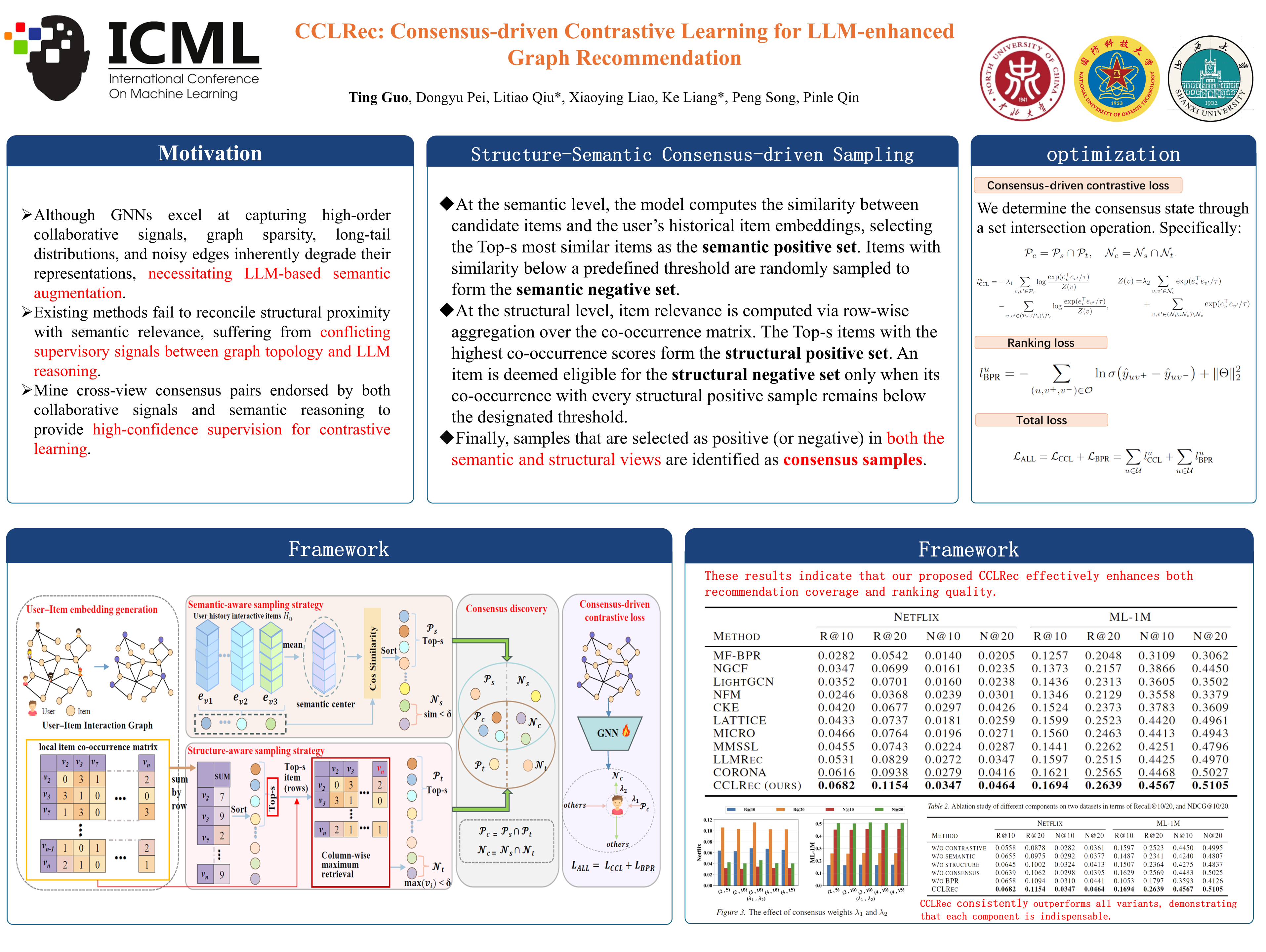
Recommendation systems seek to accurately model user preferences from a large set of candidate items. Graph neural networks (GNNs) have emerged as a dominant approach in this domain due to their ability to capture high-order user–item interactions. Recent efforts have aimed to enhance GNN-based representation learning by incorporating the semantic reasoning capabilities of large language models (LLMs). However, existing methods often process graph structural information and LLM-derived semantic knowledge separately, creating a supervisory gap between structural proximity and semantic relevance. To bridge this gap, we propose CCLRec, a consensus-driven contrastive learning framework for recommendation. CCLRec deeply integrates structural and semantic information by identifying consistent signals. Specifically, we first use an LLM to extract semantic representations of items and to sample candidate positive/negative sets in the semantic space. We then introduce a structural–semantic consensus mining strategy that computes the intersection between a node’s structural neighbors in the graph and its semantically similar items. This allows us to identify high-confidence positive pairs endorsed by both collaborative filtering patterns and LLM-based reasoning. By centering contrastive learning on these consensus pairs and applying a weight-aware reinforcement mechanism during training, CCLRec significantly amplifies the contribution of high-quality consensus features during training. Experiments across multiple public benchmarks show that CCLRec consistently outperforms state-of-the-art methods on key metrics, demonstrating the effectiveness of our consensus-aware design.
Lay Summary
Online platforms like streaming services and e-commerce apps constantly suggest movies, products, or songs to users. Traditionally, these recommendations rely on patterns from past behavior—such as what other users with similar tastes have chosen. More recently, artificial intelligence models that read and understand text have been used to analyze item descriptions, reviews, or titles to capture what items actually mean. However, these two sources of information—user behavior and item content—are often used in isolation, which can lead to suggestions that are either irrelevant or miss the bigger picture. To solve this, we introduce CCLRec, a new recommendation approach that brings these two perspectives together by looking for “consensus.” In simple terms, CCLRec asks: which items are not only frequently chosen together by users, but also described in similar ways? By focusing on items that satisfy both conditions, the system identifies higher-quality recommendations. It then uses these consensus items as reliable examples to learn from during training, reinforcing the most trustworthy signals. Experiments on several public datasets show that this consensus-driven strategy consistently produces better recommendations than existing methods. By bridging the gap between what users do and what items mean, CCLRec offers a more reliable and intuitive way to match people with things they are likely to enjoy.