
Learning Coupled Continuous-Time Latent Dynamics from Irregular Events
Abstract
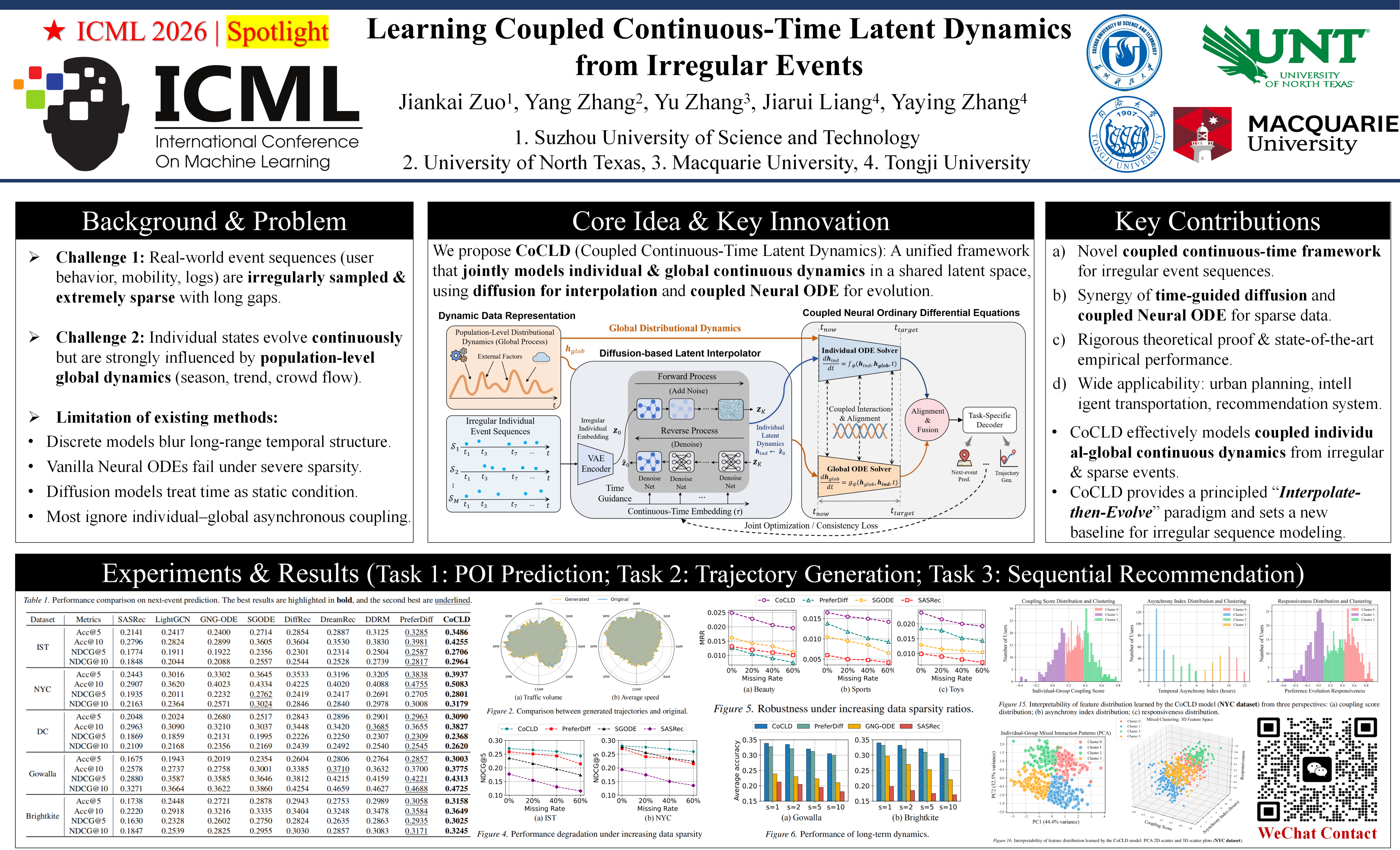
Modeling dynamic dependencies from irregularly sampled event sequences is a fundamental challenge in modern machine learning. In many real-world systems, individual-level states evolve continuously over time while being simultaneously influenced by population-level distributional dynamics. However, existing methods typically model these processes in isolation or rely on discrete-time approximations that fail to capture long-range temporal irregularities and sparse observations. This paper studies the problem of learning coupled continuous-time latent dynamics from irregular events, where individual event sequences and global distributional processes evolve asynchronously and interact over time. We propose a Coupled Continuous-Time Latent Dynamics (CoCLD) framework that jointly models individual latent dynamics and population-level distributional shifts, and aligns them in a continuous-time latent space. CoCLD integrates a Diffusion-based Latent Interpolator with Neural Ordinary Differential Equations (Neural ODEs), enabling principled interpolation, generation, and alignment of latent states across arbitrary time points. We show that the proposed coupling mechanism yields a consistent estimator of continuous-time latent dynamics under sparse and irregular observations. Empirical evaluations demonstrate that CoCLD effectively captures dynamic dependencies and generalizes across diverse tasks, including next-event prediction, mobility trajectory generation, and sequential behavior modeling. These results suggest that learning coupled continuous-time latent dynamics provides a powerful paradigm for irregular event sequence modeling.