
TPV: Parameter Perturbations Through the Lens of Test Prediction Variance
Abstract
Lay Summary
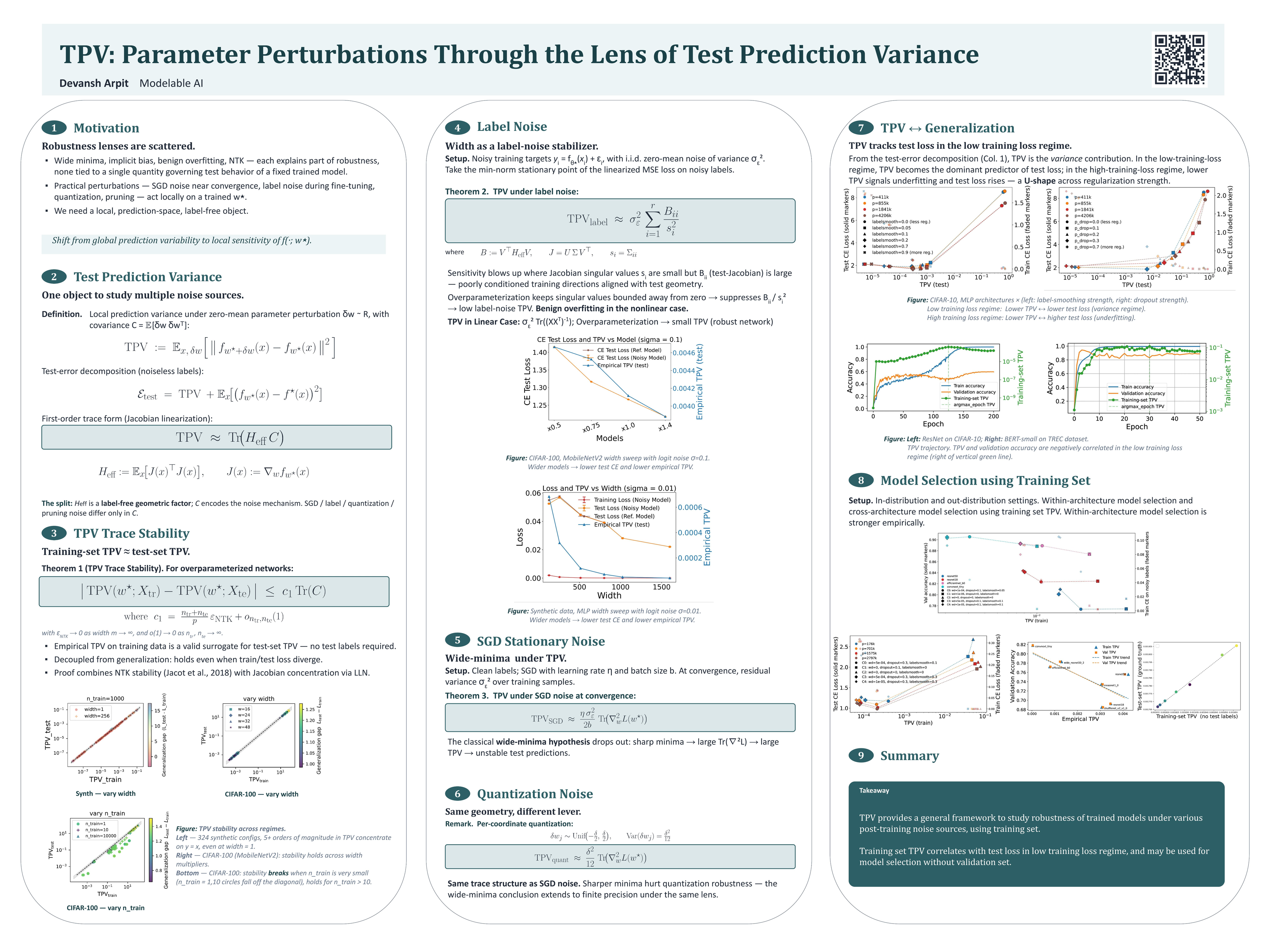
When a trained AI model is deployed in the real world, small disturbances inevitably nudge its internal settings — noise during training, rounded numbers from low-precision hardware, mislabeled examples it gets fine-tuned on, or parts of the network being removed to make it run faster. Each of these has traditionally been studied separately, with its own theory and tools, making it hard to see what they have in common or to predict which trained models will hold up best. We introduce a single quantity, called Test Prediction Variance (TPV), that measures how much a model's outputs change when its internal settings are slightly disturbed. We show mathematically that all four disturbance types act through the same underlying mechanism, just with different fingerprints, and we prove that TPV can be estimated using only the model's training data — no test data or true labels required. This gives practitioners a single tool to compare candidate models before deployment: predicting which will survive label errors during fine-tuning, deciding which parts of a network are safe to remove, or picking the most robust training recipe — all without needing held-out labeled data, which is often expensive or unavailable.