
TranX-Adapter: Bridging Artifacts and Semantics within MLLMs for Robust AI-generated Image Detection
Abstract
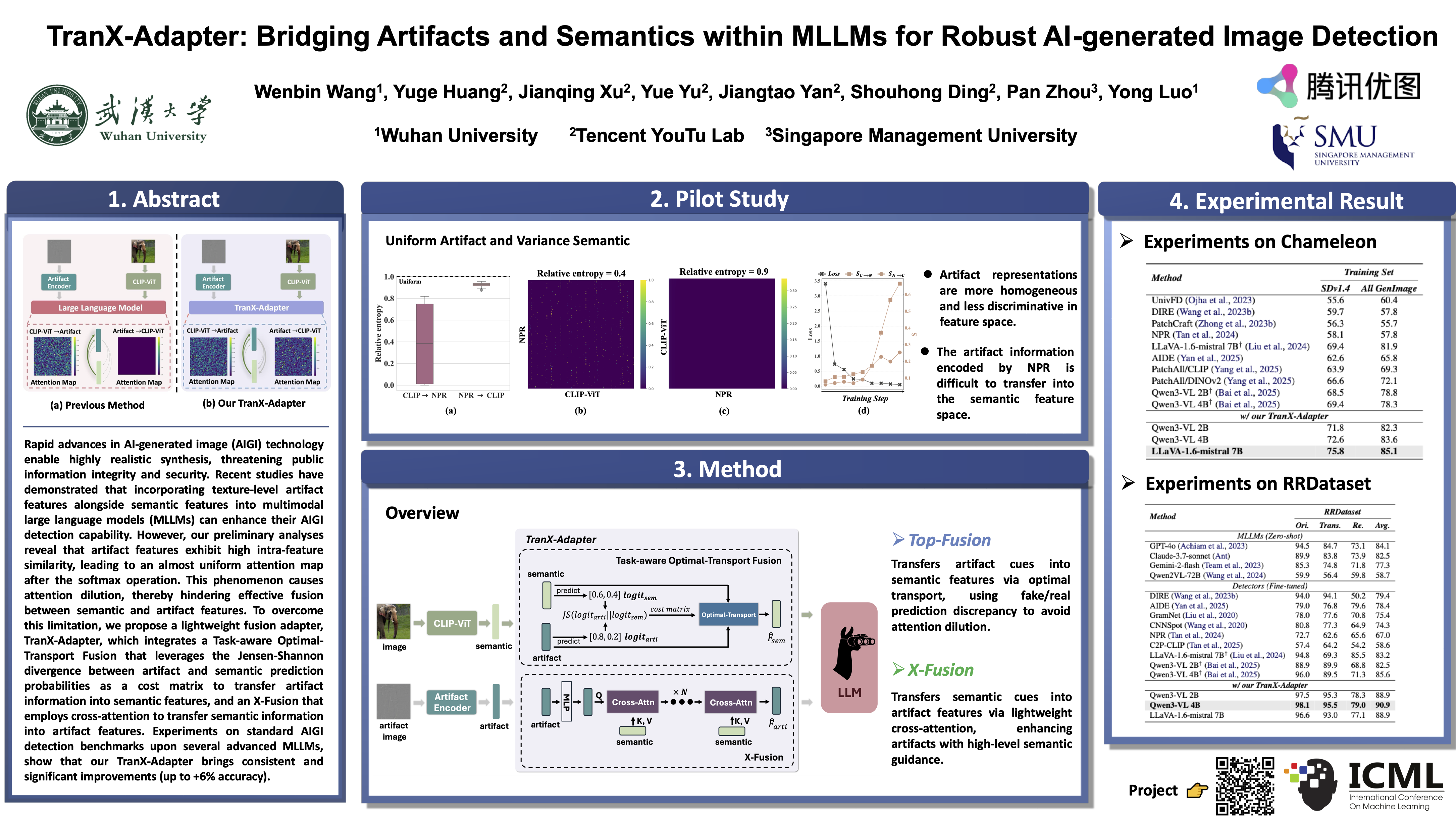
Rapid advances in AI-generated image (AIGI) technology enable highly realistic synthesis, threatening public information integrity and security. Recent studies have demonstrated that incorporating texture-level artifact features alongside semantic features into multimodal large language models (MLLMs) can enhance their AIGI detection capability. However, our preliminary analyses reveal that artifact features exhibit high intra-feature similarity, leading to an almost uniform attention map after the softmax operation. This phenomenon causes attention dilution, thereby hindering effective fusion between semantic and artifact features. To overcome this limitation, we propose a lightweight fusion adapter, TranX-Adapter, which integrates a Task-aware Optimal-Transport Fusion that leverages the Jensen-Shannon divergence between artifact and semantic prediction probabilities as a cost matrix to transfer artifact information into semantic features, and an X-Fusion that employs cross-attention to transfer semantic information into artifact features. Experiments on standard AIGI detection benchmarks upon several advanced MLLMs, show that our TranX-Adapter brings consistent and significant improvements (up to +6% accuracy). Code can be found in supplementary material.
Lay Summary
AI-generated images are becoming increasingly realistic, making it harder to tell whether an image is real or synthetic. Existing detectors often look at either high-level visual meaning, such as unnatural objects, or low-level image traces, such as subtle texture patterns left by generators. We found that simply combining these two signals inside a multimodal large language model does not work well, because the low-level artifact features are often too similar to each other and make the model’s attention spread almost uniformly. We propose TranX-Adapter, a lightweight module that helps the model better connect image artifacts with visual meaning. It first highlights places where artifact-based and semantic-based judgments disagree, then transfers useful artifact information into the semantic representation. It also injects semantic context back into the artifact features, so low-level traces can be interpreted with scene-level understanding. Across several AI-generated image detection benchmarks, TranX-Adapter improves robustness and generalization while requiring far fewer trainable parameters than full model fine-tuning. This can help build more reliable tools for identifying synthetic visual content and reducing the spread of misleading images.