
Modeling Hierarchical Thinking in Large Reasoning Models
G M Shahariar ⋅ Erfan Shayegani ⋅ Ali Nazari ⋅ Nael Abu-Ghazaleh
Abstract
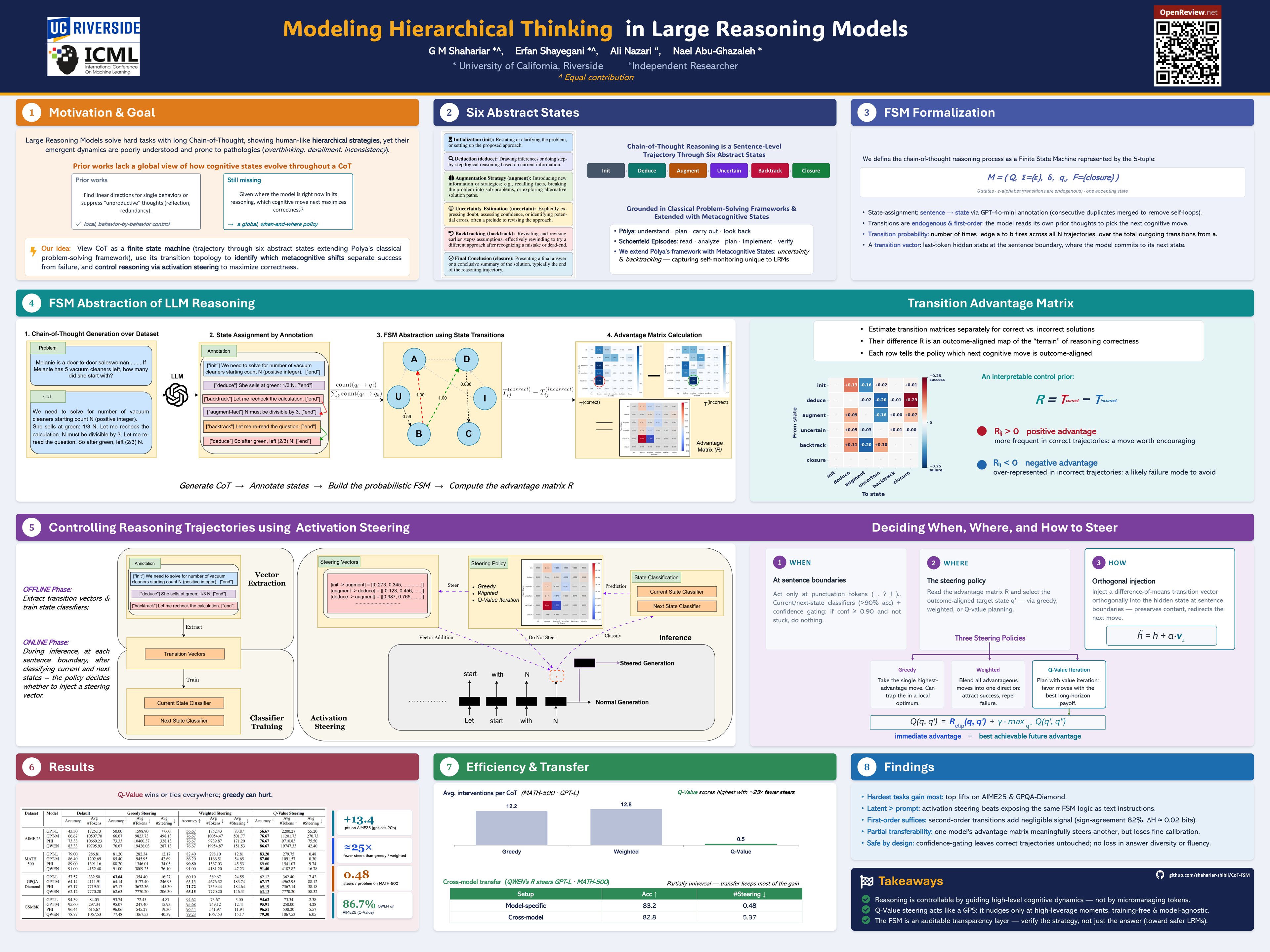
Large Reasoning Models (LRMs) solve complex tasks by generating long Chain-of-Thought (CoT) sequences; however, the emergent dynamics governing reasoning trajectories are not well understood and can lead to inconsistencies and reasoning pathologies. In this work, we propose to approximate LRM's emerging hierarchical reasoning dynamics as a trajectory within a Finite State Machine (FSM) transitioning among six abstract cognitive states. We demonstrate that these states and transitions can be captured in the latent state of the model. We believe that this representation can have different applications in the interpretability and optimization of LRM models. For example, by analyzing the topology of these transitions, we identify statistical shifts in reasoning strategies that help identify effective reasoning chains from those that fail. To illustrate these potential advantages, we propose $Q$-Value guided steering, a training-free inference-time control method that treats reasoning as a planning problem. We estimate the long-horizon utility of state transitions and apply sparse, orthogonal activation steering at sentence boundaries to align the CoT generation with optimal reasoning policies. Experiments across four benchmarks (AIME25, MATH-500, GSM8k, and GPQA Diamond) using three state-of-the-art open reasoning models demonstrate that $Q$-Value steering policy achieves significant performance gains with "surgical'' efficiency, often requiring $25\times$ fewer interventions than greedy and weighted baselines, which suggests that reasoning can be effectively controlled by guiding high-level cognitive dynamics rather than micro-managing token generation.
Video
Chat is not available.
Successful Page Load