
Denoising without Diffusion: Fixed-Noise Denoiser Anomaly Detection in Tabular Data
Abstract
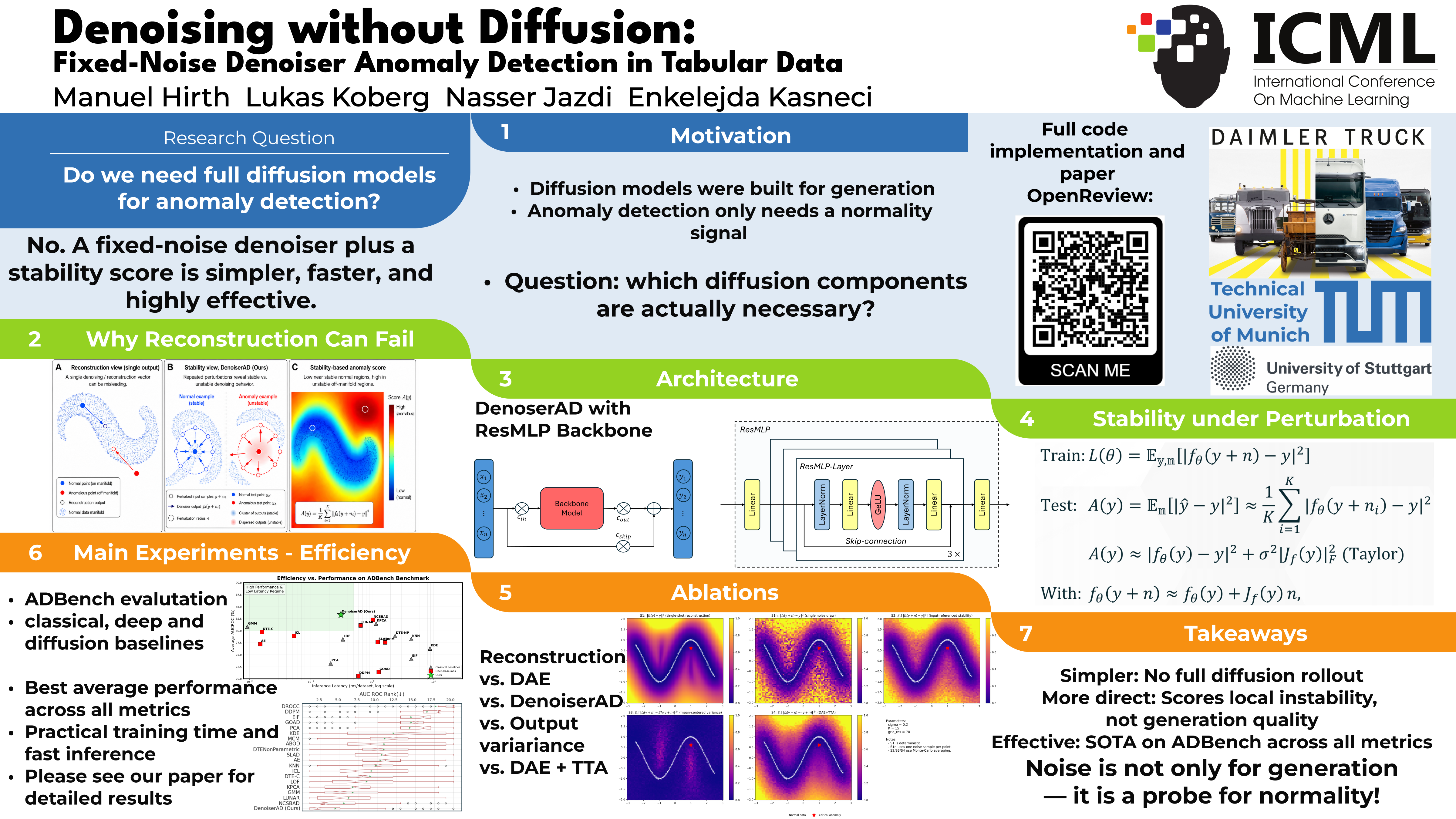
While diffusion models have advanced anomaly detection, their reliance on multi-step noise schedules introduces significant computational complexity. In this paper, we demonstrate that the generative capability of diffusion is not required for tabular anomaly detection. We revisit core principles of denoising without targeting data generation and present a deep-learning approach that streamlines these objectives into a fixed-noise formulation. Unlike denoising autoencoders that rely on reconstruction error, our method utilizes a preconditioning with an explicit linear reference channel. We train a self-supervised fixed-noise denoising predictor and derive an anomaly score from the expected deviation under repeated perturbations, yielding a stability proxy rather than merely measuring distance to the data manifold. On the well-established ADBench benchmark, our method achieves state-of-the-art performance with improvements over existing baselines of 1.22\% in AUCROC and 1.13\% in AUCPR, the most informative and threshold-independent metrics. Our approach emphasizes structural simplicity and efficiency, demonstrating that a single-step, stability-based objective outperforms complex generative schedules.
Lay Summary
Many real-world problems require us to find unusual cases in data. For example, a company may want to detect a faulty machine, a bank may want to find suspicious transactions, or a doctor may want to notice unusual measurements. This task is called anomaly detection. It is difficult because unusual cases are usually rare. In many situations, we have many examples of normal behavior, but only few reliable examples of what can go wrong. Recent machine learning methods often try to solve this problem by learning what normal data looks like. Some of these methods are inspired by diffusion models, which are powerful models that use random noise during learning. These models were originally developed for tasks such as generating images. They usually work through many small steps: data is gradually made noisy, and the model learns how to remove this noise again. While this idea is powerful, the full process can be complicated and expensive. In this paper, we ask a simple question: do we really need this full multi-step process for anomaly detection in data tables? Our answer is no. Instead, we propose a simpler method. The model is trained to understand how normal data behaves when a small amount of random noise is added. Later, when we want to check a new data point, we slightly disturb it several times and observe how the model reacts. The key idea is stability. If the data point is normal, the model’s answers should be relatively stable and consistent. If the data point is unusual, the model is more likely to react in an unstable or inconsistent way. We use this instability as a signal that the data point may be anomalous. This means that our method does not try to generate new data. It also does not need the full complexity of diffusion models. Instead, it uses noise as a practical test: does this data point behave like normal data when it is slightly disturbed? Our results show that this simpler approach works very well on a widely used anomaly detection benchmark. Overall, the paper shows that for anomaly detection, noise can be useful not mainly for generating new samples, but for checking whether data follows normal behavior. Our method is simpler than diffusion-based approaches, more efficient to use, and achieves state-of-the-art performance on a widely used anomaly detection benchmark.