
BuildArena: A Physics-Aligned Interactive Benchmark of LLMs for Engineering Construction
Abstract
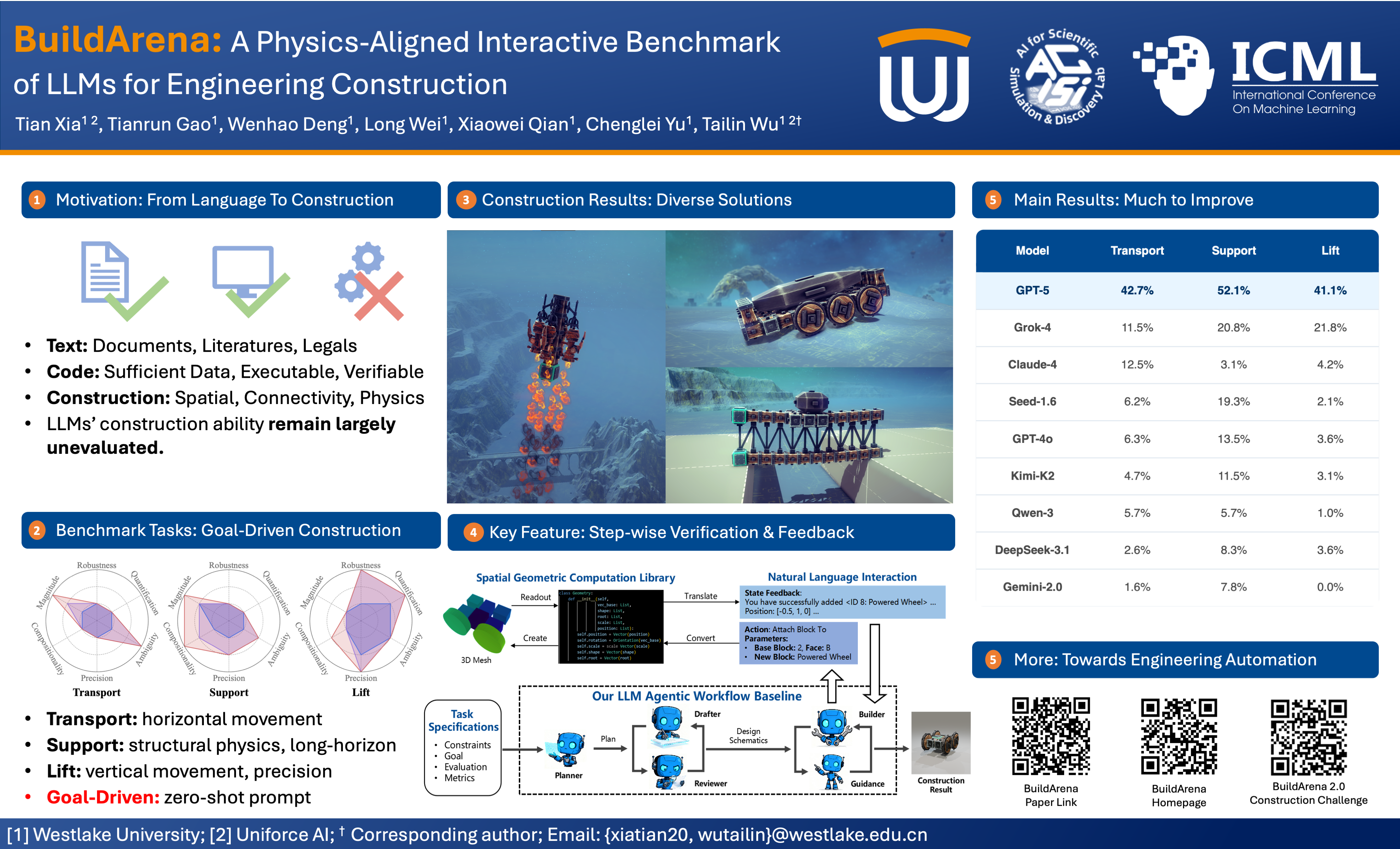
Engineering construction automation aims to transform natural language specifications into physically viable structures, requiring complex integrated reasoning under strict physical constraints. While modern LLMs possess broad knowledge and strong reasoning capabilities that make them promising candidates for this domain, their construction competencies remain largely unevaluated. To address this gap, we introduce BuildArena, the first physics-aligned interactive benchmark designed for language-driven engineering construction. Technically, it contributes to the community in two aspects: (1) an extendable task design strategy spanning static and dynamic mechanics across multiple difficulty tiers; (2) a 3D Spatial Geometric Computation Library for supporting construction based on language instructions. On nine frontier LLMs and three additional open-weight models, BuildArena comprehensively evaluates their capabilities for language-driven and physics-grounded construction automation. We release the code at https://github.com/AI4Science-WestlakeU/BuildArena to benefit construction automation in engineering applications.
Lay Summary
Engineering tasks like designing bridges, vehicles, and rockets require complex spatial reasoning and an understanding of physics. While AI language models have shown impressive abilities in writing, coding, and reasoning, it remains unclear whether they can actually design structures that work under real physical conditions. We created BuildArena, a benchmark where LLMs receive plain-language instructions and construct 3D structures inside a physics simulator. The benchmark spans tasks of increasing difficulty across both static structures (like bridges) and moving objects (like vehicles and rockets), and automatically tests whether each design functions correctly under realistic physics. Our evaluation of twelve AI models reveals that while some can produce surprisingly sophisticated structures including designs resembling real-world engineering solutions like truss bridges, significant capability gaps remain, especially for more complex tasks. BuildArena gives the research community a standardized way to measure and improve LLMs' ability to turn language into physically viable constructions, an important step toward automating parts of the engineering design process.