
CALM Before the STORM: Unlocking Native Reasoning for Optimization Modeling
Abstract
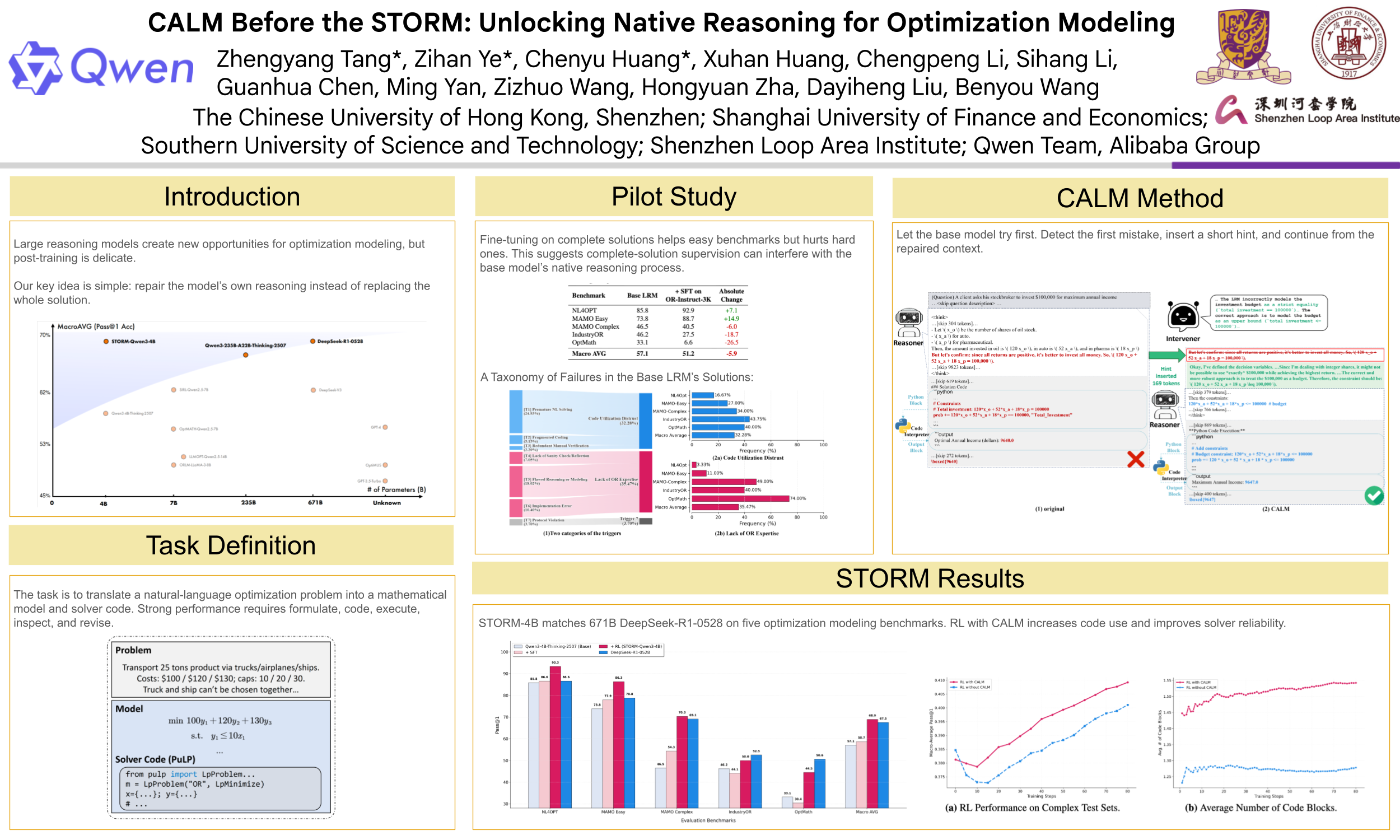
Large Reasoning Models (LRMs) create new opportunities for automating optimization modeling, but they also make post-training more delicate. In this task, strong performance often requires the model to formulate the problem, write solver code, run it, inspect the output, and revise when needed. We show that directly fine-tuning LRMs on already written-out Operations Research (OR) solutions can improve easier cases while hurting harder ones, suggesting that this training signal can interfere with the model's own way of solving the task. We therefore propose CALM (Corrective Adaptation with Lightweight Modification), which lets the base LRM attempt the problem first, then inserts a short hint at the first detected mistake and lets the model continue from there. These hints modify fewer than 2.6\% of generated tokens. The corrected solutions are used for supervised fine-tuning and then reinforcement learning, producing STORM, a 4B optimization-modeling specialist that reaches 68.9\% macro-average accuracy across five benchmarks and matches 671B DeepSeek-R1-0528. Under a matched hard-benchmark control, CALM also yields stronger final RL performance than direct distillation baselines that train on complete teacher-generated solutions from much stronger models. Overall, for this task, local repair of the base model's own solution is more effective than full teacher-solution replacement. Code and models are available at \url{https://github.com/tangzhy/STORM}.
Lay Summary
Optimization modeling is the task of turning problems such as scheduling, routing, and resource allocation into mathematical models and computer programs that can find the best solution. New AI reasoning models can help with this, but we found that training them on complete solutions can hurt performance on harder problems. This seems to happen because the training overwrites the model's own way of working through a problem. Instead, we let the model try first, add a short hint at the first mistake, and let it continue. These hints change only a small part of the original solution, but they are often enough to keep the model on track. Using this idea, we built STORM, a compact system for optimization modeling. In our evaluations, it outperformed standard training methods and matched the performance of a much larger model. This suggests that small, targeted corrections can be a better way to train AI systems for complex optimization tasks. Such tools could make optimization expertise more accessible, though human oversight remains important in high-stakes settings.