
Test-Time Reinforcement Learning for Flow Matching
Abstract
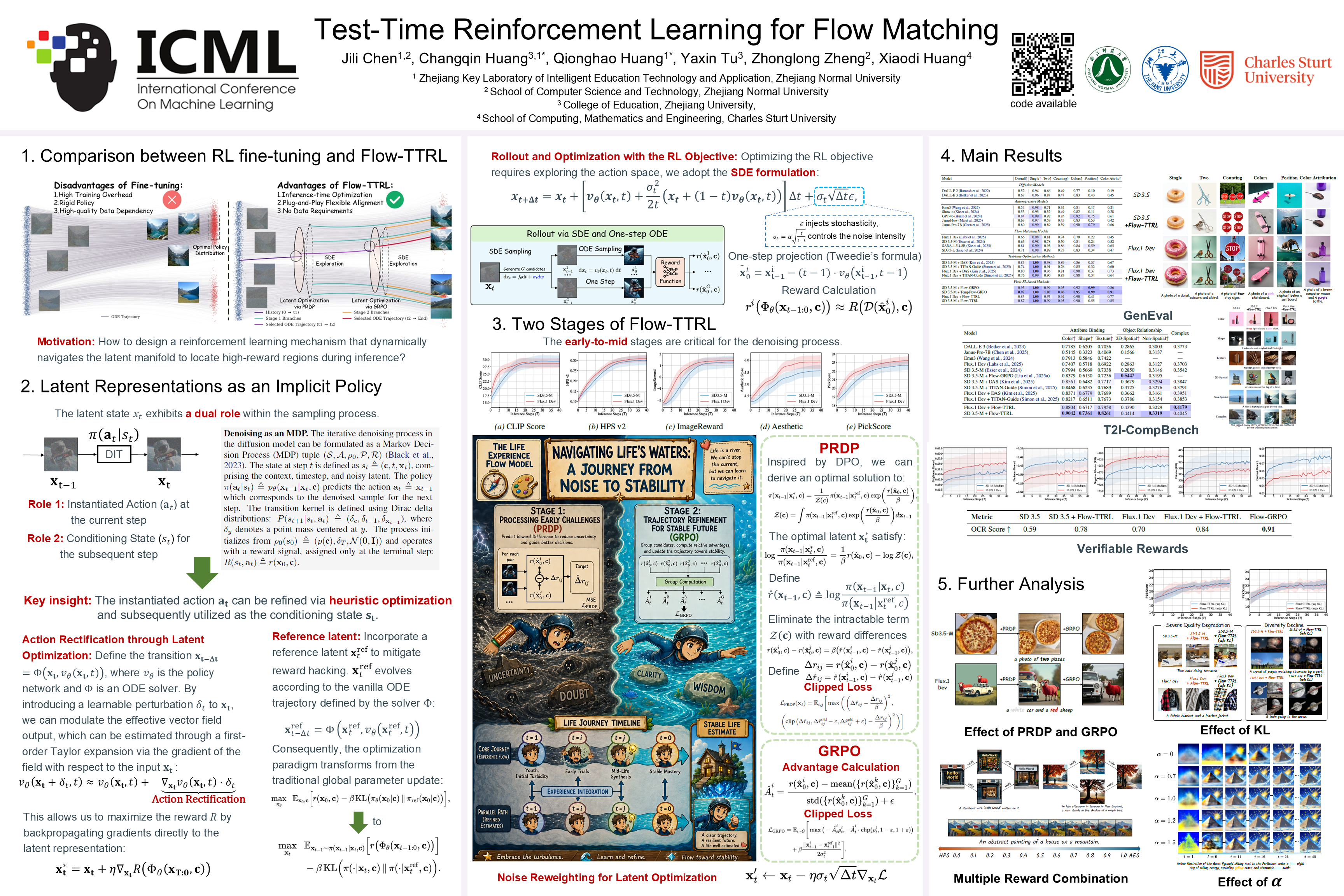
Flow-matching has emerged as a leading framework for high-fidelity text-to-image generation. However, its alignment with human preferences through RL is often hindered by substantial computational overhead. In this paper, we introduce Flow-TTRL, the first test-time reinforcement learning framework that achieves alignment on the fly. Our approach reinterprets intermediate latent representations as an implicit policy and utilizes SDE-based rollouts to explore high-reward trajectories within the learned vector field. Specifically, we propose a two-stage optimization strategy: Proximal Reward Difference Prediction (PRDP) ensures structural stability in high-noise regimes through pairwise reward regression, while Group Relative Policy Optimization (GRPO) refines fine-grained aesthetic details by maximizing relative advantages within sampled candidate groups. Experimental results show that Flow-TTRL significantly boosts aesthetic quality, text-image alignment, and human preference across diverse backbones. On the GenEval benchmark, Flow-TTRL elevates the accuracy of SD 3.5-Medium from 63\% to 87\% and Flux.1 Dev from 66\% to 83\%. Furthermore, our framework achieves an average gain of 15\% to 20\% across T2I-CompBench metrics, delivering performance comparable to state-of-the-art RL-based fine-tuning methods without the need for additional fine-tuning. Our code is available at ~\url{https://github.com/TheShy-Dream/Flow-TTRL}.
Lay Summary
Generating high quality images from text usually requires massive computing power and extensive training to align AI outputs with human preferences. We introduced a new framework called Flow-TTRL that improves image quality and accuracy instantly while the image is being created. This method works without any additional training or expensive hardware. By intelligently refining visual details during the generation process, our approach helps AI models follow complex prompts more precisely and produce more artistic results. This makes existing image generation tools much more reliable and efficient by providing a faster way to connect AI creativity with human expectations.