
Is Your LLM Overcharging You? Tokenization, Transparency, and Incentives
Ander Artola Velasco ⋅ Stratis Tsirtsis ⋅ Nastaran Okati ⋅ Manuel Gomez-Rodriguez
Abstract
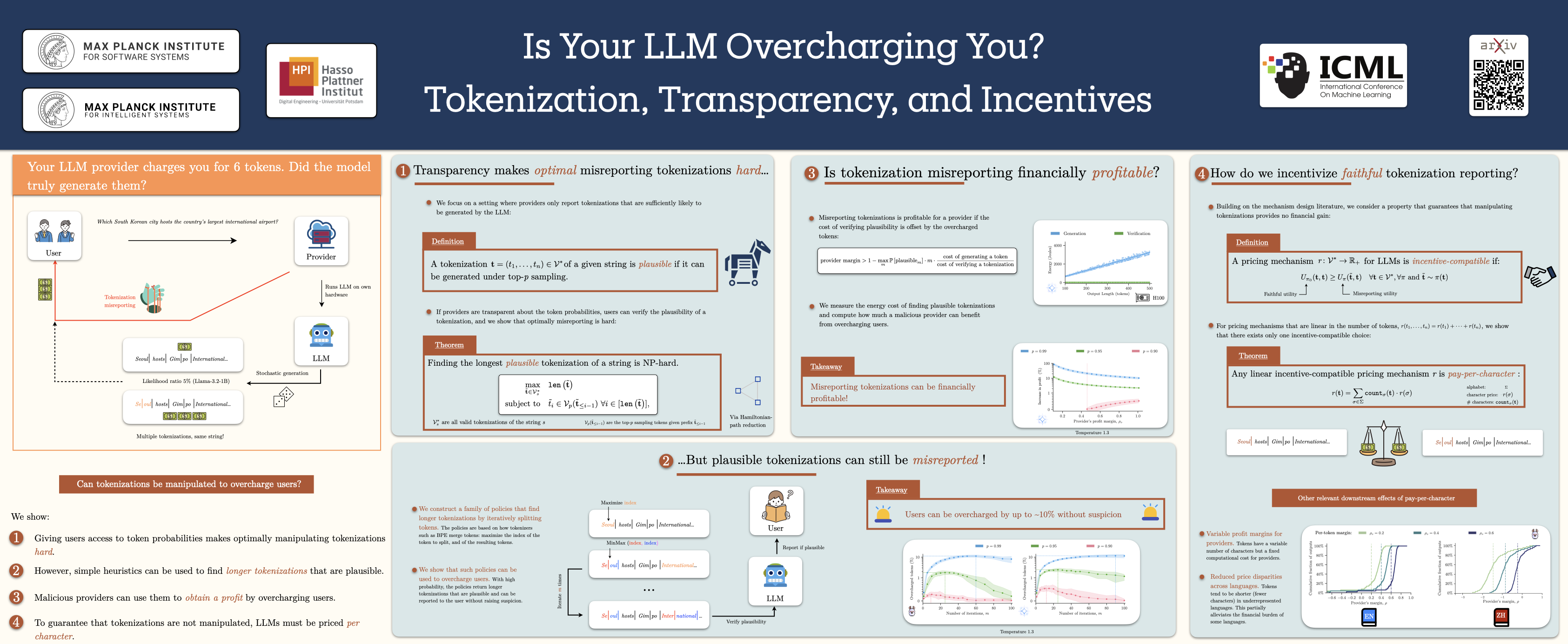
State-of-the-art large language models require specialized hardware and substantial energy to operate. Consequently, cloud-based services that provide access to these models have become very popular. In these services, the price users pay depends on the number of tokens a model uses to generate an output–they pay a fixed price per token. In this work, we show that this pricing mechanism creates a financial incentive for providers to strategize and misreport the (number of) tokens a model used to generate an output, and users cannot prove, or even know, whether a provider is overcharging them. However, we also show that, if an unfaithful provider is obliged to be transparent about the generative process used by the model, misreporting optimally without raising suspicion is hard. Nevertheless, as a proof-of-concept, we develop an efficient heuristic algorithm that allows providers to significantly overcharge users without raising suspicion. Crucially, the cost of running the algorithm is lower than the additional revenue from overcharging users, highlighting the vulnerability of users under the current pay-per-token pricing mechanism. Further, we show that, to eliminate the financial incentive to strategize, a pricing mechanism must price tokens linearly on their character count. While this makes a provider's profit margin vary across tokens, we introduce a simple prescription that allows a provider to maintain their average profit margin when transitioning to an incentive-compatible pricing mechanism. To complement our theoretical results, we conduct experiments with large language models from the $\texttt{Llama}$, $\texttt{Gemma}$ and $\texttt{Ministral}$ families, and prompts from a popular benchmarking platform.
Video
Chat is not available.
Successful Page Load