
Minimizing Upper Confidence Bounds: A Data-Driven Framework for Stochastic Programming
Abstract
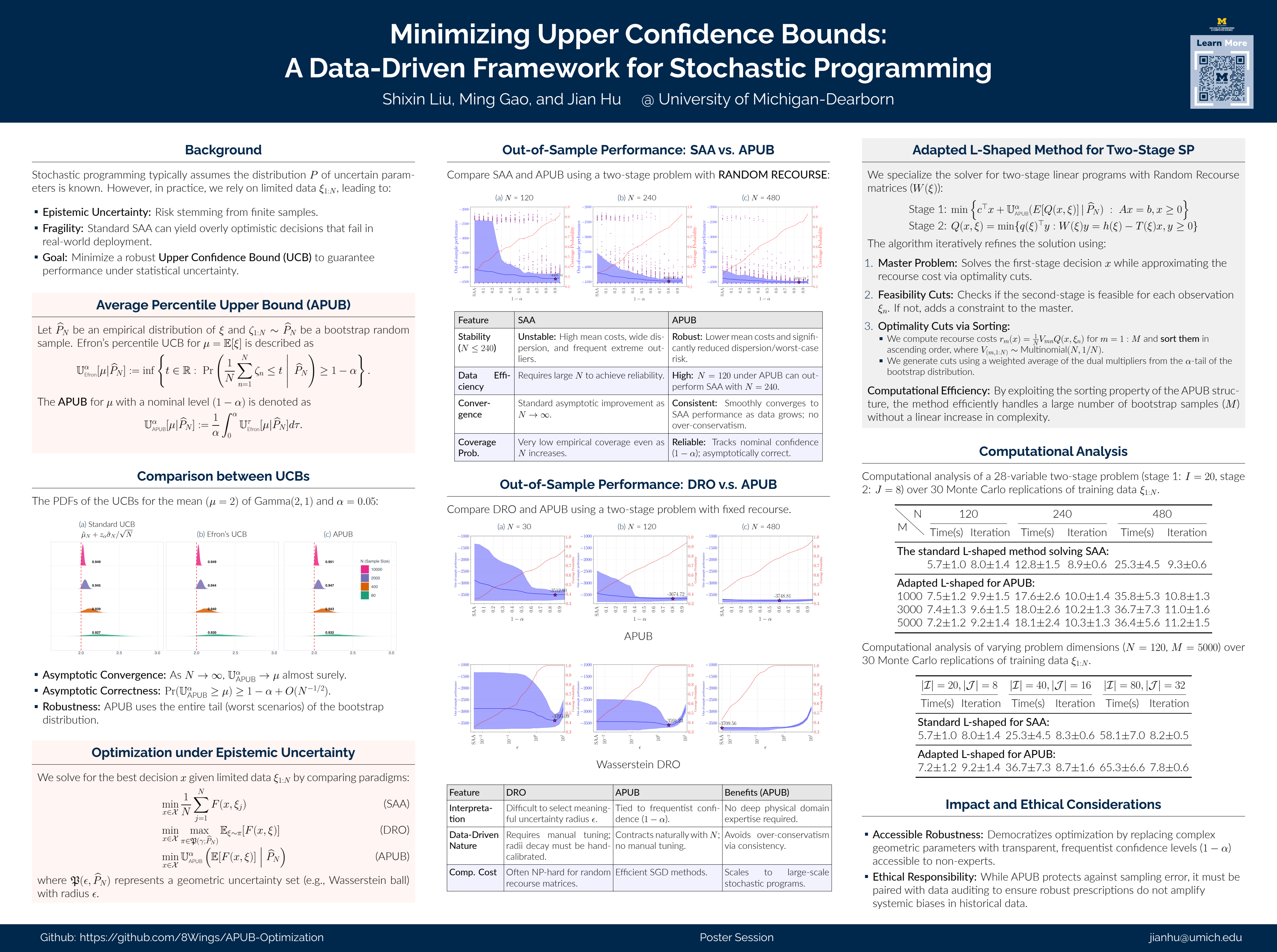
Stochastic programming is often challenged by epistemic uncertainty, where critical probability distributions are poorly characterized or unknown due to a lack of data. To address this, we pioneer a novel framework for stochastic programming that minimizes an upper confidence bound (UCB) on the expected random cost, acting as a robustness-seeking strategy. Our central contribution is the Average Percentile Upper Bound (APUB), a new statistical construct that serves as both a statistically rigorous upper bound for population means and an approximate risk metric for sample means. We rigorously prove the asymptotic correctness and consistency of APUB, establishing a reliable foundation for data-driven decision-making. We also develop practical solution methods, including a bootstrap sampling approximation method and an L-shaped method, to solve APUB optimization problems, with a specific focus on two-stage linear stochastic optimization with random recourse. Empirical demonstrations on a two-stage product mix problem reveal the significant benefits of our APUB optimization framework, which fortifies the process against epistemic uncertainty while reinforcing key decision-making attributes like reliability and consistency. The implementation and source code are available at https://github.com/8Wings/APUB-Optimization.
Lay Summary
Problem: Many real-world decisions—like managing hospital staffing or energy grids—rely on predicting the future using historical data. However, when data is scarce, these predictions can be slightly off. Traditional methods often ignore this uncertainty about the uncertainty, leading to decisions that look good on paper but fail in reality because they were too optimistic. Solution: We developed a new mathematical framework called APUB (Average Percentile Upper Bound). Instead of just aiming for the average outcome, our method automatically builds a safety buffer. It looks at the range of possible errors in our data and chooses a strategy that remains reliable even if our initial predictions were slightly wrong. It’s like planning a commute not just by the average travel time, but by accounting for the possibility of a random delay. Impact: We proved that our method is mathematically sound and becomes more precise as more data becomes available. In tests involving complex production planning, our approach consistently outperformed standard methods, preventing costly failures when data was limited. This provides a more reliable toolkit for researchers and industries making high-stakes decisions in unpredictable environments.