
Graph-Link: Bridging the Semantic-Structural Gap in Text-to-SQL via Constrained Subgraph Induction
Abstract
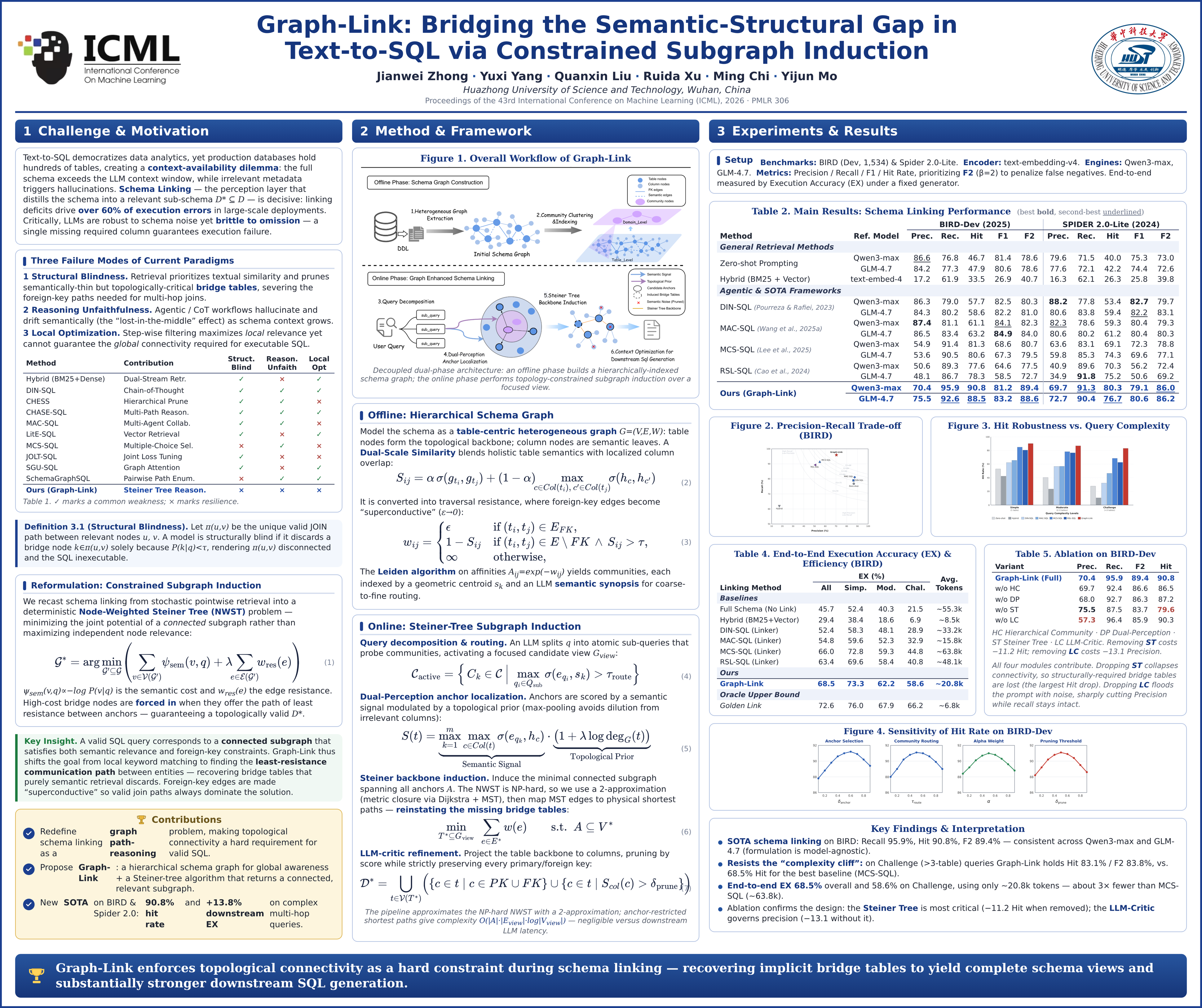
Schema Linking serves as the foundational perception layer in Text-to-SQL, tasked with grounding natural language queries into relevant schema elements. However, existing retrieval-based approaches suffer from a critical structural blindness: by prioritizing elements with high textual similarity, they inadvertently prune semantically-thin but topologically-critical bridge tables, thereby severing relational pathways necessary for multi-hop joins. To bridge this gap, we propose Graph-Link, a novel framework that reformulates schema linking from an independent retrieval task into a constrained subgraph induction problem. We argue that generating executable SQL necessitates a connected subgraph that satisfies both semantic relevance and structural constraints. Accordingly, Graph-Link employs a hierarchical schema graph to model the search space across multiple granularities, and then applies a Steiner-tree-based optimization for subgraph induction that guarantees the topological connectivity while maximizing the signal-to-noise ratio for downstream LLMs. Extensive experiments on BIRD and Spider 2.0 demonstrate that Graph-Link achieves state-of-the-art schema linking performance, improving recall and hit rates by up to 7.0\% over competitive baselines, and boosts downstream SQL generation accuracy on complex queries by 13.8\%.
Lay Summary
Imagine asking a database a complicated question, like “What was the total revenue from electronics bought by European customers last year?” To answer correctly, the system needs to connect several tables (customers, orders, products, etc.) using relationships hidden in the database. Current methods often pick only the tables that sound relevant, but they miss crucial “bridge” tables that have no obvious keywords—so the final SQL query fails. Our approach, Graph-Link, views the database as a map. Instead of just grabbing semantically similar tables, it finds the shortest connected path that links all the necessary pieces, like a navigation system. This guarantees that the chosen tables can actually be joined together, producing a working SQL query. Experiments show Graph-Link recovers missing bridge tables far better than existing methods, especially for complex questions, and improves execution accuracy by over 13% on the hardest queries.