
Asymmetric Perturbation in Solving Bilinear Saddle-Point Optimization
Abstract
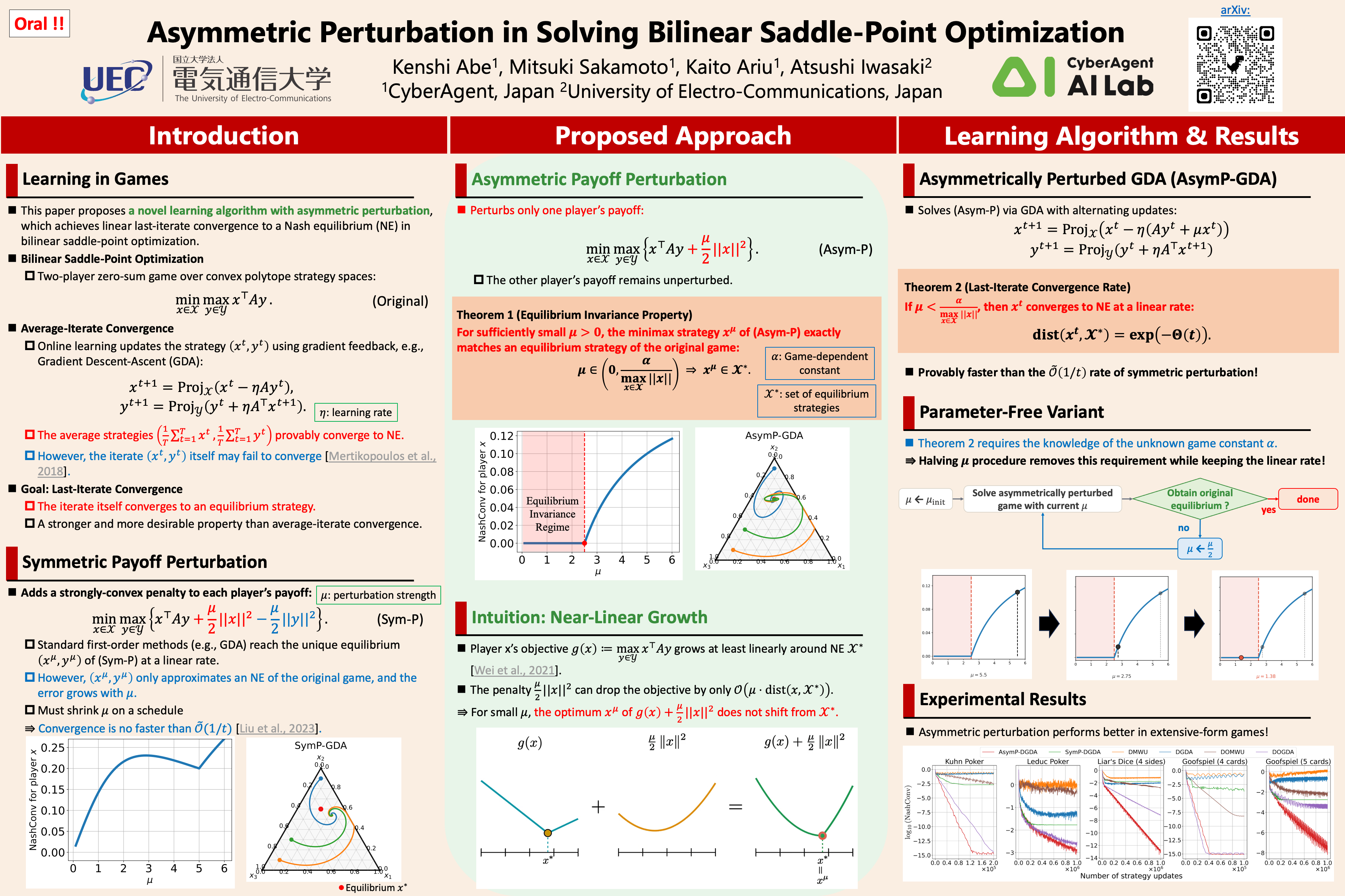
This paper proposes an asymmetric perturbation technique for solving bilinear saddle-point optimization problems, commonly arising in minimax problems, game theory, and constrained optimization. Perturbing payoffs or values is known to be effective in stabilizing learning dynamics and equilibrium computation. However, it requires decreasing perturbation magnitudes to ensure convergence to an equilibrium in the underlying game, resulting in a slower rate. To overcome this, we introduce an asymmetric perturbation approach, where only one player's payoff function is perturbed. Exploiting the near-linear structure of bilinear problems, we show that, for a sufficiently small perturbation, the equilibrium strategy of the asymmetrically perturbed game coincides with an equilibrium strategy of the original game. Building on this property, we develop a perturbation-based learning algorithm with a linear last-iterate convergence rate to an equilibrium strategy of the original game, and we further show how to construct a parameter-free procedure that retains a linear rate. Finally, we empirically demonstrate fast convergence toward equilibria in both normal-form and extensive-form games.