
scDEBART: Predicting in silico Single-Cell Perturbation Responses via Large-Scale Differential Expression Learning
Abstract
Lay Summary
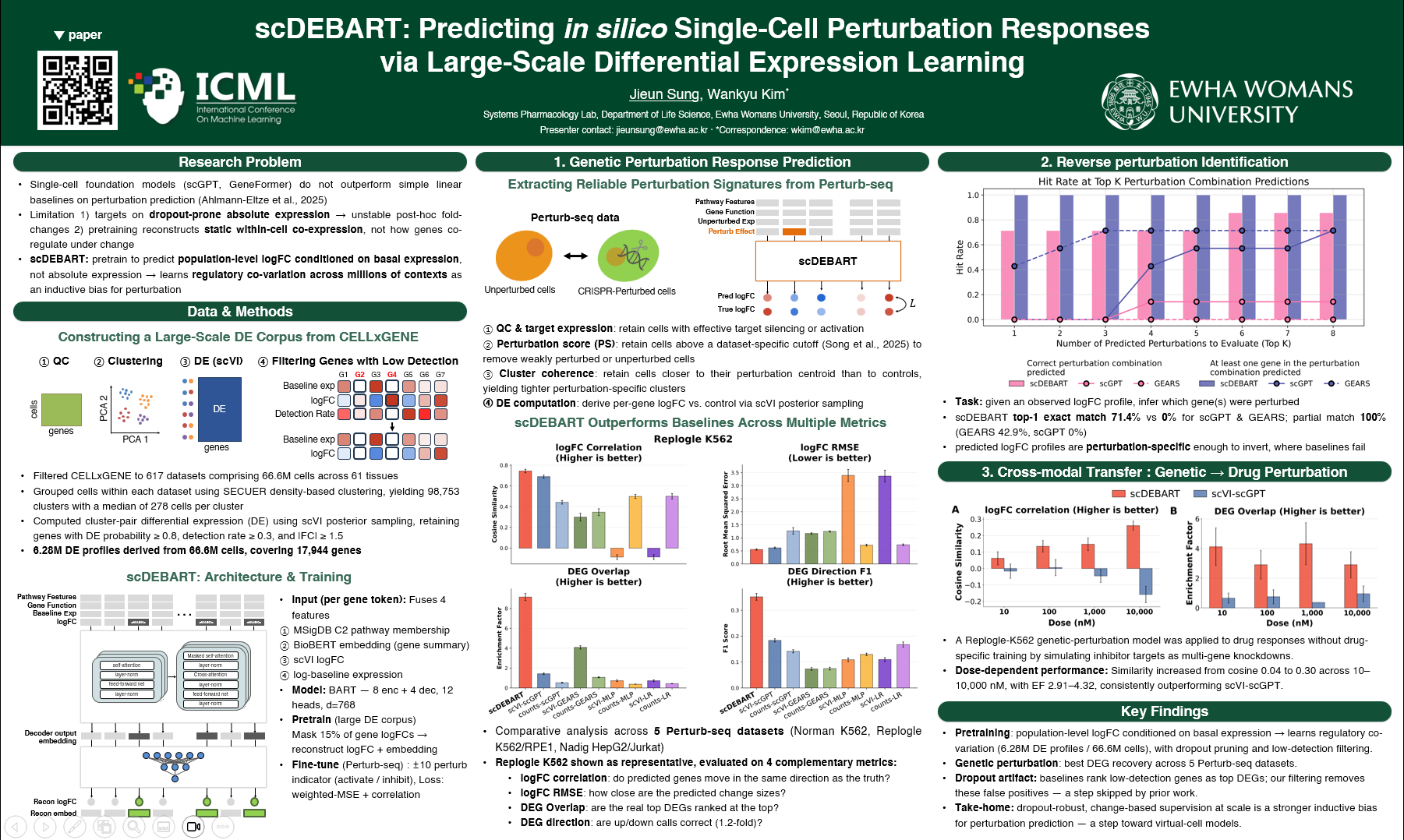
When a gene in a cell is switched on or off, hundreds of other genes react in response. Predicting these chain reactions computationally would be a powerful tool for discovering new drugs and understanding disease — but current AI models surprisingly struggle to outperform simple statistical methods on this task. We asked why, and identified a key flaw: these models are trained to predict how active each gene is, rather than how much it changes. Gene activity measurements from single cells are extremely noisy — many genes appear silent due to measurement limitations, not biology. When models learn from this noise, their predictions of change are distorted. Our approach, scDEBART, instead learns directly from gene changes across millions of cell comparisons, using a statistical cleaning step to filter out measurement noise before training. Tested across five large genetic perturbation experiments, scDEBART recovered the truly affected genes 4–7 times more accurately than existing models, and could even identify which gene was experimentally altered just by observing the resulting pattern of changes — a task prior models essentially failed.