
Information Flow Reveals When to Trust Language Models
Abstract
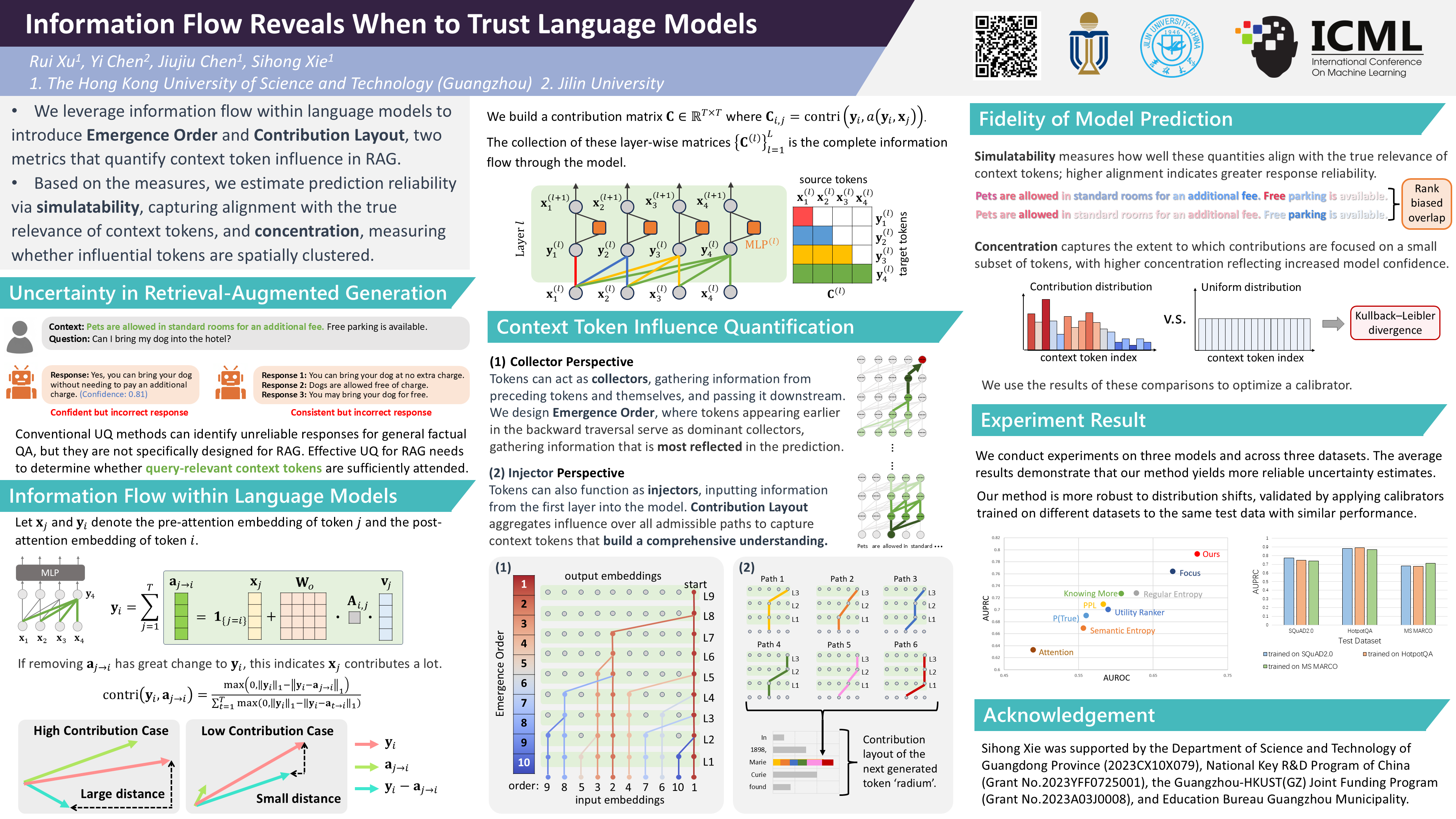
In retrieval-augmented generation, language models can generate incorrect responses if they fail to utilize query-relevant content from the retrieved evidence. This shifts the focus of uncertainty quantification (UQ) toward assessing contextual grounding, i.e., whether predictions are supported by query-relevant tokens. Recent UQ methods unpack language models to characterize how inputs are processed. Nevertheless, these methods focus on a few layers and overlook the whole progressive propagation within the model, thereby failing to fully capture the grounding dynamics essential for reliable uncertainty estimation. We use information flow to build a layer-wise trace that reveals each context token’s contribution to the output, providing an interpretable basis for assessing reliability. From this analysis, we introduce two measures to calibrate prediction confidence. The first, \textit{simulatability}, posits that a prediction is more likely to be correct when context token contributions align closely with their true relevance. The second, \textit{concentration}, asserts that a response is more likely to be correct when it is derived from a narrow, focused subset of tokens. Experiments show that our method achieves an average AUROC of 0.70, exceeding the runner-up performance of 0.65, while maintaining moderate computational cost.