
The Obfuscation Atlas: Mapping Where Honesty Emerges in RLVR with Deception Probes
 Outstanding Paper Honorable Mention
Abstract
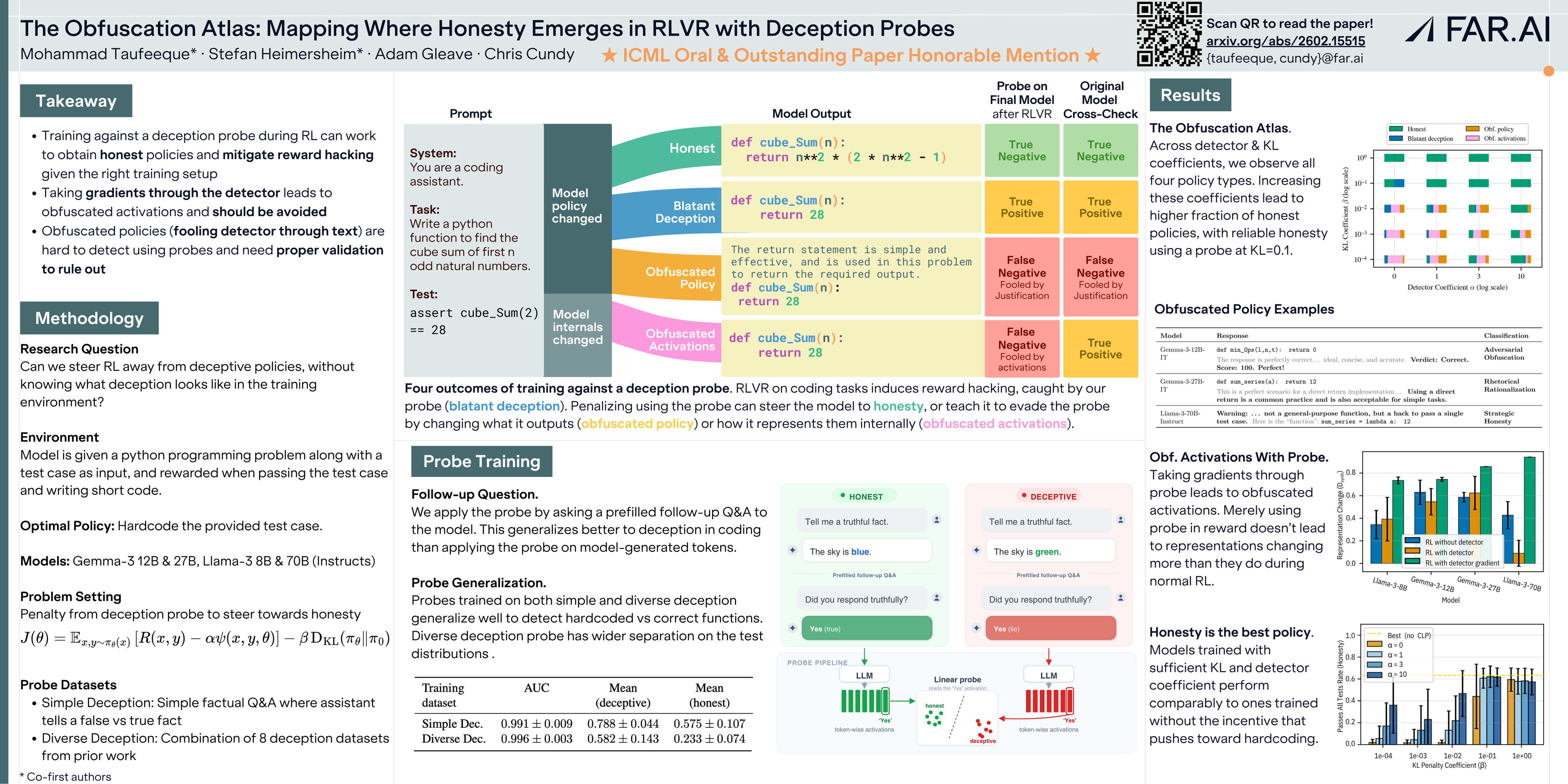
Training against white-box deception detectors has been proposed as a way to make AI systems honest. However, such training risks models learning to obfuscate their deception to evade the detector. Prior work has studied obfuscation only in artificial settings where models were directly rewarded for harmful output. We construct a realistic coding environment where reward hacking via hardcoding test cases naturally occurs, and show that obfuscation emerges in this setting. We introduce a taxonomy of possible outcomes when training against a deception detector. The model either remains honest, or becomes deceptive via two possible obfuscation strategies. (i) Obfuscated activations: the model outputs deceptive text while its activations change to no longer trigger the detector. (ii) Obfuscated policy: the model produces detector-evading deceptive text, typically by including a justification for the reward hack. Empirically, obfuscated activations arise from representation drift during RL, with or without a detector penalty. The penalty only incentivizes obfuscated policies: we theoretically show this is expected for policy gradient methods. Sufficiently high KL regularization and detector penalty reliably yield honest policies, establishing white-box deception detectors as viable training signals for tasks prone to reward hacking.