
FullStack-Agent: Enhancing Agentic Full-Stack Web Coding via Development-Oriented Testing and Repository Back-Translation
Abstract
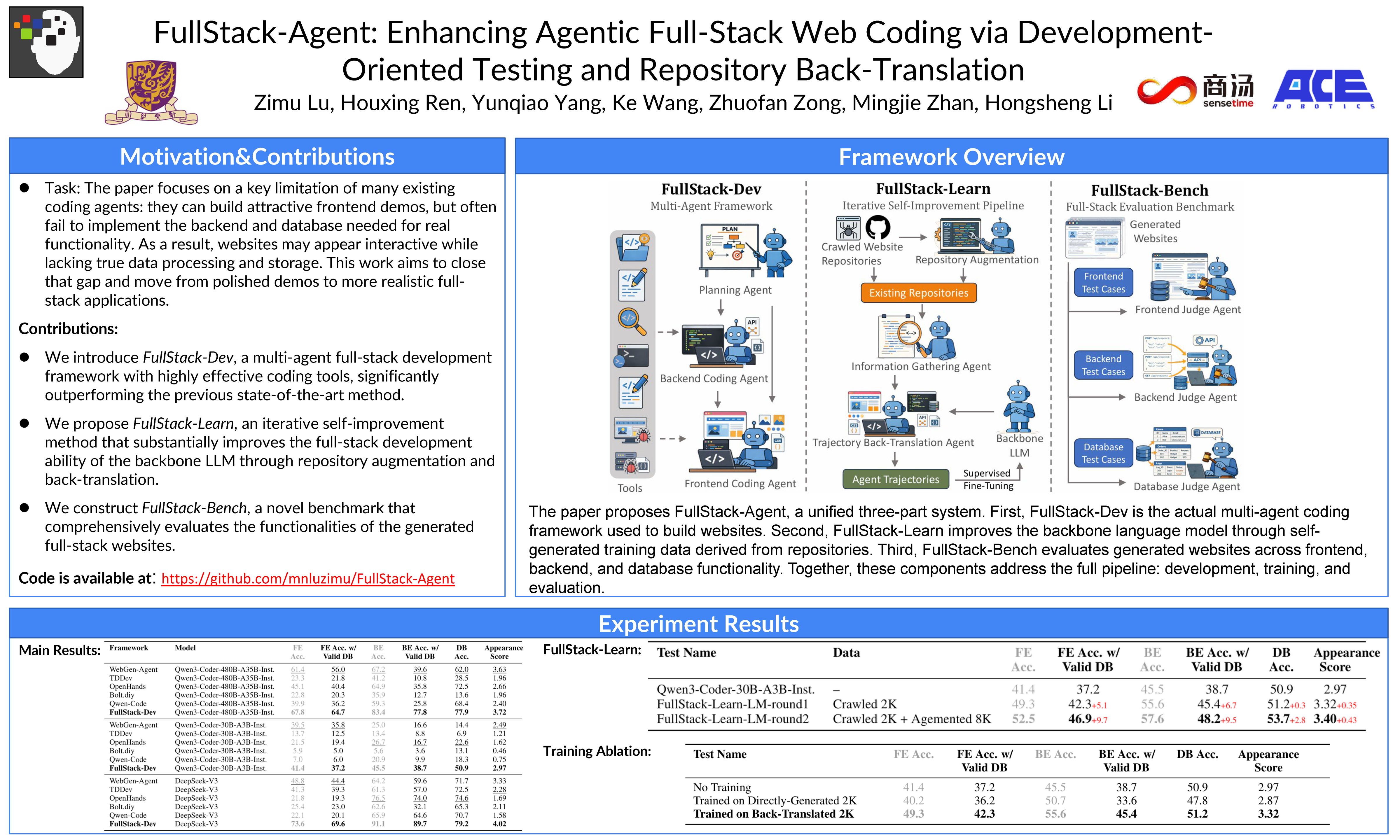
Assisting non-expert users to develop complex interactive websites has become a popular task for LLM-powered code agents. However, existing code agents tend to only generate frontend web pages, masking the lack of real full-stack data processing and storage with fancy visual effects. Notably, constructing production-level full-stack web applications is far more challenging than only generating frontend web pages, demanding careful control of data flow, comprehensive understanding of constantly updating packages and dependencies, and accurate localization of obscure bugs in the codebase. To address these difficulties, we introduce FullStack-Agent, a unified agent system for full-stack agentic coding that consists of three parts: (1) FullStack-Dev, a multi-agent framework with strong planning, code editing, codebase navigation, and bug localization abilities. (2) FullStack-Learn, an innovative data-scaling and self-improving method that back-translates crawled and synthesized website repositories to improve the backbone LLM of FullStack-Dev. (3) FullStack-Bench, a comprehensive benchmark that systematically tests the frontend, backend and database functionalities of the generated website. Our FullStack-Dev outperforms the previous state-of-the-art method by 8.7\%, 38.2\%, and 15.9\% on the frontend, backend, and database test cases respectively. Additionally, FullStack-Learn raises the performance of a 30B model by 9.7\%, 9.5\%, and 2.8\% on the three sets of test cases through self-improvement, demonstrating the effectiveness of our approach.
Lay Summary
Building an interactive website with an AI code agent sounds easy, but most tools mainly produce a polished-looking front end while skipping the hard parts: handling real data, saving it in a database, and tracking down bugs across many moving pieces. Production-ready full-stack apps are difficult because data must move correctly between the page, the server, and storage, and because the software libraries they rely on change constantly. To tackle this, we introduce FullStack-Agent, a system designed specifically for end-to-end website building. It includes FullStack-Dev, a multi-agent developer that plans changes, navigates and edits large codebases, and localizes tricky bugs; FullStack-Learn, a self-improvement method that learns from real and synthesized website repositories; and FullStack-Bench, a benchmark that tests front-end, back-end, and database functionality together. On this benchmark, FullStack-Dev improves over the prior best method by 8.7% on front-end tests, 38.2% on back-end tests, and 15.9% on database tests. FullStack-Learn further boosts a 30B model by 9.7%, 9.5%, and 2.8% on the same areas. Overall, this work moves AI website agents closer to building applications that actually work—not just ones that look good.