
CAReDiO: Enhancing Cultural Alignment of LLM via Representativeness and Distinctiveness Guided Data Optimization
Abstract
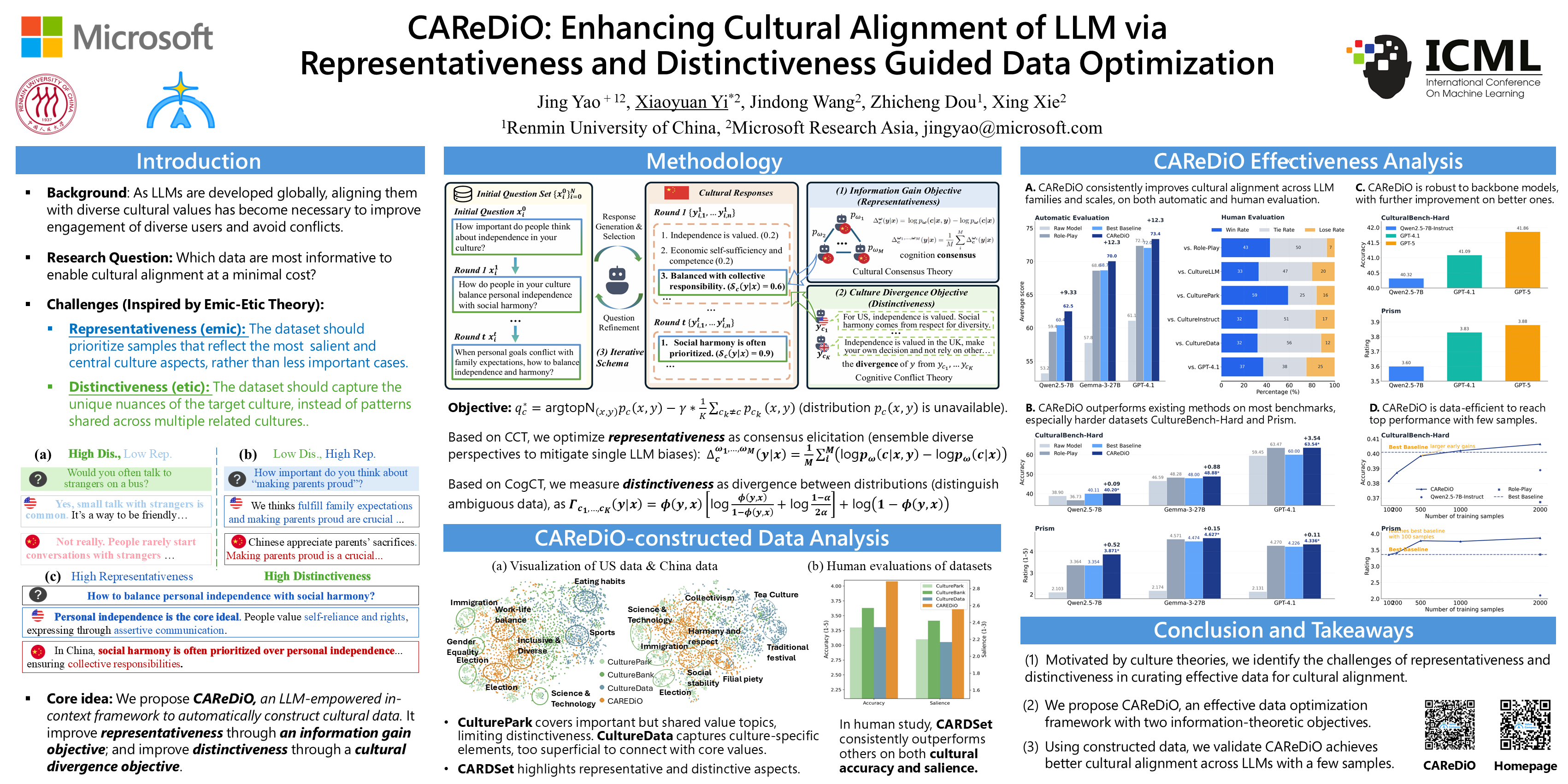
As Large Language Models (LLMs) more deeply integrate into human life across various regions, aligning them with pluralistic cultures is crucial for improving user engagement and mitigating cultural conflicts. For this purpose, recently, different culture-specific corpora have been carefully curated, either synthesized or manually annotated. Nevertheless, inspired by culture theories, we identify two key challenges faced by these datasets: (1) Representativeness: These corpora fail to fully capture the target culture's core characteristics, causing insufficient cultural coverage with redundancy; (2) Distinctiveness: They struggle to distinguish the unique nuances of a given culture from shared patterns across other relevant ones, hindering precise cultural modelling. To handle these challenges, we introduce CAReDiO, a novel data optimization framework, which alternatively refines culture-sensitive questions and responses according to information-theoretic objectives in an in-context optimization manner, enhancing the cultural informativeness and distinguishability of constructed data. Extensive experiments on 15 distinct cultures demonstrate that CAReDiO can create high-quality data with richer cultural information and enable efficient alignment of small open-source or large proprietary LLMs with as few as 200 training samples, consistently outperforming previous datasets in both multi-choice and open-ended cultural benchmarks.
Lay Summary
As Large Language Models like ChatGPT are used worldwide, it is crucial that they understand and respect diverse cultures to enhance user engagement and avoid conflicts. However, traditional cultural alignment requires massive, expensive datasets. This raises a key question: What are the most informative and essential samples we need to teach AI about different cultures at a minimal cost? Culture theories suggest focusing on two complementary traits: Representativeness (capturing a culture’s central, core beliefs) and Distinctiveness (distinguishing its unique nuances from closely related cultures). Based on this, we developed CAReDiO, an automated framework that acts as a smart "data editor." Instead of mindlessly gathering data, CAReDiO iteratively refines cultural questions and responses to maximize both traits using information-theoretic objectives. By focusing only on the most informative data, we proved that “less is truly more”. Our framework successfully taught both small and large AI models to navigate different cultures using as few as 200 high-quality training samples. This approach consistently outperformed much larger, manually-built datasets. This work paves a cost-effective, scalable way to build AI systems that are genuinely inclusive, culturally precise, and respectful of human diversity.