
From Offline Global Information to Online Decentralized Policies in Edge Network Scheduling
Abstract
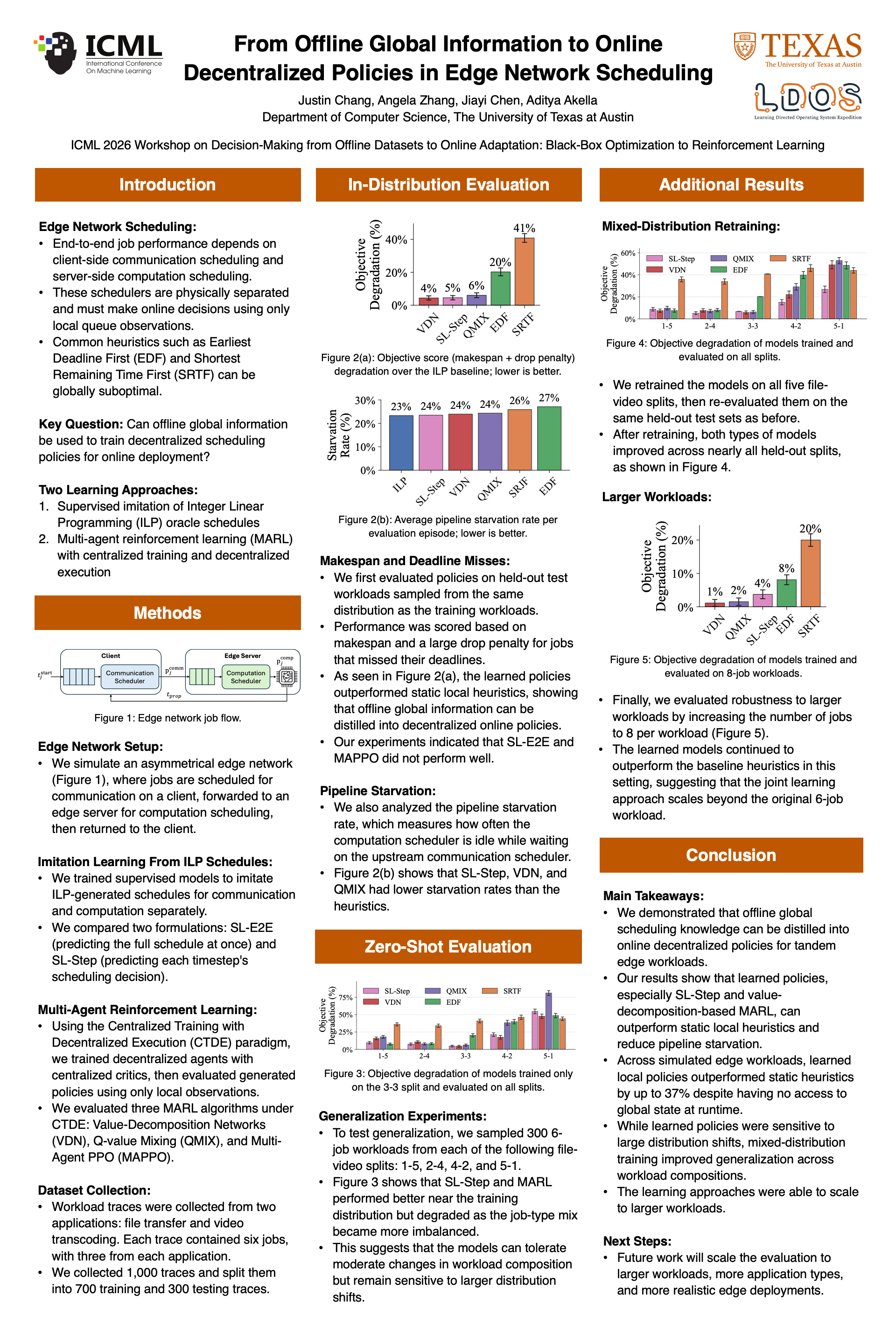
In edge computing, end-to-end job performance depends on both client-side communication scheduling and server-side computation scheduling. However, these schedulers are physically separated and must make online decisions using only local queue observations. As a result, common heuristics such as Earliest Deadline First (EDF) and Shortest Remaining Time First (SRTF) can be globally suboptimal. We study whether offline global information can be used to train decentralized scheduling policies for online deployment. We explore two approaches: supervised imitation of Integer Linear Programming (ILP) oracle schedules, and multi-agent reinforcement learning with centralized training and decentralized execution. Across simulated edge workloads, we show that learned local policies outperform static heuristics by up to 37\% despite having no access to global state at runtime. These results suggest that offline global supervision can distill coordinated scheduling behavior into decentralized policies under partial information.